




 Google
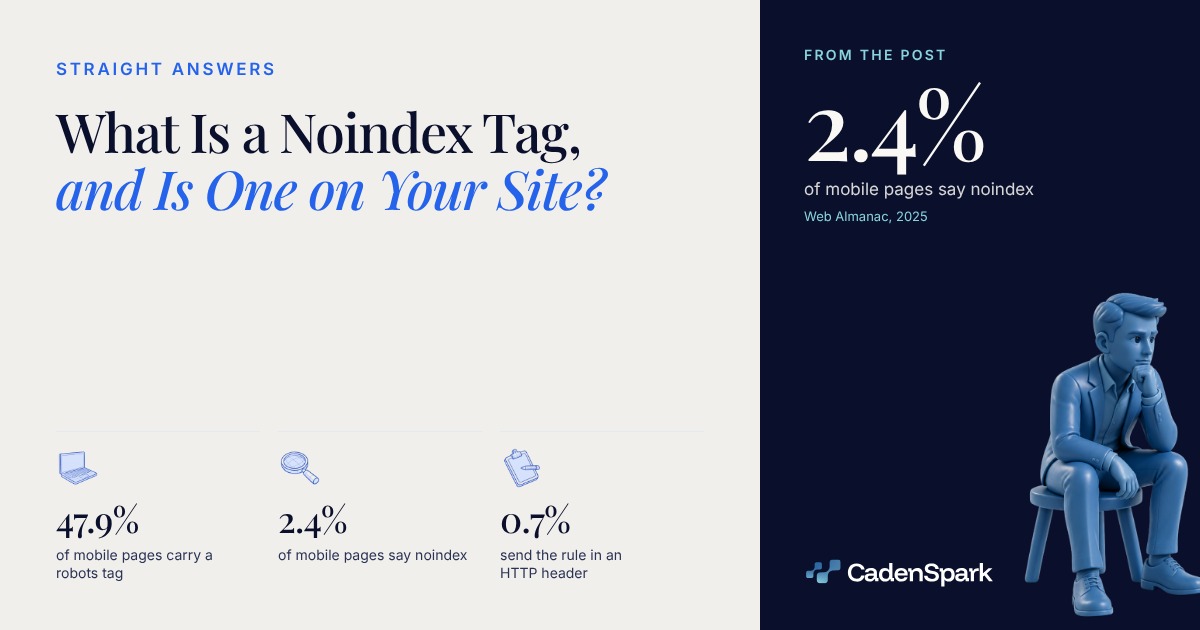
A noindex tag is one line on a page that asks search engines to leave it out of results. It sits on 2.4% of mobile pages and 3.5% of desktop pages, while 47.9% of mobile pages carry a robots tag that usually changes nothing (Web Almanac, 2025).
What is a noindex tag?
A page-level instruction, written in the HTML or sent in an HTTP header. Robots directives influence indexing and serving; robots.txt governs crawling (Web Almanac, 2025). Two different jobs.


It decides whether a crawler is allowed to request the page at all (Web Almanac, 2025).
It decides whether the page can show up in results, and how it is shown there (Web Almanac, 2025).
"For a directive to be applied, the crawler must be able to access the page" (Web Almanac, 2025).
An x-robots-tag response header puts the directive outside the HTML, and sits on 0.7% of mobile pages against 47.9% for the meta tag (Web Almanac, 2025).
How many pages actually say noindex?
Few of them. In the same crawl, noindex appears on 2.4% of mobile pages and 3.5% of desktop pages, far behind the two rules that do nothing.
The chapter’s prose counts noindex and nofollow together and gives a different pair; the figures here are its chart’s, per directive and per device.
Web Almanac, 2025 · 15,426,398 mobile sites, home page plus one inner page
View data
| Item | Value |
|---|---|
| follow | 60.5% |
| index | 59.3% |
| nofollow | 2.8% |
| max-image-preview | 2.8% |
| noindex | 2.4% |
| noarchive | 1.8% |
| nosnippet | 0.1% |
Why does your site have a robots tag you never wrote?
Your SEO plugin wrote it. Yoast SEO sits on 15.49% of mobile home pages and applies index, follow by default (Web Almanac, 2025).
Web Almanac, 2025 · home page use of SEO tools across 15,426,398 mobile sites
View data
| Item | Value |
|---|---|
| Yoast SEO | 15.49% |
| Rank Math SEO | 3.6% |
| All in One SEO | 2.92% |
| Yoast SEO Premium | 1.3% |
Yoast SEO applies index, follow by default and sits on 15.49% of mobile home pages (Web Almanac, 2025).
index on 59.3% and follow on 60.5% of mobile pages is, in the chapter’s words, a technically unnecessary combination (Web Almanac, 2025).
Those two are the default values, so a page carrying them is in the same position as a page carrying nothing.
Mobile pages with a meta robots directive went from 46.2% last year to 47.9% (Web Almanac, 2025).
Does a tag that says "index, follow" do anything?
No. The chapter calls index and follow the default values, ignored by Google, and they still appear on 59.3% and 60.5% of mobile pages.
index
asks to be indexedchanges nothing
A default value, ignored by Google when no other rule is present (Web Almanac, 2025).
follow
asks for the links to be followedchanges nothing
The other default. On 60.5% of mobile pages (Web Almanac, 2025).
noindex
asks to stay out of resultskeeps the page out
The rule that changes the outcome. On 2.4% of mobile and 3.5% of desktop pages.
nofollow
asks for the links to be ignoreddrops that page’s links
On 2.8% of mobile pages and 2.4% of desktop pages (Web Almanac, 2025).
View data
| Metric | Day zero → target |
|---|---|
| index | asks to be indexed → changes nothing |
| follow | asks for the links to be followed → changes nothing |
| noindex | asks to stay out of results → keeps the page out |
| nofollow | asks for the links to be ignored → drops that page’s links |
How do you check whether one of your pages is blocked?
Three places: the meta robots tag in the HTML, the x-robots-tag response header, and Google’s own checker, which names the failure out loud.
- 01Read the page sourceSearch the HTML for the word robots. The meta robots tag sits in the head, and 47.9% of mobile pages have one (Web Almanac, 2025). Most of them say index, follow.
- 02Ask for the response headersRequest the page and look for x-robots-tag. It carries the same rules from outside the HTML and sits on 0.7% of mobile pages (Web Almanac, 2025).
- 03Run the SEO checkGoogle’s own checker reports that the page is blocked from indexing when it finds a blocking rule in either place. It is one line of what a website audit actually checks.
What keeps a page out of Google for months without anyone noticing?
Blocking the page in robots.txt and adding noindex at the same time. If the crawler cannot reach the page, the directives "may never be seen or obeyed" (Web Almanac, 2025).
The crawler never reads the rule it was supposed to obey, so nothing is certain either way (Web Almanac, 2025).
0.4% of pages carry a meta robots tag and an x-robots-tag header together, which the chapter calls not a widely recommended practice because it raises the chance of conflicting signals (Web Almanac, 2025).
Google’s own checker (Lighthouse 13.6.0) treats a past unavailable_after the same as noindex, and the title it prints is "Page is blocked from indexing".
The 2025 rule figures come from the rendered HTML (Web Almanac, 2025), so a tag injected after load counts the same. Reading the source alone can miss it.
- 01Find the tag
- 02Decide index or not
- 03Pick one method
- 04Re-check after each deploy
Open the page source, search for robots, and read the line. If it says noindex and nobody put it there on purpose, you found the reason. Before that, check what the crawler asks for first.
Questions owners ask
What is a noindex tag?
One line on a page, in the HTML or in an HTTP header, that asks search engines to keep that page out of results. It sits on 2.4% of mobile pages and 3.5% of desktop pages (Web Almanac, 2025). It does not stop crawling.
Why is my page not showing up on Google?
Start by checking whether the page is asking for that. Google’s own checker, Lighthouse 13.6.0, reports that the page is blocked from indexing when it finds noindex, none, or an unavailable_after date that has already passed, in the HTML or in the response header.
Does index, follow help my SEO?
No. The Web Almanac calls index and follow the default values, ignored by Google when no other rule is present. They still appear on 59.3% and 60.5% of mobile pages (Web Almanac, 2025), usually because an SEO plugin writes them for you.
Should I block a page in robots.txt and add noindex too?
Pick one. If robots.txt stops the crawl, the Web Almanac says the directives may never be seen or obeyed. And 0.4% of pages send both a meta robots tag and an HTTP header, which the same chapter calls not a widely recommended practice.
Sources
- HTTP Archive, Web Almanac 2025, SEO chapter, Robots directives (16,213,084 websites: 15,426,398 mobile and 12,155,374 desktop, two pages each; site list from the Chrome UX Report released July 11, 2025; read November 22, 2026) (2025)
- HTTP Archive, Web Almanac 2025, Methodology (sample sizes and the Chrome UX Report release used for the site list) (2025)
- Google Chrome, Lighthouse 13.6.0, core/audits/seo/is-crawlable.js (the source code of Google's own SEO check, not a measurement of the web) (2026)
The first meeting starts with findings, not promises.The free Business Health Report reads your business and shows you what it found, in days.
Get Your Free Business Health Report