 Google
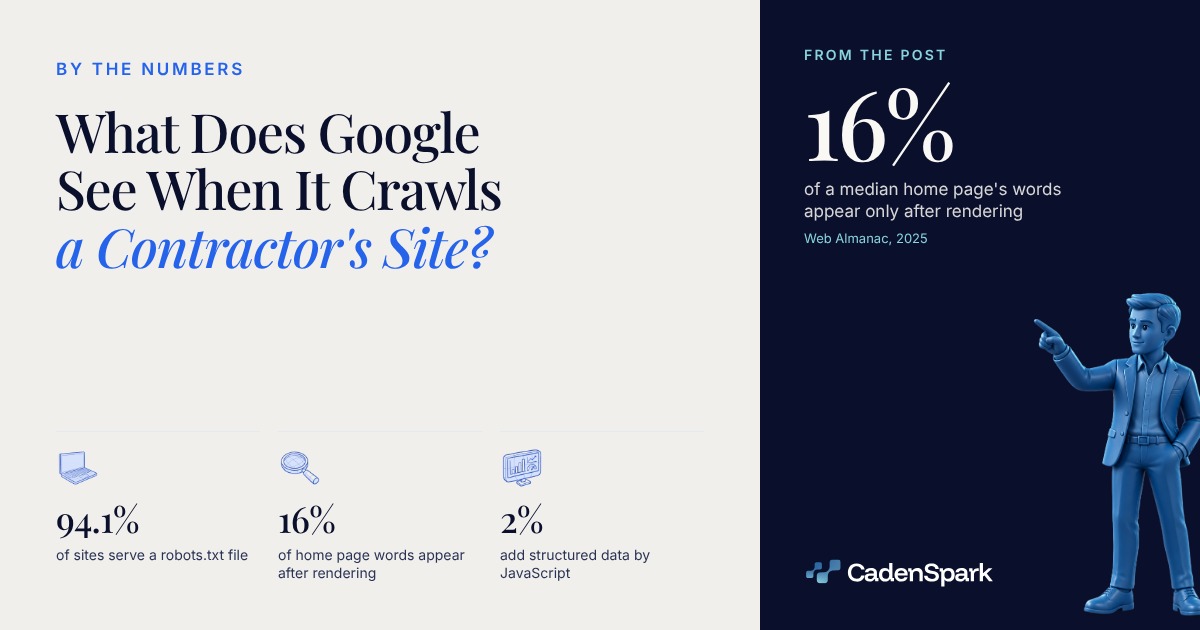
 does not see your design. It reads HTML, twice: the raw file your server sends and the page after JavaScript runs. Every figure below covers the whole measured web, about 12.9 million sites in HTTP Archive’s July 2025 crawl, mobile pages; nobody publishes them for contractors alone.
What does Google actually see when it crawls your site?
Code, not pixels. Google crawls, renders the page in a headless browser, then indexes the rendered HTML (Google Search Central, 2026).



Google Search Central, 2026.
View data
| Step | Value |
|---|---|
| Request | 01 (Googlebot asks for the URL) |
| robots.txt | 02 (may it crawl this path?) |
| Raw HTML | 03 (what your server sends) |
| Render | 04 (a headless browser runs the JavaScript) |
| Index | 05 (the rendered page is read and stored) |
What happens before Google reads a single word?
It asks for robots.txt. Almost every site answers; the risk is a file whose rules nobody has read, because a 200 only proves the file exists.
HTTP Archive, Web Almanac 2025, SEO chapter · July 2025 crawl, mobile
View data
| Item | Value |
|---|---|
| 200 success | 84.9% |
| 404 not found | 13.2% |
| Timeout | 1.1% |
| 403 forbidden | 0.5% |
| 500 server error | 0.1% |


Fine, if someone has read the rules. A 200 response confirms the file exists, not that its directives are right for the site.
Also fine. It tells crawlers there are no restrictions, and the chapter calls it the safer choice when none are intended.
The risky middle. Major crawlers read it as permissive, but the standard (RFC 9309) never defined it, so lesser-known bots may not.
Which signals does Google look for in the head?
The title is nearly universal. The meta description and the canonical are missing on about a third of mobile pages.
HTTP Archive, Web Almanac 2025, SEO chapter · July 2025 crawl, mobile
View data
| Item | Value |
|---|---|
| Title | 98.5% |
| Viewport | 95.2% |
| Meta description | 67.2% |
| Canonical | 67% |
Google’s main source for the title link, which it can rewrite when the tag does not match the page (Google Search Central, 2026). Present on 98.5% of mobile pages.
The snippet you propose for the result. Present on 67.2% of mobile pages, so missing on about a third.
A strong hint, not a directive, about which URL is the main one. Present on 67% of mobile pages.
10.3% of mobile pages carry an invalid element in the head, most often an image (23.0% of mobile sites). A title or canonical below it can stop counting.
What is missing most often on a typical page?
Headings and alt text. The h1 is absent on 3 in 10 mobile pages, and the median page describes only 60% of its images.
HTTP Archive, Web Almanac 2025, SEO chapter · July 2025 crawl, mobile
View data
| Item | Value |
|---|---|
| h1 | 70% |
| h2 | 71% |
| h3 | 60% |
| h4 | 36% |
Structured data helps Google understand a page, though the chapter itself says it is not a direct ranking factor.
Does Google see the content your JavaScript loads?
It renders it, but the raw HTML is the safe place. On the median mobile home page, 16% of the visible words appear only after rendering.
HTTP Archive, Web Almanac 2025, SEO chapter · July 2025 crawl
View data
| Item | Value |
|---|---|
| Home page, raw HTML | 316 |
| Home page, rendered | 378 |
| Inner page, raw HTML | 271 |
| Inner page, rendered | 323 |
Part of that gap is content hidden in mobile accordions, present in the page but not shown.
Put the service, the city and the phone number in the HTML the server sends, not only in what a script loads later.
Only about 2% of crawls add it by JavaScript. Google can process injected schema, but the initial HTML avoids potential delays.
3.02% of mobile sites change it during rendering, which sends Google two different answers about the main URL.
What should a contractor fix first?
Anything that blocks crawling. Google’s own SEO checker weights that one check about four times any other, so failing it alone fails the category.
- 01Do not block it
- 02Name it: title and description
- 03Point it: canonical and h1
- 04Describe it: alt text and structured data
Page isn’t blocked from indexing
blockedcrawlable
Weight 93/23, about 4.04 against 1 for each of the other nine (Lighthouse, 2026).
Document has a meta description
missing on about a thirdpresent
67.2% of mobile pages have one.
Document has a valid rel=canonical
missing on about a thirdpresent
67% of mobile pages have one.
Images have alt text
60% on the median pageevery image
15% of images carry a blank alt.
View data
| Metric | Day zero → target |
|---|---|
| Page isn’t blocked from indexing | blocked → crawlable |
| Document has a meta description | missing on about a third → present |
| Document has a valid rel=canonical | missing on about a third → present |
| Images have alt text | 60% on the median page → every image |
That weight works out to about 31% of the category score, our arithmetic on the published weights. For the rest of the checklist, see what a website audit actually checks; for speed, how fast a service business website needs to load.
Questions owners ask
What does Googlebot actually read on my site?
The HTML, not the design. It asks for robots.txt first, then reads the raw HTML your server sends, then the page after JavaScript runs. On the median mobile home page those two versions differ by 16% of the visible words (Web Almanac, 2025).
Why isn’t my new site showing up in Google?
Start with whether anything blocks it. Google’s own SEO checker weights the is-crawlable check about four times every other check, by design, so one blocked page fails the whole category. Then check the title, the meta description and the canonical.
Does my site need a robots.txt file?
94.1% of crawled sites serve one with at least one directive. A valid file or a clean 404 is fine. An empty file is the risky middle: the standard never defined how bots should read it, and 1.7% of mobile sites serve one anyway.
Is alt text an SEO thing or an accessibility thing?
Both, and it is one of the thinnest signals on a typical page: on the median mobile page only 60% of images carry an alt attribute, and 15% carry a blank one (Web Almanac, 2025).
Sources
- HTTP Archive, Web Almanac 2025, SEO chapter (July 2025 crawl; mobile pages; read from the chapter's source text, commit 46992bf, October 2026) (2025)
- HTTP Archive, Web Almanac 2025, Generative AI chapter (~12.9 million sites analyzed for robots.txt) (2025)
- Google Lighthouse, SEO category audit weights (open-source code, core/config/default-config.js, commit 1c45a6f, October 2026) (2026)
- Google Search Central: Understand the JavaScript SEO basics (2026)
- Google Search Central: Influencing your title links in search results (2026)
The first meeting starts with findings, not promises.The free Business Health Report reads your business and shows you what it found, in days.
Get Your Free Business Health Report