




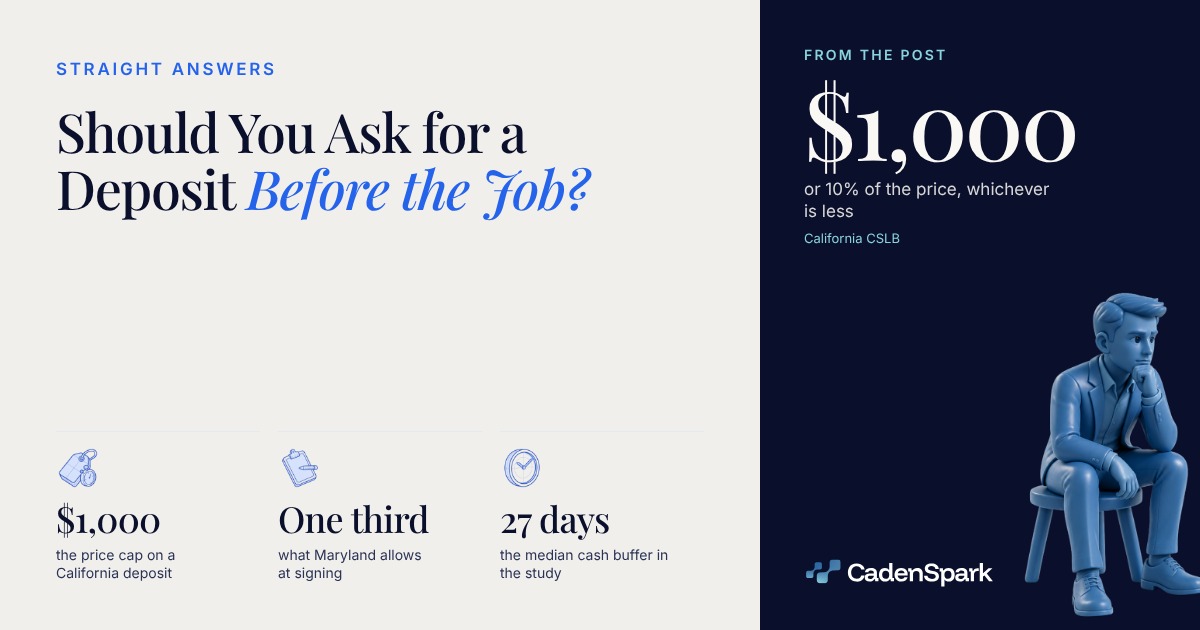
Yes for most jobs, and the real question is not whether but how much. That part is not yours to decide: California stops a home improvement down payment at $1,000 or 10% of the contract price, whichever is less (California CSLB). There is no federal cap, so the ceiling is whatever your state wrote.
Should you ask for a deposit before the job?
Yes for most jobs. Every state in this post lets you take one. What changes is the ceiling, and in Maryland you cannot take a dollar before the contract is signed (Maryland Business Regulation Section 8-617).


Every state below allows a deposit on a home improvement job. The argument is about how big it is and where the money waits, not about whether you may ask for it.
The ceiling is state law, not company policy. It runs from a flat $1,000 in California to one third of the contract price in Maryland (California CSLB; Maryland Business Regulation Section 8-617).
How much of a deposit can you legally ask for?
It depends on the state, and the spread is wide. On the same job, California’s ceiling is a flat $1,000 while Maryland’s is a third of the price (California CSLB; Maryland Business Regulation Section 8-617).
The statutes give a rule, not a dollar figure on your quote. The multiplication to a $10,000 job below is ours, not the regulator’s.
State law as cited · the multiplication to a $10,000 job is ours · Massachusetts can go higher when special order materials cost more
View data
| Item | Value |
|---|---|
| California | $1000 |
| Maryland | $3333 |
| Massachusetts | $3333 |
California
a number you choose$1,000 or 10%, whichever is less
Past a $10,000 job the ceiling stops moving, because it is a dollar amount and not a share (California CSLB).
Maryland
a number you chooseone third of the contract price
And nothing at all before the contract is signed (Maryland Business Regulation Section 8-617).
Massachusetts
a number you choosethe greater of one third or special order materials
The materials branch is in the statute, so a custom order can lift the deposit above a third (M.G.L. c. 142A Section 2).
Florida
a number you chooseno ceiling, but a clock starts
Above 10% up front you have 30 days to apply for permits and 90 days from issue to start work (Florida Statutes Section 489.126).
New York
a number you chooseno ceiling, escrow instead
Payments taken before substantial completion go into a New York escrow account within five business days, or you post a bond (New York Lien Law Section 71-a).
View data
| Metric | Day zero → target |
|---|---|
| California | a number you choose → $1,000 or 10%, whichever is less |
| Maryland | a number you choose → one third of the contract price |
| Massachusetts | a number you choose → the greater of one third or special order materials |
| Florida | a number you choose → no ceiling, but a clock starts |
| New York | a number you choose → no ceiling, escrow instead |
What has to be in writing before you take a dollar?
The contract itself, with the deposit amount and the payment schedule in it, signed before any money moves. Maryland bars any payment at all before that signature (Maryland Business Regulation Section 8-617).
- 01The signed contractIn writing, with the payment schedule inside it. California requires the home improvement contract in writing, and New York requires one signed by the parties (California CSLB; New York General Business Law Section 771).
- 02The deposit amountThe figure and what it applies to, in the contract. California requires the down payment to appear in bold type of at least 12 points, which is the state telling you not to bury it (California CSLB).
- 03The payment schedulePayments after the deposit cannot exceed the value of the work performed or the material delivered (California CSLB). A deposit is capped. A progress payment is earned.
- 04The cancellation noticeOn a sale signed at the customer’s home, the notice goes with the contract and the window runs to midnight of the third business day (FTC Cooling-Off Rule, 16 CFR 429).
FTC Cooling-Off Rule, 16 CFR Part 429
View data
| Step | Value |
|---|---|
| The customer signs at home | 1 (the rule covers sales of $25 or more there, and $130 or more elsewhere) |
| The notice goes with the contract | 2 (part of what you hand over, not a follow up email) |
| Midnight of the third business day | 3 (unless the customer called you out to repair something they own) |
| After that the deposit is yours to work against | 4 (state cancellation rights can still sit on top of the federal rule) |
What does it cost you to not take one?
You fund the job out of your own account. The median firm in JPMorgan Chase Institute’s study held 27 days of cash buffer and the bottom quarter held 13 days or fewer (2016 report on 2015 data, 597,000 small businesses).

JPMorgan Chase Institute, 2016 report on 2015 data · 597,000 small businesses with a Chase Business Banking account
View data
| Item | Value |
|---|---|
| Real estate | 47 |
| All firms in the study | 27 |
| Repair and maintenance | 23 |
| Restaurants | 16 |
View data
| Piece | What happens |
|---|---|
| Door | Job booked |
| Door | Materials ordered |
| Door | Crew on site |
| Hub | Your own account carries it — every day until the balance lands |
| Stage | The work finishes — the money is still all yours to front |
| Stage | The invoice goes out — the clock on getting paid starts here |
| Return | The next job starts on what is left — and the cycle repeats at that size |
Rising costs for goods, services and wages were the most common financial challenge of the previous 12 months, and 77% of employer firms named higher operating costs, tariff related costs, or both (Federal Reserve Banks, Small Business Credit Survey, 2026 report, 6,525 employer firms).
The deposit is the one part of the price whose timing you control. How long a service business waits to get paid is its own number, and it is not short.
How do you ask for a deposit without losing the job?
In the quote, in writing, with your state’s rule named out loud. Nobody has published a trial on whether asking costs you work, so treat it as a cash and compliance decision and not a closing tactic.
- 01Put it in the quoteThe figure and what it covers, before the visit. A deposit that shows up for the first time at the kitchen table reads as a surprise, and surprises get slept on.
- 02Tie it to something realSpecial order materials or the slot you are holding. Massachusetts writes that logic into its own cap: the greater of one third or the actual cost of special order materials (M.G.L. c. 142A Section 2).
- 03Name your state’s ruleSaying the ceiling out loud turns a request into a procedure. California’s is $1,000 or 10% of the price, whichever is less (California CSLB).
- 04Hand over the receipt and the windowWhat you took, when, and against what, plus the cancellation notice if the sale was signed at the home (FTC Cooling-Off Rule, 16 CFR 429). You do not need an online store to take it.
The lowest ceiling in this post is a flat $1,000 (California CSLB). A small deposit collected at signature does more for the account than a large one argued over for a week.
There is no published trial on whether asking for a deposit wins or loses jobs, and none on what it does to no-shows. The case for it is cash and compliance, not conversion.
The rules change by state and by type of job, and this is not legal advice. Read your own regulator before you print a number in a template.
Check your state’s ceiling before you print a number, write the deposit into the quote, and collect it at signature. The statute tells you the maximum. Your own account tells you why to bother.
- 01Check your state’s cap
- 02Write it into the quote
- 03Collect at signature
- 04Invoice the balance on day one
Questions owners ask
Should I ask for a deposit before starting a job?
For most jobs, yes, and keep it small. What you cannot choose is the ceiling. California caps a home improvement down payment at $1,000 or 10% of the price, whichever is less (California CSLB). Check your own state. Not legal advice.
How much deposit can a contractor legally ask for?
It depends on the state. California caps it at $1,000 or 10%, whichever is less; Maryland at one third of the contract price; Florida sets no ceiling but starts a permit clock above 10%. There is no federal cap.
Can a customer cancel after paying a deposit?
If the sale was signed at their home, the FTC Cooling-Off Rule runs the window to midnight of the third business day, unless the customer called you out to repair something (16 CFR 429). States can add their own rights.
Is a deposit the same as a progress payment?
No. The deposit is what you take before work starts, and it is what a state caps. Progress payments come after, and in California they cannot exceed the value of the work performed or material delivered (California CSLB).
Sources
- California CSLB, Industry Bulletin: Progress Payment Restrictions (the down payment capped at $1,000 or 10% of the contract price, whichever is less, under the Business and Professions Code, in bold 12 point type in the contract; later payments limited to the value of work performed or material delivered) (2022)
- Maryland General Assembly, Business Regulation Article Section 8-617 (no payment may be demanded or received before the home improvement contract is signed; deposit capped at one third of the contract price; statute text in force) (2026)
- Massachusetts General Laws, Chapter 142A Section 2 (advance deposit not to exceed the greater of one third of the total contract price or the actual cost of materials or equipment of a special order or custom made nature; statute text in force) (2026)
- Florida Statutes Section 489.126 (an initial payment of more than 10 percent of the contract price triggers a 30 day deadline to apply for permits and a 90 day deadline to start work after all permits are issued; 2025 edition) (2025)
- New York Lien Law Section 71-a (payments received before substantial completion deposited in a New York escrow account within five business days, or secured by a bond or indemnity contract; statute text in force) (2026)
- New York General Business Law Section 771 (home improvement contract in writing and signed by the parties, with notice to the owner of the escrow duty and the bond option; statute text in force) (2026)
- FTC Cooling-Off Rule, 16 CFR Part 429 (sales of $25 or more at the buyer's residence and $130 or more elsewhere, cancellable until midnight of the third business day; the rule does not cover a visit the buyer requested to repair or maintain personal property, beyond what is sold in addition) (2026)
- JPMorgan Chase Institute, Cash is King: Flows, Balances, and Buffer Days (597,000 small businesses with a Chase Business Banking account, transactions from February to October 2015; report published September 2016) (2016)
- Federal Reserve Banks, 2026 Report on Employer Firms: Findings from the 2025 Small Business Credit Survey (6,525 responses from firms with 1 to 499 employees across 50 states and D.C., fielded 2025) (2026)
The first meeting starts with findings, not promises.The free Business Health Report reads your business and shows you what it found, in days.
Get Your Free Business Health Report