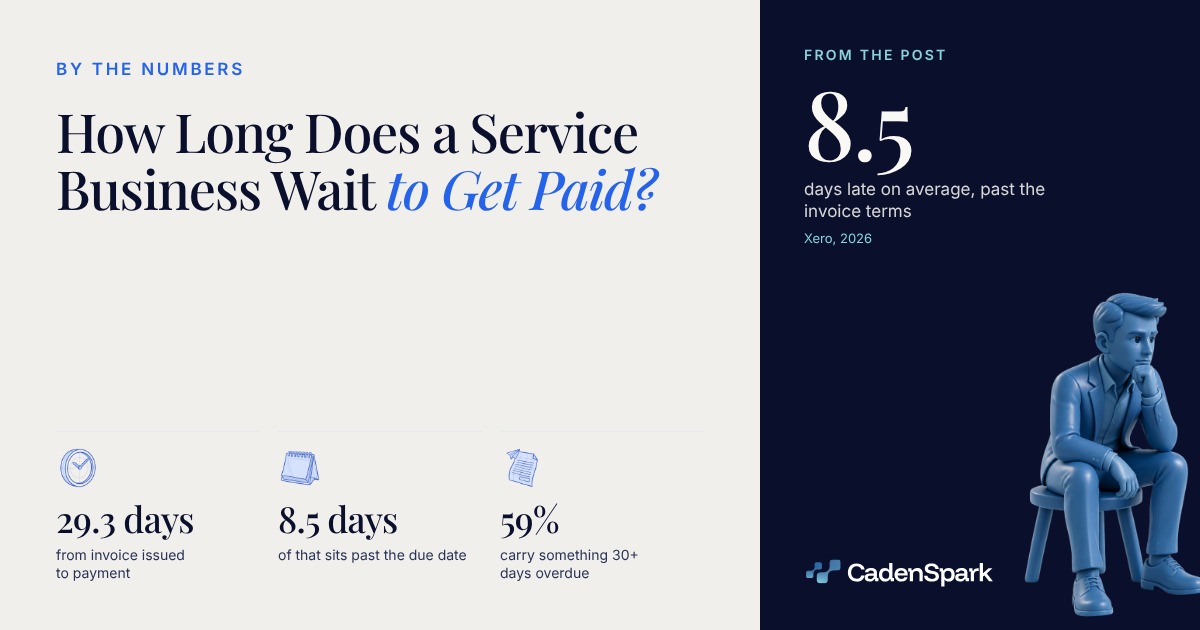
Invoices in Xero’s U.S. data were paid 29.3 days after they were issued, and 8.5 of those days were past the invoice’s own terms (Xero Small Business Insights, June 2026 quarter). The terms you print are a floor, not a date.
How long does a service business wait to get paid?
About a month, and it got slightly longer. The wait is measured on real invoices moving through Xero, not on what owners remember.



Xero Small Business Insights, U.S. edition · March and June 2026 quarters, invoice data, no sample count published
View data
| Item | Value |
|---|---|
| March quarter | 28.6days |
| June quarter | 29.3days |
our arithmetic on Xero’s two published U.S. averages (29.3 days to payment, 8.5 days late), not their figure
View data
| Item | Value |
|---|---|
| Inside the invoice’s own terms | 20.8days |
| Past the due date | 8.5days |
Why does an invoice sit unpaid?
Rarely because someone refuses to pay. The invoice leaves late, the default terms run for weeks, and nobody names the amount again until it is already overdue.
View data
| Step | Value |
|---|---|
| the work is finished | Day 0 (the day the customer thinks the job is over) |
| the invoice is issued | Day N (the only date on this row that you set alone) |
| the terms run out | Day 20.8 (our arithmetic on Xero’s two U.S. averages, not their figure) |
| the money lands | Day 29.3 (Xero’s U.S. average for the June 2026 quarter) |
Nothing in the data starts before you issue. An invoice that goes out on Friday cannot be paid on Thursday, and no reminder recovers the days before day N.
Payment arrived 8.5 days past the due date on average (Xero, June 2026 quarter). Stretching the term to 30 days does not buy patience, it moves the late clock later.
Where nothing is overdue, 64% require immediate payment, against 34% where invoices are overdue (Intuit QuickBooks, 2026, its own panel). Asking is part of the process, not a confrontation.
59% carry something 30+ days overdue, against 47% a year earlier (Intuit QuickBooks, 2026). At that share it is a process to fix, and yours is the half you control.
What does the wait actually cost you?
It is not a loss. It is your money parked somewhere you cannot spend it, while payroll, fuel and materials keep their own schedule.
our arithmetic on Xero’s two published U.S. averages (29.3 and 8.5 days), not their figure
View data
| Stage | Value |
|---|---|
| days the average invoice spends unpaid, start to finish | 29.3d |
| days of that you agreed to when you set the terms | 20.8d |
| days of that nobody agreed to, and at least one payroll runs inside them | 8.5d |
What actually shortens the wait?
Four levers, in order of effort. The first costs nothing and moves the only date you fully control.
- 01Invoice the same day the work endsDay N is yours. Every day the invoice waits on a desk is a day added to the 29.3, and no amount of chasing gets it back.
- 02Take a deposit at bookingPart of the job is paid before anyone drives out. It also filters the customer who was never going to pay the balance.
- 03Keep the card on fileDigital payments were more than 51% of all transactions processed on Jobber in Q1 2026, up 7% year over year (Jobber, 2026, its own platform). A saved card turns payment into a tap.
- 04Let the reminder go out on its ownA reminder that depends on you remembering is not a system. Put it on a schedule and it survives your busy week, which is exactly the week it matters.
When the invoice goes out
end of the week, in a batchthe day the work ends
The one date you set alone, and the only one no reminder can recover.
What the customer is asked for
payment terms on a PDFpayment now, with a link
64% with nothing overdue require immediate payment, against 34% with overdue invoices (Intuit QuickBooks, 2026).
How the money moves
check, or a call for the carda saved card, one tap
Digital payments passed 51% of transactions processed on Jobber in Q1 2026 (Jobber, 2026, its own platform).
Who chases the invoice
you, when you remembera scheduled reminder
The amount, the due date and the link, sent without a decision.
View data
| Metric | Day zero → target |
|---|---|
| When the invoice goes out | end of the week, in a batch → the day the work ends |
| What the customer is asked for | payment terms on a PDF → payment now, with a link |
| How the money moves | check, or a call for the card → a saved card, one tap |
| Who chases the invoice | you, when you remember → a scheduled reminder |

The card on file and the payment link are the difference between a site that shows your prices and one that actually does something.
What should the payment reminder say, and when?
Three messages and one amount: the day you invoice, on the due date, and a week after. Each one carries the payment link inside it.
- 01The day you invoiceThe amount, what it covers, the due date and the link. This is the message that sets expectations, and it travels on the same channel as the confirmation they already got.
- 02On the due dateOne line: the amount, that it is due today, and the link again. No apology, no explanation, no attachment to open.
- 03One week afterThe amount, how many days it has been, and a question that is easy to answer: is this one going on the card we have, or do you need an invoice copy for your office?
A second copy of a document nobody opened is not a reminder. The amount and the link belong in the message itself.
The due date is the urgency. A label on top of it reads as pressure and invites a reply about tone instead of payment.
Late fees depend on your contract and your state. Ask counsel before you print one. This is not legal advice.
59% of the panel carries something 30+ days overdue (Intuit QuickBooks, 2026). Treat it as a process step, because at that share it is one.
- 01Invoice the same day
- 02Save the card
- 03Remind on a schedule
- 04Count your own days
Start with the same-day invoice. Then count your own two numbers, days to payment and days past due, and watch the second one before the first.
Questions owners ask
How long does it take a service business to get paid?
Longer than the terms on the invoice. In Xero’s U.S. invoice data, payment landed 29.3 days after the invoice was issued in the June 2026 quarter, and 8.5 of those days were past the due date. The terms you print are a floor, not a date.
Is 30 days a normal payment term?
Common, and a choice. Payment arrived 8.5 days past the due date on average (Xero, June 2026 quarter), so a longer term only moves the late clock later. A short term with a payment link beats a long term with a PDF attachment.
What is the fastest way to get paid sooner?
Invoice the same day the work ends. It is the one date you set alone, and nothing in the data starts before it. After that: a deposit at booking, a card kept on file, and a reminder that goes out without you remembering.
Should you charge a late fee?
That depends on your contract and your state, so ask counsel before you print one. What works without a lawyer is a reminder on a schedule, with the amount and a one-tap payment link, instead of a second copy of the same PDF.
Sources
- Xero Small Business Insights, United States edition, June 2026 quarter (anonymised, aggregated invoice data from U.S. small businesses on Xero, weighted by invoice value and seasonally adjusted; Xero publishes no sample count; read October 18, 2026) (2026)
- Intuit QuickBooks, Small Business Late Payments Report 2026 (survey of Intuit's own small-business panel; no U.S. sample count published for the 2026 edition; read October 18, 2026) (2026)
- Jobber, Home Service Economic Report, Q1 2026 (share of transactions processed on Jobber's own platform, not a market share; read October 18, 2026) (2026)
The first meeting starts with findings, not promises.The free Business Health Report reads your business and shows you what it found, in days.
Get Your Free Business Health Report