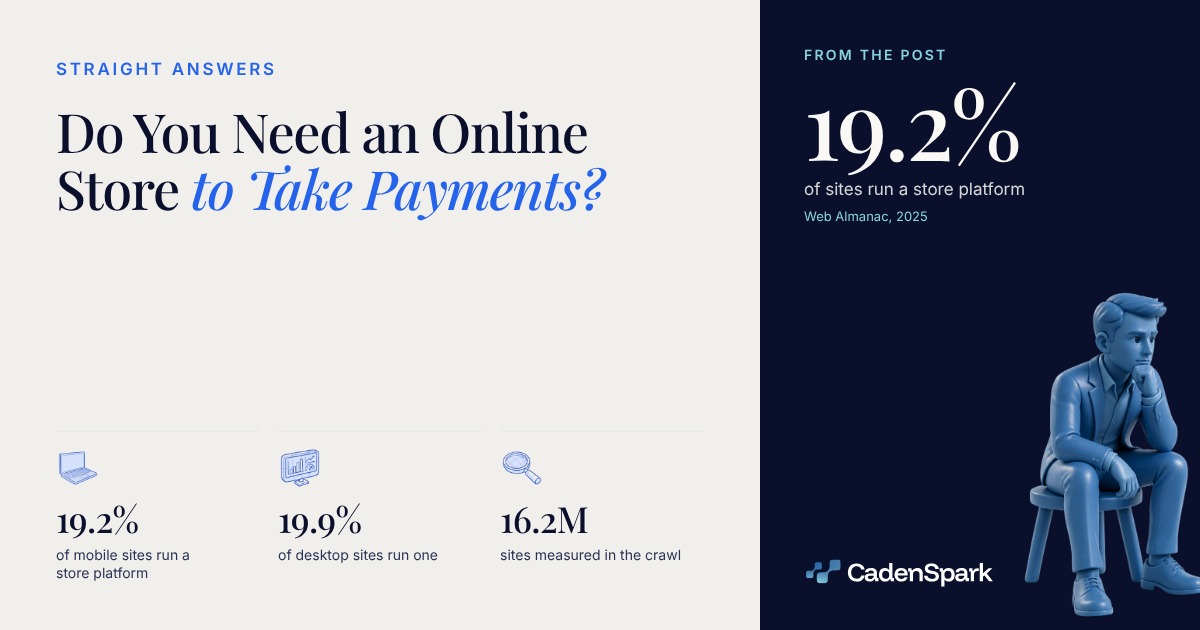
No. Only 19.2% of analyzed mobile sites run a store platform (Web Almanac, 2025), and the same source says detecting a payment processor is not enough to call a site a store, because many non-store sites also take payments.
Do you need an online store to take payments?
No. A store platform runs a catalog, a cart and a checkout. A payment page does one thing: it moves money for work that was already agreed on.



What you run
a catalog, a cart, a checkoutone page with an amount
A store sells products. A payment page settles a job.
What the buyer does
browses and adds to a cartopens the link you sent
The price and the scope were agreed before the link existed.
How the crawl counts it
an ecommerce sitenot counted at all
Detecting a payment processor alone is not sufficient to classify a site as ecommerce, because many non-store sites also take payments (Web Almanac, 2025).
View data
| Metric | Day zero → target |
|---|---|
| What you run | a catalog, a cart, a checkout → one page with an amount |
| What the buyer does | browses and adds to a cart → opens the link you sent |
| How the crawl counts it | an ecommerce site → not counted at all |
How much of the web is actually a store?
About one in five, and it stopped growing: 17% in 2022, 19% on mobile in 2024, and 19% again in 2025.
Web Almanac, 2025 · mobile sites, July 2025 crawl
View data
| Item | Value |
|---|---|
| 2022 | 17% |
| 2024 | 19% |
| 2025 | 19% |
Web Almanac, 2025 · our subtraction from the published 19.2%
View data
| Stage | Value |
|---|---|
| sites measured on mobile | 100 |
| run a store platform | 19 |
| run none, and some of them still take payments | 81 |
The rate also depends on how big the site is.

Which platforms are those stores built on?
Four names cover most of the stores detected on mobile. Three are hosted builders; WooCommerce is self-hosted, so somebody has to maintain it.
Web Almanac, 2025 · share of detected stores, mobile
View data
| Item | Value |
|---|---|
| WooCommerce | 44.4% |
| Shopify | 25.3% |
| Wix eCommerce | 11.1% |
| Squarespace Commerce | 9.9% |
Read those against stores. Against every site measured, the same platforms look like this.
Which payment buttons do people already see?
No single one dominates. PayPal is still the most detected provider, but its share of payment detections fell from around 39% in 2022 to around 30% in 2025.


Web Almanac, 2025 · figures published as approximate
View data
| Item | Value |
|---|---|
| 2022 | 39% |
| 2025 | 30% |
What does your site need before a payment button works?
HTTPS on the page where the money moves, and room for third-party scripts. The browser’s payment API is only available over HTTPS (W3C Payment Request API).
- 01Serve that page over HTTPSThe API is only exposed in a secure context, which in practice means HTTPS. The padlock is the floor, not the verdict: see what the padlock actually proves.
- 02Pick the provider your customers recognizeThe data does not crown one. Pick the button they already know and the one your bookkeeper can reconcile without a side spreadsheet.
- 03Expect the dependency surfacePayments are a major dependency surface area: third-party scripts, redirects, fraud tooling and compliance constraints (Web Almanac, 2025).
- 04Put the link where the invoice already goesThe link belongs in the invoice and in the reminder, not behind a catalog. The wait it shortens is measured in how long a service business waits to get paid.
A payment page settles work you quoted. It needs no catalog, no cart and no inventory to exist.
80.8% of analyzed mobile sites run none (our subtraction from the Web Almanac’s 19.2%).
The crawl would not even count it as a store, which is exactly the point.
HTTPS is a technical requirement, not a seal. This is not legal or tax advice.
If you quote the work before you do it, you do not need a store. You need one page that takes money and an invoice that points at it.
- 01Quote the work
- 02Send one payment link
- 03Put it in the invoice
- 04Reconcile it monthly
Questions owners ask
Do you need an online store to take payments on your website?
No. A store platform runs a catalog, a cart and a checkout. A payment page moves money for work already agreed on. Detecting a payment processor is not enough to call a site a store, because many non-store sites also take payments (Web Almanac, 2025).
How many websites are online stores?
19.2% of analyzed mobile sites and 19.9% of desktop sites, out of 16,213,084 sites in the July 2025 crawl (Web Almanac, 2025). Flat since 2024, after 17% in 2022.
Which payment provider should a service business use?
The data does not pick one. PayPal is still the most detected, but its share of payment detections fell from around 39% in 2022 to around 30% in 2025, and on desktop Stripe leads in 31 geographies against PayPal’s 22 (Web Almanac, 2025).
Does a payment page need HTTPS?
Yes. The browser’s Payment Request API is only available over HTTPS (W3C Payment Request API), and the wallet buttons sit on top of it. HTTPS is the floor, not proof that a site is safe.
Sources
- Web Almanac 2025 (HTTP Archive), Ecommerce chapter: 16,213,084 sites measured, of which 15,426,398 mobile and 12,155,374 desktop, July 2025 crawl; platform detection by Wappalyzer on the home page plus one internal page; read October 29, 2026 (2025)
- Web Almanac 2025 (HTTP Archive), Methodology: dataset size and crawl date, with the declared bias toward sites visited by Chrome users (2025)
- W3C, Payment Request API (specification, no sample): the API is only exposed in a secure context (2026)
The first meeting starts with findings, not promises.The free Business Health Report reads your business and shows you what it found, in days.
Get Your Free Business Health Report