




 Google
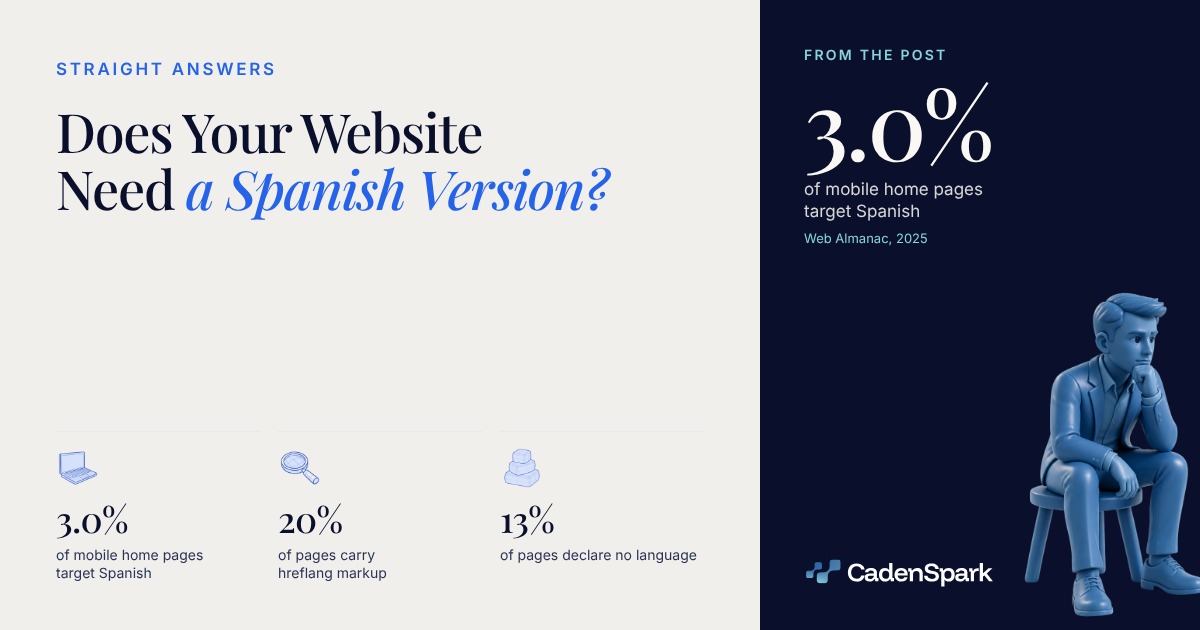
Almost nobody has one. Spanish is in the hreflang markup of 3.0% of mobile home pages (Web Almanac, 2025) and the declared language of about 5 to 6% of pages (Web Almanac, 2024). A market decision, not a markup one.
Does your website need a Spanish version?
The measured web says a second language is rare, and that most sites are careless about declaring any language.



How many websites have a second language at all?
About one in five pages carries hreflang markup: 19.7% on mobile, 20.3% on desktop. Roughly double the 9 to 10% of a year earlier (Web Almanac, 2025).
Web Almanac, 2024 and 2025 · HTTP Archive crawls of June 2024 and July 2025
View data
| Item | Value |
|---|---|
| Mobile, 2024 | 9.1% |
| Mobile, 2025 | 19.7% |
| Desktop, 2024 | 9.5% |
| Desktop, 2025 | 20.3% |
Markup is not a translation. It only says an alternate version exists.
Which languages do sites actually target?
A short list. English and x-default lead on mobile home pages, then French, German and Spanish cluster between 3.0% and 3.2%.
Web Almanac, 2025 · HTTP Archive crawl of July 2025
View data
| Item | Value |
|---|---|
| en | 7.4% |
| x-default | 6.9% |
| fr | 3.2% |
| de | 3.1% |
| es | 3% |
| it | 2.4% |
| ru | 2.1% |
| en-us | 1.9% |
| pt | 1.6% |
A separate signal, content-language, ranks them differently. Different mechanism, different crawl: the two do not add up.
Web Almanac, 2024 · a signal separate from hreflang and from the lang attribute
View data
| Item | Value |
|---|---|
| en | 18% |
| pt-br | 9% |
| en-us | 8% |
| ja | 5% |
| fr | 5% |
| de | 4% |
| es | 4% |
Does the language tag tell Google what language your page is in?
No. Google works it out from the visible content and the navigation, and ignores the lang attribute because, as the Web Almanac reports, it is almost always wrong.
View data
| Step | Value |
|---|---|
| what a search engine actually reads | The words (Google can determine a page’s language from its visible content (Web Almanac, 2024).) |
| the menu and the links | The nav (search engines also detect the language used in navigation elements.) |
| the hreflang you declare | The pair (it says which version is for whom, not what language the page is written in.) |
| lang, for screen readers and translation | The tag (a WCAG Level A requirement, and about 86% of sites declare a valid one (Web Almanac, 2025).) |
Same reason what a search engine sees comes down to the words on the page.
Google ignores the lang attribute when working out the language of a page, because "it is almost always wrong" (reported by the Web Almanac, 2024).
Engines read the visible words and the navigation, so a Spanish shell with English copy inside still reads as English.
Screen readers take pronunciation from it and browsers translate from it. It is a WCAG Level A requirement, and about 86% of sites declare a valid one (Web Almanac, 2025).
13% of pages declare no language at all, and the crawl found 5,625 distinct language codes (Web Almanac, 2024).
What goes wrong when only half the site is translated?
The visitor lands in Spanish and the next click is in English. hreflang gets prioritized on home pages; inner pages see less consistent coverage (Web Almanac, 2025).
Web Almanac, 2025 · home pages against inner pages, July 2025 crawl
View data
| Item | Value |
|---|---|
| en, home | 7.4% |
| en, inner | 6.9% |
| x-default, home | 6.9% |
| x-default, inner | 6.8% |
| es, home | 3% |
| es, inner | 3% |
Adoption is prioritized on home pages, while inner pages see less consistent coverage (Web Almanac, 2025).
Only 6.9% of mobile home pages carry an x-default value, so most sites never say which version serves everyone else (Web Almanac, 2025).
The declared language can disagree with the content. The Web Almanac says exactly that about its own 40.5% English share (2024).
Raw and rendered hreflang differ by under 1%, so the sites doing it are doing it in the HTML, not after the fact (Web Almanac, 2025).
What should you check before translating anything?
What language your calls, forms and reviews already come in. Nobody publishes that by trade or by city; the data only shows what other sites do.
- 01Count the Spanish you already getCalls, voicemails, form notes, reviews and walk-ins, for one month. That number lives on your phone and in your inbox, and no public dataset has it for your trade or your city.
- 02Translate the pages that take moneyThe service page, the quote form, the booking page. Not the whole site, and not the archive of posts nobody reads twice.
- 03Give each language its own URLOne page per language, each with its own lang attribute and an hreflang pair, including an x-default for everyone the two languages do not cover.
- 04Keep the two in syncAn hour or a service that changed in English and not in Spanish is worse than one language done properly.
Declaring a valid language is worth doing either way. That is a readability question.
- 01Count the demand you already have
- 02Translate the money pages
- 03Declare the pair
- 04Keep them in sync
Count the Spanish calls you already take. If the number is real, translate the pages that take money and keep both versions in sync.
Questions owners ask
How many websites have a Spanish version?
Few. Spanish appears in the hreflang markup of 3.0% of mobile home pages, and it is the declared language of about 5 to 6% of pages (Web Almanac, 2024 and 2025). Markup being present is not proof of a real translation.
Do I need hreflang if I add a Spanish page?
If you publish the same page in two languages, yes. It tells a search engine which version is for whom. About one in five pages now carries hreflang markup, double the share of a year earlier (Web Almanac, 2025).
Is changing the lang attribute enough to have a Spanish site?
No. Google works the language out from the visible content and ignores the lang attribute, because it is almost always wrong (reported by the Web Almanac, 2024). The tag serves screen readers and browser translation instead.
Which pages should I translate first?
The ones that take money: the service page, the quote form, the booking page. Translating only the home page is the common half measure, since inner pages get less consistent hreflang coverage (Web Almanac, 2025).
Sources
- Web Almanac 2025, SEO chapter, Internationalization section (HTTP Archive, 16,213,084 sites, 15,426,398 of them mobile; July 2025 crawl; read November 8, 2026) (2025)
- Web Almanac 2025, Accessibility chapter, language identification (HTTP Archive, July 2025 crawl) (2025)
- Web Almanac 2024, Markup chapter, Document language (HTTP Archive, 16,935,953 sites, 16,130,357 of them mobile; June 2024 crawl) (2024)
- Web Almanac 2024, SEO chapter, Internationalization and content language usage (HTTP Archive, June 2024 crawl) (2024)
The first meeting starts with findings, not promises.The free Business Health Report reads your business and shows you what it found, in days.
Get Your Free Business Health Report