



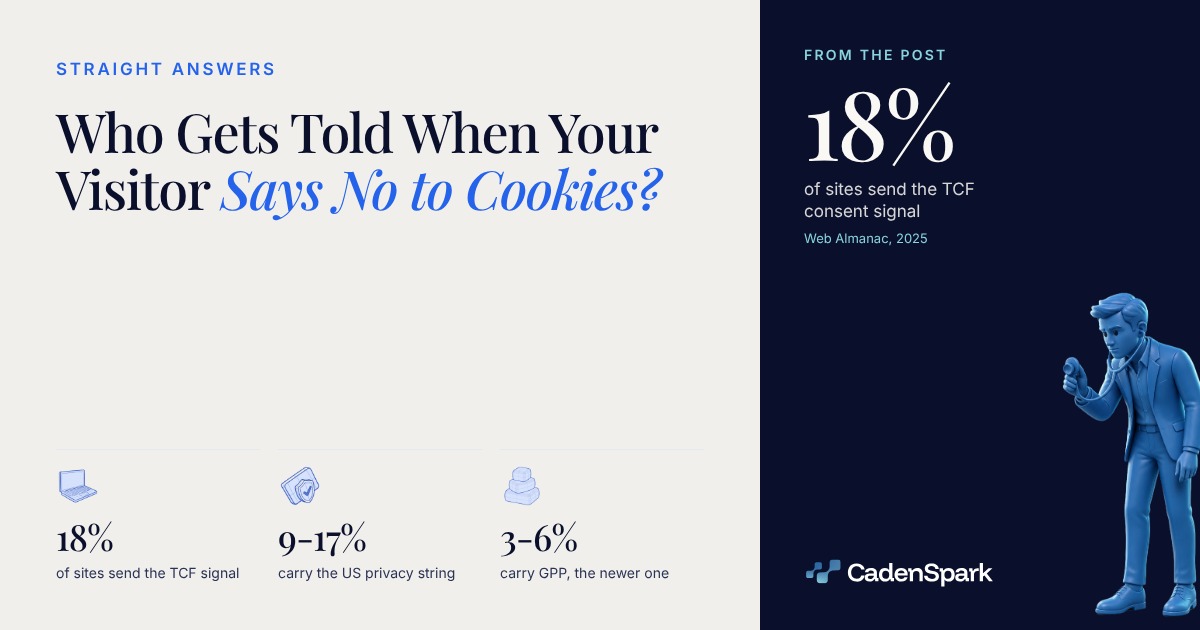
Mostly the advertising vendors, and only the ones whose request carries the signal. The European string rides on 18% of sites, the US privacy string on 9% to 17% and GPP on 3% to 6% (Web Almanac, 2025). This is general information, not legal advice.
Who gets told when your visitor says no to cookies?
Only the vendors whose request carries a consent parameter. Everyone else receives the same request as always, because the banner stores the choice and something downstream has to attach it.



Any one of the four can be missing. Three of them are owned by somebody other than you: the banner vendor, the tag vendor and the receiving vendor.
View data
| Step | Value |
|---|---|
| The visitor chooses | 1 (Accept, reject, or close the banner and never answer at all) |
| The platform stores it | 2 (A consent string in local storage or a cookie, written by the banner vendor) |
| The tag reads it | 3 (Each tag has to ask for the string before it fires its request) |
| The request carries it | 4 (The string travels as a parameter on the URL, or it does not travel.) |
Which companies are at the other end?
Ad exchanges and ad servers. Among top-ranked sites, pubmatic.com receives the highest volume of consent signals and adservice.google.com is second, and the chapter says most of the rest are ad tech too (Web Almanac, 2025).
third-party-web, dataset dated March 1, 2026 · HTTP Archive mobile crawl · rounded to the nearest thousand
View data
| Item | Value |
|---|---|
| adservice.google.com | 1961k |
| cookiebot.com | 367k |
| onetrust.com | 273k |
| pubmatic.com | 268k |
| iubenda.com | 203k |
On 1,961,236 pages in the March 2026 dataset. Classified as advertising. This is the kind of vendor that both expects a consent string and is built to read one.
On 268,195 pages, classified as advertising, and first by volume of consent signals received among top-ranked sites. It sits behind other people’s ad slots, not behind your contact form.
On 272,514 pages, and the only one of these three classified as a consent provider. The thing that collects the choice is itself a third party on your page.
On 367,484 and 202,893 pages. The dataset files both as utilities rather than consent providers, so read this as prevalence of domains, not as market share of banner vendors.


How does a no travel from the banner to the vendor?
As text appended to the request URL. The chapter detects consent by looking for `gdpr` and `gdpr_consent` (TCF), `gpp` and `gpp_sid` (GPP), and `us_privacy` (USP) on third-party requests.
- 01gdpr and gdpr_consent, the European pairThe TCF string. Written by the banner platform, read by any vendor registered in the framework. This is the signal the Almanac finds on 18% of sites, and the one your US-only visitors are least likely to need.
- 02us_privacy, the US stringFour characters that say which version applied, whether notice was given, whether the visitor opted out of sale, and whether a limited service provider agreement is in place. Between 9% and 17% of sites send it, depending on rank.
- 03gpp and gpp_sid, the unified attemptOne envelope meant to carry any jurisdiction’s string, with a section ID saying which one is inside. Adoption is still 3% to 6%, so a vendor that only reads GPP is reading something most sites do not send.
- 04Nothing at all, the defaultA request with none of the three tells the vendor nothing about the choice. That is the common case, and it is not the same thing as a request that says no.
The visitor closed it, or the platform only logged the view. There is no string for anyone downstream to read, so nothing can be attached.
A pixel pasted straight into the page markup fires on load without consulting the consent platform. The banner appears, the request leaves anyway.
A vendor wired for GPP gets a TCF string and ignores it. The parameter is present and still does nothing.
The honest best case. A tag held back until consent arrives sends no request, so there is no signal to find and no data to withdraw.
Why do most requests show no signal at all?
Because four different situations look identical from outside the browser. The absence of a parameter is not proof that a vendor ignored your visitor, and the chapter calls its own client-side numbers a lower bound.
Web Almanac 2025, Third Parties · HTTP Archive crawl of July 1, 2025
View data
| Item | Value |
|---|---|
| Lower-ranked sites | 36% |
| All sites | 18% |
The platform handed the string to the vendor through a JavaScript API instead of a URL. Nothing shows in the request, and the vendor got the answer.
Your server, or a tag manager running on it, passed the choice behind the scenes. The chapter treats that traffic as first party and says its figures are a floor.
Plenty of third parties never registered for TCF, USP or GPP. There is no parameter for them to read, which is a gap, not a violation.
The most common one. The banner was installed, the tags were never connected to it, and no error was ever raised. See whether a US-only site needs the banner at all.
What can you check on your own site this week?
Five things, in half an hour, with the browser you already have. None of them is a purchase, and none of them is a legal opinion.
- 01Open the network tab and reject everythingLoad your own site in a private window, click reject on the banner, then look at the requests that go out after the click. That list is the answer to the question in the title.
- 02Filter the request list for the three parametersSearch the network panel for `us_privacy=`, `gpp=` and `gdpr_consent=`. Whatever matches is a vendor being told. Whatever does not match is a vendor you have to ask directly.
- 03List the third parties still firing after a rejectWrite down every domain, not just the familiar ones. If you have never counted them, start with who else is collecting data on your website.
- 04Ask each vendor which standard it readsUSP, GPP, TCF, an in-frame API, or none. A vendor that cannot answer in one line is a vendor whose behavior you cannot describe to a customer who asks.
- 05Write down what you found, with the dateA dated list of vendors, signals and gaps is what a lawyer, a client or an enterprise security questionnaire actually asks for. Memory is not a record.
What the banner looks like it does
blocks the vendorsshows and stores a choice
The blocking, if any, happens in the tags that read the stored choice.
What you know about a vendor
it is on the pagewhich standard it reads
One question by email, answered in one line, closes the gap.
What a missing parameter means
the vendor ignored the nofour possibilities, one list
In frame, server side, outside the framework, or never wired.
What you can hand to a reviewer
a vendor logo in a footera dated list of requests
Produced by the network tab, not by a subscription.
View data
| Metric | Day zero → target |
|---|---|
| What the banner looks like it does | blocks the vendors → shows and stores a choice |
| What you know about a vendor | it is on the page → which standard it reads |
| What a missing parameter means | the vendor ignored the no → four possibilities, one list |
| What you can hand to a reviewer | a vendor logo in a footer → a dated list of requests |
The plumbing is connected for those vendors. Keep the dated list and recheck after the next tag goes in.
Four causes, and you cannot tell them apart from outside. Ask the vendor before you conclude anything.
The tags are being held back, which is the cleanest result on this page.
It is a description of wiring. Which law applies to you, and what it requires, is a question for a lawyer who has read your contracts.
Check it with the network tab, write the date next to what you found, and recheck after the next tag goes in. The banner is a question. The parameter is the only part the vendor hears.
- 01Install the banner
- 02Read what the requests carry
- 03Connect the tags that ignore it
- 04Record it, with the date
Questions owners ask
Does my cookie banner block anything by itself?
Not on its own. The banner shows the choice and stores it. Whether the request to a vendor carries that choice depends on the tag reading it and the vendor understanding it. The most widespread signal appears on 18% of sites (Web Almanac, 2025).
Who actually receives the consent signal?
Mostly advertising. The chapter puts pubmatic.com first and adservice.google.com second among the domains receiving the highest volume of consent signals, and says most of them are ad exchanges, DSPs and ad servers (Web Almanac, 2025).
Which signal matters for a US-only business?
The USP string (us_privacy) and GPP. TCF is the European one and is still the most widespread: 18% of sites, against 9% to 17% for USP and 3% to 6% for GPP (Web Almanac, 2025).
If I see no signal in a request, is the vendor ignoring my visitor?
You cannot conclude that. Consent also travels by in-frame API and server to server, which this measurement cannot see, and the chapter calls its client-side figures a lower bound. General information, not legal advice: ask a lawyer.
Sources
- HTTP Archive, Web Almanac 2025, Third Parties chapter (crawl of July 1, 2025; consent signals detected as parameters on third-party request URLs; read November 27, 2026) (2025)
- Patrick Hulce, third-party-web, entity scripting dataset dated March 1, 2026 (HTTP Archive mobile crawl, 1,047 third-party entities, page counts and main-thread script time per page) (2026)
The first meeting starts with findings, not promises.The free Business Health Report reads your business and shows you what it found, in days.
Get Your Free Business Health Report