



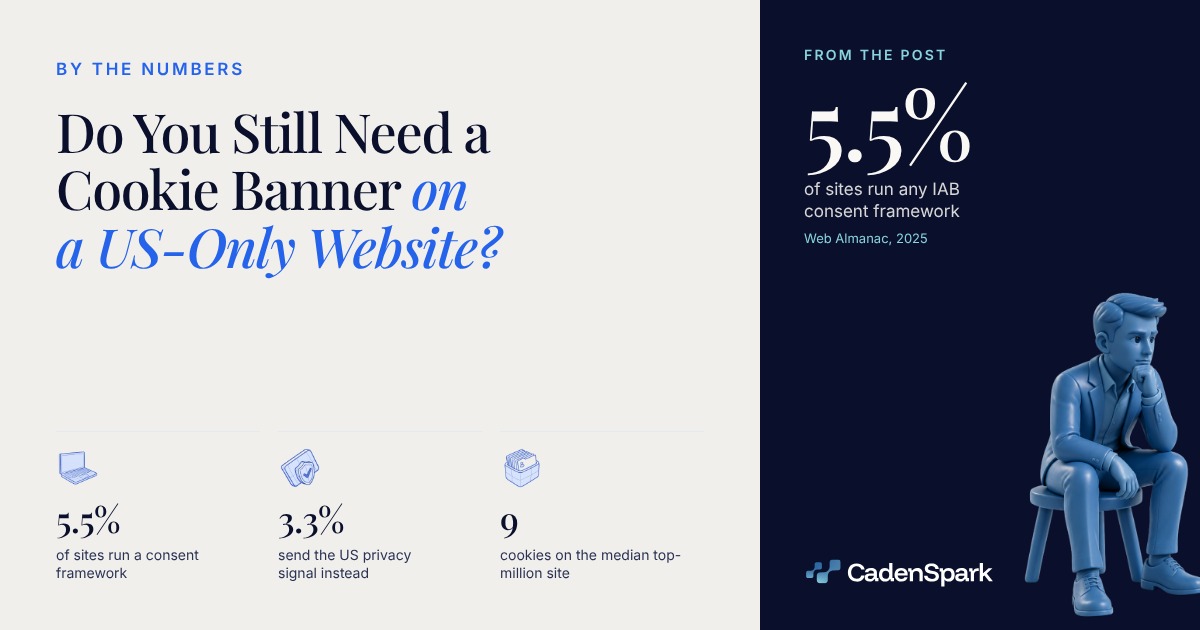
The data cannot answer the legal question, and this post does not try. What the measured web shows is narrower: the ad industry’s consent plumbing runs on just above 5.5% of sites (Web Almanac, 2025).
Do US sites run a cookie banner?
Most do not run the ad industry’s frameworks. Any IAB framework sits just above 5.5% of sites, the European TCF at 4.0%, and the US privacy string at 3.3% (Web Almanac, 2025).



Web Almanac, 2025 · July 2025 crawl of 16,213,084 sites
View data
| Item | Value |
|---|---|
| Any IAB framework | 5.5% |
| TCF | 4% |
| USP, the US string | 3.3% |
| GPP, the newer unified one | 0.9% |
| TCFv1, deprecated | 0.2% |
The chapter caveats its own figure: the crawler is US-based, and under TCF a banner is not required for non-EU visitors, so real TCF use is likely higher.
Which consent signal do US sites actually send?
The US one, and it reads the same almost everywhere. The most common string, on 1.296% of sites, records that notice was given and the visitor did not opt out.
Web Almanac, 2025 · share of all crawled sites
View data
| Item | Value |
|---|---|
| 1YNY, notice given and no opt-out | 1.296% |
| 1---, a placeholder with no signal | 1.073% |
| 1YYN, new visitors default to opted out | 0.078% |
A site can send the US privacy string without drawing anything on screen. The chapter counts signals, not banners.
CCPA’s standard model assumes consent until it is explicitly revoked, which is why 1YNY dominates (Web Almanac, 2025).
Only 0.078% of sites default new visitors to an opted-out state, which the chapter calls a stricter than required posture.
GPP appears on 0.9% of sites and gpp_data_available matches at 0.9%, so the code transmits rather than just loads.
Why does the European framework barely show up on US sites?
Because TCF is not required outside the EU, and the measurement shows it. Among identified publisher countries, Germany sits at 0.042%, France at 0.030% and the US at 0.017%.
The European framework, which the chapter ties to GDPR. On 4.0% of sites.
The US string, which the chapter ties to CCPA compliance work. On 3.3%.
The newer unified framework from IAB, meant to carry both. On 0.9%.
Web Almanac, 2025 · share of all crawled sites
View data
| Item | Value |
|---|---|
| Undefined country code AA | 0.26% |
| Germany | 0.042% |
| France | 0.03% |
| United States | 0.017% |
The largest bucket is not a country: 0.26% falls under an undefined code, which the chapter reads as missing publisher metadata.
TCF adoption
4.2% in 20244.0% in 2025
The chapter calls the dip too small to name a trend.
Automattic, among TCFv2 CMPs
0.67% in 20240.30% in 2025
Shares of all crawled sites, not of the banner market.
Didomi, among TCFv2 CMPs
0.22% in 20240.50% in 2025
Cookie-script entered at 0.27%; every other CMP is under 0.12%.
View data
| Metric | Day zero → target |
|---|---|
| TCF adoption | 4.2% in 2024 → 4.0% in 2025 |
| Automattic, among TCFv2 CMPs | 0.67% in 2024 → 0.30% in 2025 |
| Didomi, among TCFv2 CMPs | 0.22% in 2024 → 0.50% in 2025 |
What is a banner asking about, in numbers?
Cookies the page leaves behind. On the top million desktop sites the median is 9, and the 99th percentile is 395 (Web Almanac, 2025).

Trackers are counted differently from the third parties we measured in October: at least one tracker appears on 75% of desktop pages.
Web Almanac, 2025 · WhoTracksMe categories, desktop pages
View data
| Item | Value |
|---|---|
| CDN | 74% |
| Advertising | 59% |
| Essential, like tag managers | 55% |
| Site analytics | 52% |
What does the US use instead of a consent gate?
A signal, not a gate. The chapter describes Global Privacy Control as having legal backing under CCPA/CPRA, while Do Not Track has none and most advertisers ignore it.
Web Almanac, 2025 · detection, not compliance
View data
| Item | Value |
|---|---|
| Top 5,000 | 44% |
| Top 10,000 | 43% |
| Top 100,000 | 35% |
| Top 500,000 | 27% |
| Top 50 million | 17% |
Detection is not compliance: whether those sites honor the signal is an open question in the chapter.
View data
| Step | Value |
|---|---|
| No legal backing | DNT (Most advertisers ignore it, and it was never enforceable.) |
| Legal backing under CCPA/CPRA | GPC (The chapter notes that ignoring it carries legal risk.) |
| Firefox, Brave and Safari support it | Browsers (Chrome is set to implement it in 2026.) |
| California legislation | 2027 (Browsers required to offer the setting.) |
The chapter measures what sites do. It does not map which rules apply to whom, and it does not break results out by state.
The crawler is US-based, and under TCF a banner is not required for non-EU visitors, so real use is likely higher than measured.
Whether the sites that check for DNT honor it is left as an open question in the chapter itself.
None of this is legal advice. For whether your own site needs anything, ask a lawyer.
These numbers describe what the web does, not which law reaches your site. That part is a lawyer’s answer. Browser signals, like the padlock, promise less than they appear to.
Questions owners ask
How many sites run a cookie consent framework?
Just above 5.5% run one of the IAB frameworks, on the July 2025 crawl (Web Almanac, 2025). The European TCF is at 4.0% and the US string at 3.3%. The crawler is US-based, so real TCF use is likely higher.
What does the US privacy string say?
The most common one, on 1.296% of sites, records that notice was given and the visitor did not opt out. The second, on 1.073%, is a placeholder that carries no preference at all (Web Almanac, 2025).
Is Global Privacy Control the same as Do Not Track?
Not in its backing. The chapter describes GPC as having legal backing under CCPA/CPRA and already supported by Firefox, Brave and Safari, and DNT as a signal with none that most advertisers ignore.
Does this tell me whether my site needs a banner?
No. The chapter measures what the web does, not which law reaches whom, and it does not break results out by state. This is general information, not legal advice: ask a lawyer.
Sources
- HTTP Archive, Web Almanac 2025, Privacy chapter (July 2025 crawl of 16,213,084 sites; framework adoption, USP strings, DNT and GPC; chapter source read November 14, 2026) (2025)
- HTTP Archive, Web Almanac 2025, Cookies chapter (same crawl, top one million desktop sites by CrUX rank; cookie count percentiles) (2025)
- HTTP Archive, Web Almanac 2025 Methodology (sample size and crawl date) (2025)
The first meeting starts with findings, not promises.The free Business Health Report reads your business and shows you what it found, in days.
Get Your Free Business Health Report