




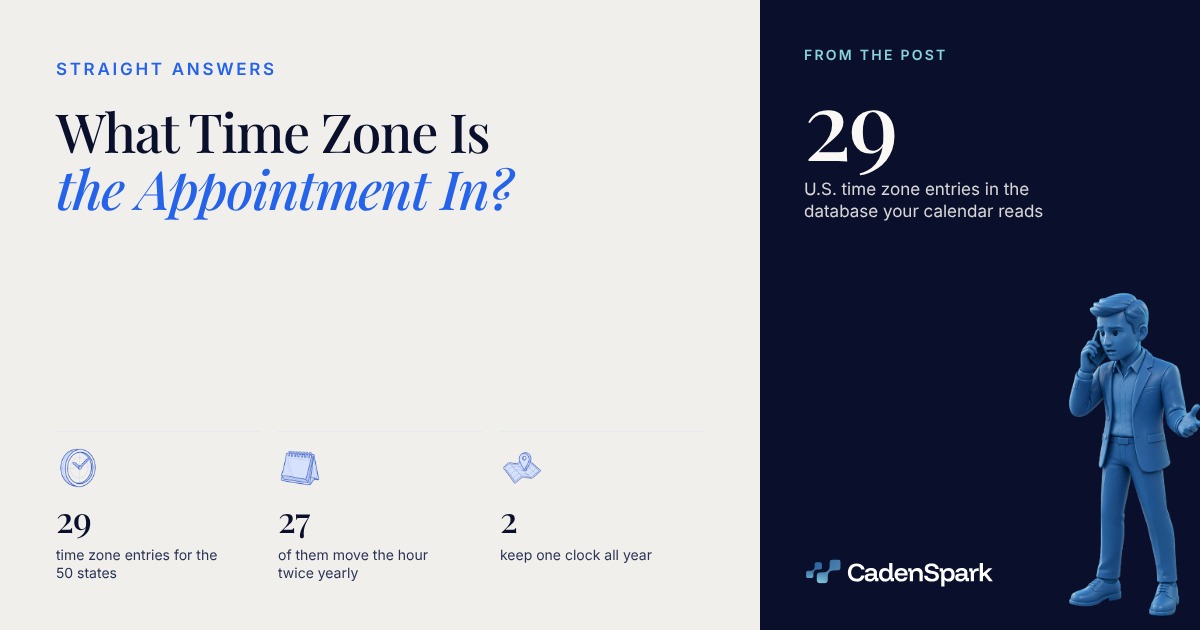
The appointment is in whatever time zone your calendar stored with it, and in the United States that is one of six clocks in January and seven in July. The database your phone and your booking tool read lists 29 U.S. entries. Two of them never move.
How many time zones does a U.S. business have to handle?
More than the four on a weather map. The database that phones, calendars and booking tools read lists 29 separate U.S. entries, spread across six standard time offsets (IANA tzdb, 2026).



IANA Time Zone Database, release 2026f (repository read November 20, 2026) and our count on the database file
View data
| Item | Value |
|---|---|
| Eastern (UTC-5) | 10 |
| Central (UTC-6) | 7 |
| Mountain (UTC-7) | 3 |
| Pacific (UTC-8) | 1 |
| Alaska (UTC-9) | 6 |
| Hawaii-Aleutian (UTC-10) | 2 |
When exactly do the clocks move, and who sits it out?
Second Sunday in March at 2:00 local, forward an hour, and first Sunday in November at 2:00, back again. That is the rule the database has carried since 2007. The four dates below are our arithmetic on that published rule.
- 01Nov 1, 2026: clocks went back
- 02Mar 14, 2027: clocks go forward
- 03Nov 7, 2027: clocks go back
- 04Mar 12, 2028: forward again
The daylight saving column of those two rows is empty: America/Phoenix and Pacific/Honolulu (IANA tzdb, 2026). The other 27 carry the shared U.S. rule, and that 27 is our count on the database file.
The Arizona row reads MST, AZ (most areas), Creston BC. That parenthesis matters: the Navajo Nation does change its clocks and sits under a different entry. The file labels rows with postal abbreviations, not state names.
Six distinct standard time offsets in January and seven in July, because the two entries that never move separate from the rest while everyone else shifts. That count is ours, on the database file.
Why does one state show up in eight different entries?
Because the line does not follow state borders. Indiana alone needs eight entries, two of them on Central time, and North Dakota needs three (our count on the database file).
IANA Time Zone Database, release 2026f, and our count on the database file. The file labels rows with postal abbreviations, not state names.
View data
| Item | Value |
|---|---|
| Indiana | 8 |
| Alaska | 7 |
| North Dakota | 3 |
| Kentucky | 2 |
| Michigan | 2 |
What the map shows
four time zonesthe shape of the country
Useful for a weather forecast, not for a booking.
What the database shows
29 entries for the 50 statessix standard time offsets
IANA tzdb, 2026. The six offsets are our count on the file.
Where it bites
one service area, one clocktwo counties, two clocks
Indiana needs eight entries and North Dakota three, so a crew can cross a line without crossing a state.
What it is not
a list of political borderszones that have agreed since 1970
The file header says each row stands for a timezone where civil timestamps have agreed since 1970.
View data
| Metric | Day zero → target |
|---|---|
| What the map shows | four time zones → the shape of the country |
| What the database shows | 29 entries for the 50 states → six standard time offsets |
| Where it bites | one service area, one clock → two counties, two clocks |
| What it is not | a list of political borders → zones that have agreed since 1970 |
Why isn’t "2 PM CST" enough in a confirmation?
Because the abbreviation is not unique, and for much of the year it is also the wrong letter. The people who maintain the database say so in their own documentation, and they recommend the numeric offset instead.
The project documentation puts it plainly: CST means one thing in China and something else in North America, and IST can refer to time in India, Ireland or Israel.
Between the second Sunday in March and the first Sunday in November that clock is CDT, not CST (IANA tzdb, rule in force since 2007). The letters change under the appointment while the appointment sits still.
The same page says to use numeric abbreviations like -06 or -0600 instead of alphabetic abbreviations like CST. A city name does the same job for a customer who does not read offsets.
Each handoff is a place the hour can survive or get dropped. Only the zone makes it survive all four.
View data
| Step | Value |
|---|---|
| You pick the time | 2 PM (On your clock, in your office.) |
| With a zone, or without one | Stored (Only one of those survives the trip.) |
| Their phone picks the clock | Rendered (It follows their device, not your office.) |
| The text names no zone | 2 PM (Nothing in the message settles it.) |
| One of you is off | 1 hour (And the other one records a no show.) |
What should your calendar and your confirmation carry?
The hour with its zone attached, and the zone written out in words the customer can read. Then software that keeps up: the database shipped six releases in 2026, the latest on October 27 (IANA tzdb, 2026).
- 01Ask where the customer is, not only whenThe time zone is a field on the appointment, the same way the address is. A booking that stores only a wall clock has stored half the answer, and nobody finds out until the day of.
- 02Write the city or the offset, never only the letters2 PM in Phoenix, or 2 PM at -07:00, survives a forward. 2 PM CST does not, because the letters are ambiguous in the first place and change in March.
- 03Say the zone in the confirmation and again in the reminderThe reminder goes out on a different day, and that day can sit on the other side of a transition. What your confirmation text must say covers the rest of that message.
- 04Check that your tools carry current rulesSix releases went out in 2026 alone (IANA tzdb, 2026). Software that stopped taking updates keeps booking against rules that were replaced.

What you control
the zone stored with the appointmentand the words in the message
Both of those are yours to set today, on the next booking you take.
What you do not control
which clock their phone showsit follows their device
So the message has to name the zone out loud instead of assuming it.
What nobody should treat as law
the database itselfthe national standards bodies
Its own documentation says the tz database is not authoritative, and it surely has errors, and that users requiring authoritative data should consult national standards bodies.
View data
| Metric | Day zero → target |
|---|---|
| What you control | the zone stored with the appointment → and the words in the message |
| What you do not control | which clock their phone shows → it follows their device |
| What nobody should treat as law | the database itself → the national standards bodies |
Put the zone on the appointment and in the message. The database maps clocks, it is not law. And an hour misread still gets counted as a no show.
Questions owners ask
How many time zones does the United States have?
It depends what you count. The map shows four continental zones plus Alaska and Hawaii. The database phones and calendars read lists 29 U.S. entries across six standard time offsets (IANA tzdb, 2026). The line does not follow state borders.
When do the clocks change in 2027?
March 14 forward an hour, November 7 back, both at 2:00 local. That comes from the rule in force since 2007: second Sunday in March, first Sunday in November. The dates themselves are our arithmetic on that rule.
Which states do not change their clocks?
Arizona in most areas, and Hawaii. Their entries carry no daylight saving rule (IANA tzdb, 2026). The words most areas matter: the Navajo Nation does change its clocks, and the Arizona row says most areas for that reason.
Should I write the time zone in an appointment confirmation?
Yes, and better as a city or a numeric offset than as three letters. The database documentation warns that CST means one thing in China and another in North America, and recommends -06 or -0600 instead.
Sources
The first meeting starts with findings, not promises.The free Business Health Report reads your business and shows you what it found, in days.
Get Your Free Business Health Report