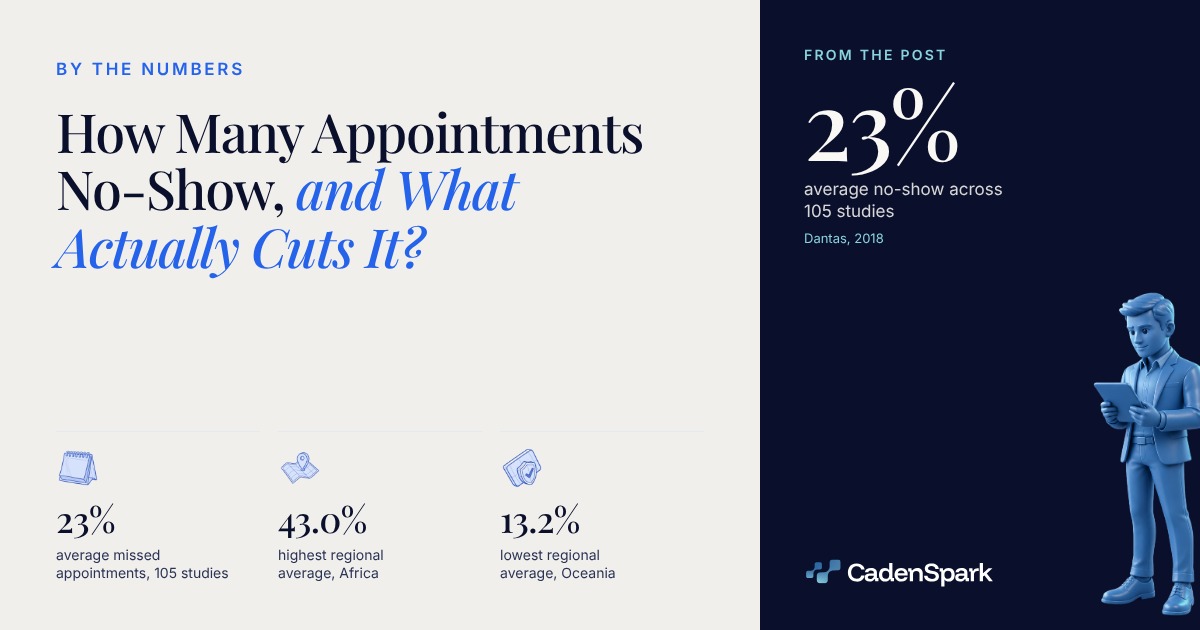
No study measures the no-show rate for home services, salons or the trades. Clinics do: the average across 105 studies is of the order of 23% (Dantas et al., 2018). The one lever with trial evidence behind it is an automatic reminder.
How many appointments no-show?
About 23%, in clinics. That is an unweighted average across 105 studies of healthcare appointments, not a share of appointments weighted by volume (Dantas et al., 2018).



Dantas et al., Health Policy 2018 · unweighted averages across the 105 studies reviewed
View data
| Item | Value |
|---|---|
| Africa | 43% |
| All 105 studies | 23% |
| Oceania | 13.2% |
Outside healthcare there is nothing to cite: vendor figures for salons and home services run from 1% to 30% for the same thing. If you do not count it, you do not know it.
Why does a booked customer not show up?
Two determinants lead the list in that review: a long wait between booking and the appointment, and a previous no-show on the record (Dantas et al., 2018).
The most reported determinant across the 105 studies: the more days between booking and visit, the more no-shows.
Reported just as often. The best available predictor of a missed appointment is a missed appointment.
Reported in the same review as more likely to miss than older patients.
Also reported: lower socioeconomic status, distance to the clinic, and not holding private insurance.
View data
| Step | Value |
|---|---|
| The customer picks a slot | Booked (The one moment they are paying attention) |
| Days pass with no contact | The wait (Lead time, the top determinant (Dantas, 2018)) |
| A text goes out on its own | The reminder (Attendance 67.8% to 78.6% in trials (Cochrane, 2013)) |
| One tap to keep or reschedule | Confirm or move it (A moved slot is a kept slot, not a loss) |
| The slot holds | They show |
Do reminders actually cut no-shows, and by how much?
In clinics, attendance went from 67.8% with no reminder to 78.6% with a text, across seven randomized trials and 5,841 participants (Cochrane, 2013).
Gurol-Urganci et al., Cochrane 2013 · seven trials, 5,841 participants, moderate quality evidence
View data
| Item | Value |
|---|---|
| No reminder | 67.8% |
| Text reminder | 78.6% |
| Phone call reminder | 80.3% |
our arithmetic on Cochrane’s published attendance rates, not their figure
View data
| Stage | Value |
|---|---|
| appointments booked | 100 |
| kept with no reminder | 68 |
| kept with a text reminder | 79 |
The newest review is less sure than the old one. Al-Turbag et al. pooled ten studies and 8,236 participants: reminders overall at relative risk 1.11 (95% CI 1.05 to 1.19), text alone at 1.14 with an interval of 0.99 to 1.31 that crosses 1. Heterogeneity was 83%.


Text, call, or email, and when?
Text and phone call tied: relative risk 0.99 (95% CI 0.95 to 1.02) across three trials and 2,509 participants (Cochrane, 2013). The text cost less per attendance.
Attendance in the trials
67.8% with no reminder78.6% with a text
Cochrane, 2013: seven trials, 5,841 participants, mostly outside the United States.
Text against a phone call
a phone call per bookinga text that costs less
Attendance tied: relative risk 0.99 (0.95 to 1.02), three trials, 2,509 participants.
Cost per attendance
the phone callthe text, 55% to 65% less
Measured in two of the trials inside the same review.
What the newest review found
a clean effect for text alonean interval that crosses 1
Al-Turbag, 2026: 1.14 (0.99 to 1.31), four trials, not statistically significant.
View data
| Metric | Day zero → target |
|---|---|
| Attendance in the trials | 67.8% with no reminder → 78.6% with a text |
| Text against a phone call | a phone call per booking → a text that costs less |
| Cost per attendance | the phone call → the text, 55% to 65% less |
| What the newest review found | a clean effect for text alone → an interval that crosses 1 |
Wording and timing were tested too, at a single NHS trust in England.
Hallsworth et al., PLoS ONE 2015 · trial 1, 10,111 appointments, one NHS trust in England
View data
| Item | Value |
|---|---|
| Existing reminder | 11.1% |
| Reminder naming the cost | 8.4% |
- 01Sent five days before the appointmentBoth trials randomized appointments to four wordings, all of them sent five days out (Hallsworth, 2015).
- 02Name what the missed slot costsDid not attend fell to 8.4% from 11.1% for the existing message, odds ratio 0.74 (95% CI 0.61 to 0.89).
- 03Be specific, not vagueThe replication held at 8.2%, while saying the same thing in general terms did worse, at 9.9%.
- 04Read the limits before copying itOne NHS trust in England, not the United States, and a phone number on record for only 20% of eligible appointments.
What cuts it when the reminder is not enough?
Four levers, and none of them has a trial behind it: one-tap rescheduling, a shorter wait between booking and visit, a deposit at booking, and a waitlist for the gap.
A customer who moves the slot keeps it. No study puts a number on this, so treat it as design, not as a measured lift.
Lead time is the determinant most reported in the literature (Dantas, 2018), and the booking calendar is the part you control.
Nobody has published a trial on deposits in a service business. Rules on fees vary by state, so ask counsel before writing a policy.
A slot that gets refilled never shows up as lost revenue, and that needs a booking page that can take it: see what a dynamic website does.
- 01Count it
- 02Remind on a cadence
- 03Make rescheduling easy
- 04Ask for a deposit
Count your own rate first, then automate one reminder and watch it move. What the message says is its own job: what your confirmation text must say.
Questions owners ask
What is a normal no-show rate?
There is no normal. Across 105 studies of healthcare appointments the average is of the order of 23%, with regional averages from 13.2% to 43.0% (Dantas, 2018). Nobody has measured the trades, so your own count is the only rate that matters.
Do text reminders reduce no-shows?
In clinics, yes, with caveats. Cochrane pooled seven randomized trials and 5,841 participants: attendance rose from 67.8% to 78.6% (2013). The 2026 review of ten studies found text alone not statistically significant, so treat the size as a direction.
How many reminders should go out, and when?
No trial ranks the hours. The two trials that fixed a time sent the reminder five days before the appointment (Hallsworth, 2015). Pick a cadence, keep it automatic, and compare your show rate month over month.
What should the reminder say?
The appointment, the time, the place, and one tap to confirm or reschedule. Naming what a missed slot costs beat the existing wording in a randomized trial at an NHS trust (Hallsworth, 2015).
Sources
- Dantas LF, Fleck JL, Cyrino Oliveira FL, Hamacher S, No-shows in appointment scheduling: a systematic literature review, Health Policy 122(4), pp. 412-421 (105 studies selected from 727 retrieved in Scopus; abstract read October 19, 2026) (2018)
- Gurol-Urganci I et al., Mobile phone messaging reminders for attendance at healthcare appointments, Cochrane Database of Systematic Reviews, Issue 12, CD007458.pub3 (seven trials and 5,841 participants for text against no reminder; moderate quality) (2013)
- Al-Turbag A, Mooney J, Corry M, A systematic review and meta-analysis of appointment reminders for enhancing hospital attendance, Journal of Hospital Management and Health Policy (ten studies, 8,236 participants, adult hospital outpatients) (2026)
- Hallsworth M et al., Stating appointment costs in SMS reminders reduces missed hospital appointments: findings from two randomised controlled trials, PLoS ONE 10(9): e0137306 (two trials, 10,111 and 9,848 appointments, one NHS trust in England) (2015)
The first meeting starts with findings, not promises.The free Business Health Report reads your business and shows you what it found, in days.
Get Your Free Business Health Report