


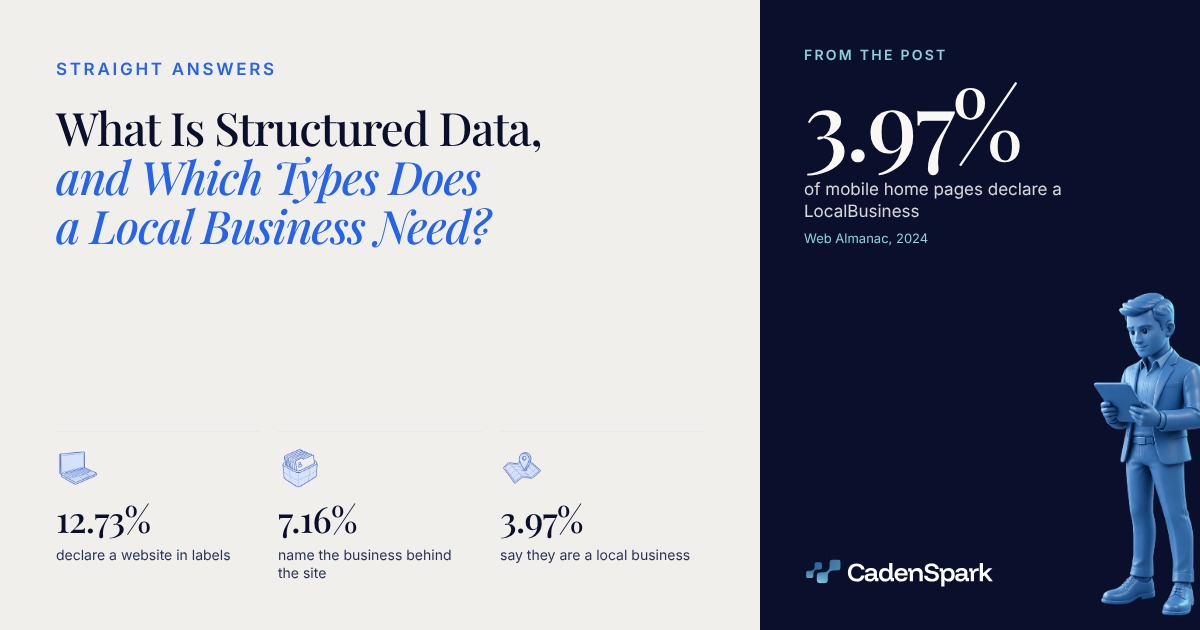
Structured data is a second copy of what your page already says, written in labels instead of sentences so a machine does not have to guess. A local business needs `LocalBusiness`, or the most specific type under it that is actually true. Only 3.97% of mobile home pages declare one (Web Almanac, 2024 crawl).
What is structured data?
A labeled copy of the page, sitting in the HTML where no visitor sees it. One vocabulary won: schema.org appeared in 20,960,693 JSON-LD contexts against 11,973 for the next one (Web Almanac, 2024 crawl).
View data
| Step | Value |
|---|---|
| The page a person reads | 01 (The headline, the address in the footer, the hours, the number in the header.) |
| A JSON-LD block in the HTML | 02 (The same facts as key-value pairs. Nothing new, nothing the page does not already claim.) |
| schema.org names the keys | 03 (20,960,693 JSON-LD contexts against 11,973 for the next one (Web Almanac, 2024 crawl).) |
| Machines read the labels | 04 (Search engines, assistants and map listings stop parsing your sentences.) |
Most sites say something. Few say they are a business with an address.



Which schema type does a local business need?
`LocalBusiness`, or the most specific type below it that is true about you. Generic types win by a wide margin, and trade-specific ones are still rare.
Web Almanac, 2024 crawl · JSON-LD types on home pages, June 2024
View data
| Item | Value |
|---|---|
| WebSite | 12.73% |
| Organization | 7.16% |
| BreadcrumbList | 5.66% |
| LocalBusiness | 3.97% |
| AutoDealer | 1.09% |
| Restaurant | 0.19% |
| Store | 0.17% |
The root of the vocabulary. This is where sameAs and url come from, for every type.
LocalBusiness is a subclass of both at once, which is the whole trick of it.
The honest default, and the one on 3.97% of mobile home pages (Web Almanac, 2024 crawl).
Plumber, Dentist, HairSalon. Only if it is true, and only one of them.
Is there a schema type for your trade?
For eight building trades, a dentist, an attorney and a hair salon, yes. For cleaning, landscaping, pest control, a med spa or a law firm, no.
- 01PlumberA direct subclass, so a plumbing company has a leaf type that is literally its trade.
- 02ElectricianSame level, same inheritance. Nothing extra to fill in beyond the LocalBusiness fields.
- 03HVACBusinessHeating and cooling together. There is no separate heating type and no separate cooling type.
- 04RoofingContractorThe only roofing type. No gutter, siding or window equivalent exists next to it.
- 05GeneralContractorThe catch-all for the trades that build. Use it when no leaf below is truer.
- 06HousePainterInterior and exterior alike. Painting is the one finishing trade with a type of its own.
- 07LocksmithAlso the closest thing to an emergency trade at this level of the tree.
- 08MovingCompanyRounds out the eight direct subclasses, counted in schema.org v30.1.
What the vocabulary leaves out is longer than what it names.
Lawn care, landscaping and tree work all end at plain LocalBusiness in schema.org v30.1.
Two of the most common service trades in the country have no leaf type of their own.
Attorney exists, under LegalService, and so does Dentist. The firm itself does not get a type.
"The general ProfessionalService type for local businesses was deprecated due to confusion with Service" (schema.org v30.1). It is still in the release file, so nothing stops you using it. That does not make it the fallback.
Not a workaround. A general type that is true beats a specific type that is not.
What does the specific type actually buy you?
Almost nothing in fields. `LocalBusiness` is named in the domain of six properties, counted in schema.org v30.1, and none of them are the ones you came for.
- 01openingHoursShared with CivicStructure. Free text, in the "Mo-Fr 09:00-17:00" shorthand.
- 02priceRangeA string, not a number. Two dollar signs and a range both validate.
- 03paymentAcceptedCash, check, card, written out as text rather than as a list of codes.
- 04currenciesAcceptedThree-letter currency codes. Almost nobody outside a border town has a use for it.
- 05branchOfPoints one location at the organization that owns it. Useful once you have two.
- 06floorLevelShared with Accommodation and Residence. The floor the suite is on, as a string.
The fields a customer would recognize come from further up the tree.
Inherited from Organization and Place, not declared by LocalBusiness (schema.org v30.1).
From Place. Hours as real open and close times, rather than shorthand, is a Place property.
From Organization. The radius your trucks cover is not a LocalBusiness field at all.
From both Organization and Place, which is why ratings work on either one.
From Thing, the root. Every single type in the vocabulary carries them.
Choosing Plumber over LocalBusiness adds no fields. It states what you are more precisely, and that is the whole benefit.
Does linking your profiles help?
`sameAs` is the one property that ties the site to the accounts that already exist. Sites point it at social profiles far more often than at the sources that settle who you are.
Web Almanac, 2024 crawl · mobile pages, June 2024
View data
| Item | Value |
|---|---|
| 4.53% | |
| 3.67% | |
| 1.11% | |
| Wikidata | 0.17% |
| Wikipedia | 0.13% |
View data
| Piece | What happens |
|---|---|
| Door | A business name with three other spellings in the wild |
| Door | An address that only exists inside an image |
| Door | Hours written in a sentence |
| Door | Five profiles nobody ever linked |
| Hub | sameAs points at the accounts that already exist — Facebook 4.53% and Instagram 3.67% of mobile pages (Web Almanac, 2024 crawl) |
| Stage | The accounts point back — the same name, the same address, the same phone number |
| Stage | Authoritative sources get named — Wikidata at 0.17% and Wikipedia at 0.13% do the disambiguating work |
| Return | One entity instead of four candidates — the labels and the profiles finally agree |
Declare the truest type, fill the inherited fields, point `sameAs` at what you own. Then read what a crawler reads on the page itself and who ends up citing it.
- 01Declare LocalBusiness
- 02Fill the inherited fields
- 03Point sameAs at your profiles
- 04Narrow to the truest leaf
Questions owners ask
What is structured data on a website?
A second copy of what the page already says, written in labels a machine reads instead of sentences. It lives in a JSON-LD block in the HTML. One vocabulary dominates: schema.org, in 20,960,693 JSON-LD contexts against 11,973 for the next one (Web Almanac, 2024 crawl).
Which schema type does a local business need?
LocalBusiness, or the most specific type under it that is true about you. 130 types descend from it, counted in schema.org v30.1. Only 3.97% of mobile home pages declare any of them (Web Almanac, 2024 crawl).
Is there a schema type for my trade?
For eight building trades there is: Plumber, Electrician, HVACBusiness, RoofingContractor, GeneralContractor, Locksmith, MovingCompany, HousePainter. There is no Landscaper, PestControl, CleaningService, MedSpa or LawFirm type in schema.org v30.1. Plain LocalBusiness is the right answer there, not the deprecated ProfessionalService.
Does the specific type do more than LocalBusiness?
Not in fields. Six properties name LocalBusiness in their domain, counted in schema.org v30.1. Address, phone, geo, map, hours-as-data, area served and ratings are all inherited from Organization and Place. The specific type is a label, not a new form.
Sources
- Web Almanac 2024, Structured Data chapter (HTTP Archive, June 2024 crawl; 16,130,357 mobile websites of 16,935,953; JSON-LD on home pages; chapter source read November 5, 2026) (2024)
- Web Almanac 2024, Methodology (dataset size and crawl date) (2024)
- schema.org vocabulary, release v30.1 (published September 16, 2026; 1,016 classes and 1,694 properties in the release file; the type and property counts in this post are ours, counted in that file) (2026)
The first meeting starts with findings, not promises.The free Business Health Report reads your business and shows you what it found, in days.
Get Your Free Business Health Report