




 WordPress
A CMS is software that lets people create and update content on the web without editing code for every change (Web Almanac, 2025). It stores your content. The theme, the page builder and the plugins decide what a visitor sees. Every figure below covers the whole measured web on mobile, not service businesses.
What is a CMS?
Software that holds your content and lets you change it without writing code. Most CMSs separate content from presentation, so text, images and structure move without touching HTML, CSS or JavaScript.



Two families, says the chapter: a monolithic CMS stores, presents and delivers in one system; a headless one only stores, and hands the content to whatever displays it.
Decide what a service page, a job photo or a price list actually is.
Change text, images and structure without writing HTML, CSS or JavaScript.
One library for the photos, instead of a folder on somebody’s laptop.
Themes, plugins and modules, built on top of the core by developers.
Integrate with the other systems that hold your bookings and your leads.
How many websites run a CMS?
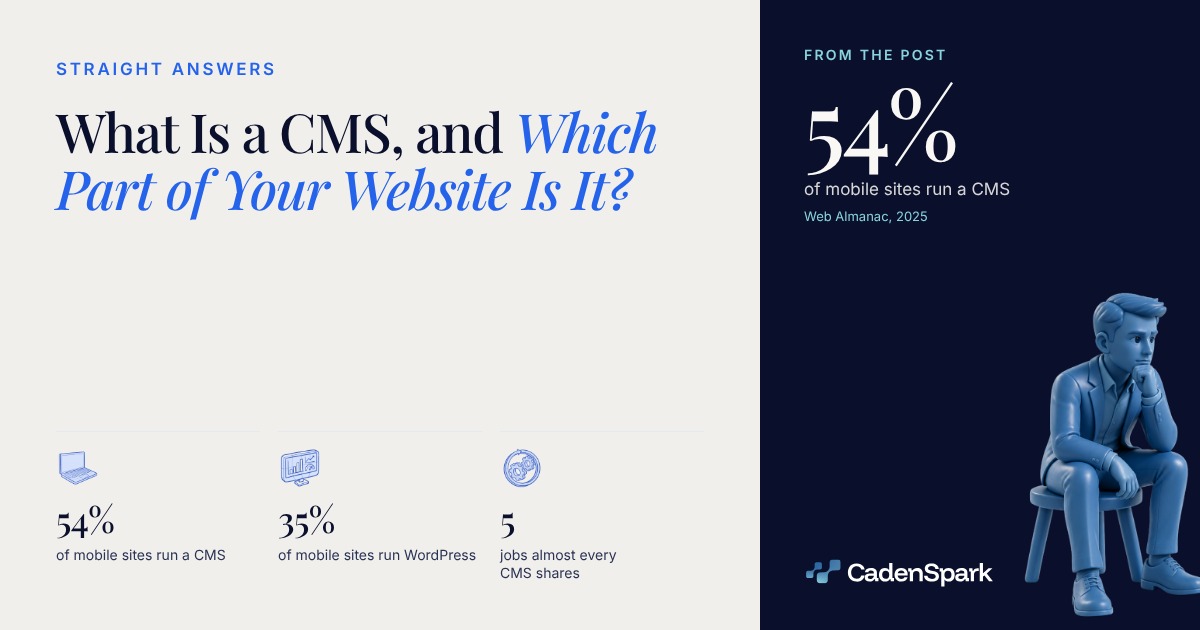
A little over half, and the share climbs every year: 54% of mobile sites and 55% of desktop sites in 2025, against 43% and 42% in 2021 (Web Almanac, 2025).
Mobile sites running a CMS
43% in 202154% in 2025
HTTP Archive’s five-year trend, mobile.
Desktop sites running a CMS
42% in 202155% in 2025
Desktop jumped in 2025 to take a 1-point lead over mobile.
View data
| Metric | Day zero → target |
|---|---|
| Mobile sites running a CMS | 43% in 2021 → 54% in 2025 |
| Desktop sites running a CMS | 42% in 2021 → 55% in 2025 |
HTTP Archive, Web Almanac 2025, CMS chapter · ten countries measured, mobile. Every country shown reads below the 54% global figure, and the chapter does not reconcile the two bases.
View data
| Item | Value |
|---|---|
| Italy | 51% |
| United States | 49% |
| United Kingdom | 49% |
| Brazil | 32% |
| Indonesia | 25% |
Which CMS are those sites running, and why do the numbers disagree?
WordPress, on 35% of all mobile sites. The same platform reads much higher when the denominator is only the sites that have a CMS, so read what each figure counts.
HTTP Archive, Web Almanac 2025, CMS chapter · one base for all three, all mobile sites. The chapter publishes the WordPress figure three times with three values (35%, 35.0% and 35.6%); this is the one from its year-over-year chart. Joomla and Drupal are described as in gradual decline, without a value.
View data
| Item | Value |
|---|---|
| WordPress | 35.6% |
| Wix | 2.8% |
| Squarespace | 1.5% |
54% of the mobile sites measured in 2025 run some CMS, up from 43% in 2021 (Web Almanac, 2025).
WordPress sits on 35% of all mobile sites, with Wix at 2.8% and Squarespace at 1.5% on that same base (Web Almanac, 2025).
WordPress is roughly 58% of CMS usage there, and Drupal 6% to 7% of CMS usage against about 1% overall (Web Almanac, 2025). That is a share of CMS usage, not of all sites.
Shopify’s highest reading is 5.0%, among the top 10 million sites, and the chapter notes that Shopify entered its CMS category this year (Web Almanac, 2025).
Which part of your website is the CMS, and which part is not?
The CMS stores and serves the content. The theme, the page builder and the plugins build the page a visitor gets. The chapter estimates that around 60% of WordPress sites add a page builder on top.
View data
| Piece | What happens |
|---|---|
| Door | Your service pages |
| Door | Photos of the work |
| Door | Prices and hours |
| Door | The quote form |
| Hub | The CMS stores it once — content, media and users in one place |
| Stage | The theme sets the layout — the part you did not write |
| Stage | The page builder arranges the blocks — Elementor leads at 43% of them (Web Almanac, 2025) |
| Stage | The plugins add the rest — forms, booking, tracking |
| Return | The page a visitor gets — your content, assembled by the three layers above it |
HTTP Archive, Web Almanac 2025, CMS chapter · published as adoption rates among page builders, and the chapter does not state that denominator in numbers. Beaver Builder is published as a steady share of around 2%.
View data
| Item | Value |
|---|---|
| Elementor | 43% |
| WordPress Block Editor | 18% |
| WPBakery | 13% |
| Divi | 10% |
| Beaver Builder | 2% |

What does a CMS not decide for you?
Your content, your structure and your editing habits. The chapter’s conclusion: outcomes depend less on the logo at the bottom of the site than on how well the tools fit the site and the team.
View data
| Step | Value |
|---|---|
| You write it | 01 (the words, the photos, the prices) |
| The CMS stores it | 02 (once, for every page that uses it) |
| Theme, builder and plugins assemble it | 03 (three layers you chose, not the CMS core) |
| Search and AI tools read it | 04 (LLM tools favor content that is regularly updated, clearly attributed and easy to extract (Web Almanac, 2025)) |
LLM-based tools favor content that is regularly updated, clearly attributed and easy to extract, says the chapter. None of that arrives with the software.
Platforms with native schema support tend to generate more consistent markup; those leaning on plugins or custom work vary more (Web Almanac, 2025).
The chapter calls it an assistive layer, uneven and mostly optional, and a workflow accelerator rather than a performance optimizer.
Editorial tools without guardrails produce inconsistent layouts, heavy pages, accessibility problems and outdated content, says the chapter. Whether the platform itself is what slows your site down is a separate question, and a measured one.
Name the layer before you pay anyone to change it. The CMS is the one a visitor never sees, and also what makes a site dynamic.
Questions owners ask
What is a CMS?
Software that lets people create and update the content of a website without editing code for every change (Web Almanac, 2025). It stores the content and serves it, and most CMSs separate content from presentation, so text, images and structure change without writing HTML, CSS or JavaScript.
Do most websites use a CMS?
Yes. 54% of mobile sites measured in 2025 run one, up from 43% in 2021, and desktop reads 55%, up from 42% (Web Almanac, 2025). The chapter also says sites without a CMS are declining every year.
Which CMS do most sites use?
WordPress, on 35% of all mobile sites measured, with Wix at 2.8% and Squarespace at 1.5% on the same base (Web Almanac, 2025). Inside the top 10,000 sites, WordPress is roughly 58% of CMS usage and Drupal 6% to 7% of it, against about 1% overall.
Is a page builder the same as a CMS?
No. The CMS holds the content; the page builder is a layer on top that arranges it. The chapter estimates around 60% of WordPress sites use one, with Elementor at 43% of them, and 5.0% of mobile pages run two layout systems at once (Web Almanac, 2025).
Sources
The first meeting starts with findings, not promises.The free Business Health Report reads your business and shows you what it found, in days.
Get Your Free Business Health Report