Partly. The platform sets the floor, not the ceiling. Every figure below covers the whole measured web, 16.2 million sites in HTTP Archive’s July 2025 crawl and 15.4 million of them mobile; nobody publishes any of this for service businesses alone.
Does your website platform decide how fast your site is?
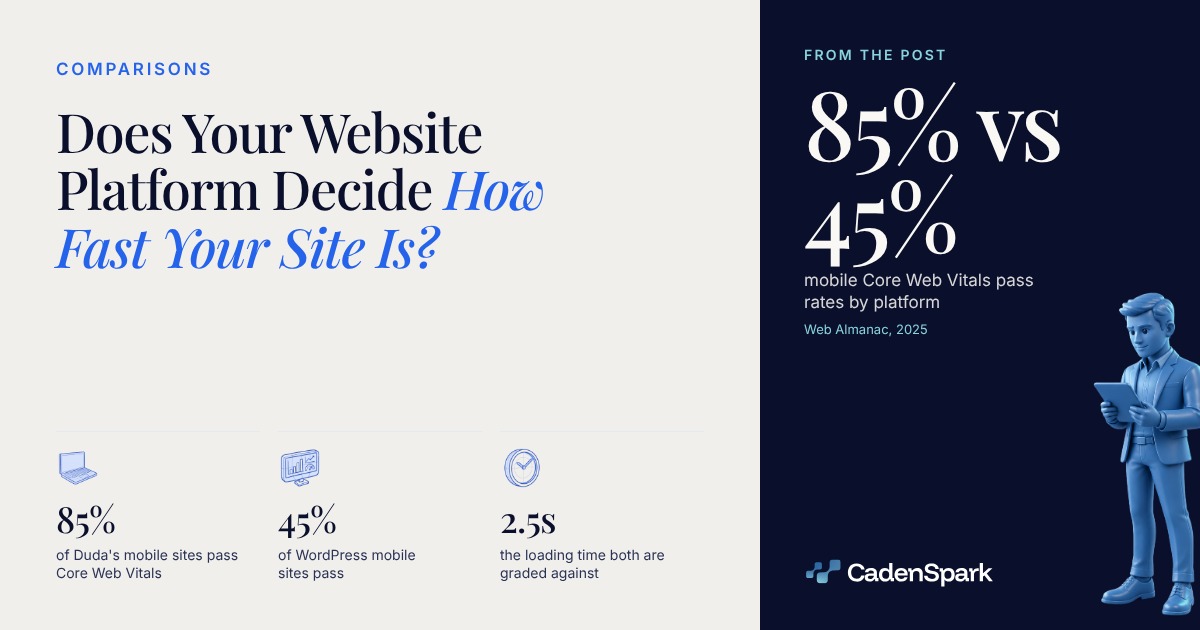
Partly. On mobile, the share of a platform’s sites passing Core Web Vitals runs from 45% to 85%, against 48% of mobile sites web-wide (Web Almanac, 2025).



HTTP Archive, Web Almanac 2025, CMS chapter · CrUX June 2025 data, sites where that platform was detected. The 48% web-wide figure is a different base and is not shown here.
View data
| Item | Value |
|---|---|
| Duda | 85% |
| TYPO3 | 79% |
| Wix | 74% |
| Weebly | 47% |
| WordPress | 45% |
The chapter’s own framing: the goal is not to crown a single fastest CMS. WordPress is also the most common choice, roughly 64% of CMS-driven sites (Web Almanac, 2025).
Which part of the experience differs most?
Loading. Good loading on mobile runs from 52% to 94% of a platform’s sites; layout stability and responsiveness sit in tighter bands (Web Almanac, 2025).
HTTP Archive, Web Almanac 2025, CMS chapter · CrUX June 2025 data, mobile
View data
| Item | Value |
|---|---|
| Duda | 94% |
| TYPO3 | 89% |
| Wix | 81% |
| Tilda | 56% |
| WordPress | 53% |
| Weebly | 52% |
HTTP Archive, Web Almanac 2025, CMS chapter · CrUX June 2025 data, mobile. WordPress and Joomla are published as around the 84% mark.
View data
| Item | Value |
|---|---|
| Wix | 95% |
| Duda | 93% |
| Squarespace | 89% |
| WordPress | 84% |
| Joomla | 84% |
| Weebly | 58% |
Each range below is our reading of the three published figures, not a figure the chapter states.


Do the platforms differ on SEO too?
Barely. Median Lighthouse SEO is 92 on every platform the chapter measures and 100 on two of them, with no gap between desktop and mobile (Web Almanac, 2025).
HTTP Archive, Web Almanac 2025, CMS chapter · ten platforms measured, identical on desktop and mobile. Lighthouse is a lab test run on a server, not a ranking factor.
View data
| Item | Value |
|---|---|
| Wix | 100 |
| Webflow | 100 |
| WordPress | 92 |
| Shopify | 92 |
| Drupal | 92 |
| Duda | 92 |
| Joomla | 92 |
Median Lighthouse SEO is 92 on every platform in the chapter, 100 on Wix and Webflow, and the score does not move between desktop and mobile (Web Almanac, 2025).
Median mobile Lighthouse performance is 64 at the top, 41 for WordPress, and the lowest platform medians land between 30 and 32 (Web Almanac, 2025).
The chapter’s own caveat: these lab scores are best read as context, not as a proxy for real-user experience.
Core Web Vitals come from Chrome users in June 2025, not from a test run on request. Here is what a website audit actually checks.
Is a heavier platform the same as a slower site?
No. The heaviest median page in the chapter belongs to Squarespace, and Squarespace also leads responsiveness at 96% of its mobile sites (Web Almanac, 2025).
HTTP Archive, Web Almanac 2025, CMS chapter · five platforms measured, mobile, 50th percentile. Values in kilobytes.
View data
| Item | Value |
|---|---|
| Squarespace | 3974 |
| Joomla | 2900 |
| WordPress | 2894 |
So should you move your site to another platform?
Only if the platform is what holds you back. Two sites on the same CMS can have very different transfer sizes, and the chapter credits themes, plugins and third-party tools, not the core.
- 01Measure your own pages firstCore Web Vitals come from real visitors. Your own field data is the only number that describes your site. A platform median describes a million other sites.
- 02List what you would carry overThemes, plugins, page builders, embeds, tracking scripts and images. The chapter attributes most of the variation inside one platform to exactly those.
- 03Check the pages that bring the workWeb-wide, 45% of mobile home pages pass Core Web Vitals against 56% of secondary pages (Web Almanac, 2025). Your service and location pages are not your home page.
- 04Price the forms and the trackingA migration moves the content. The quote form, the call tracking and the analytics are separate work, and they are what your leads actually run through.
- 05Keep the URLsSame paths, or a redirect for every one that changes. Nothing else on this list matters if the pages that already rank stop resolving.
Platform-wide, mobile pass rates run from 45% to 85% (Web Almanac, 2025). You start from a different median, which is a floor and not a result.
The server and the delivery stack come with the platform. That is the part of the page you were never going to edit yourself.
Median mobile page weight already runs from 2,894 KB to 3,974 KB across the five platforms measured, and the heaviest of them leads on responsiveness (Web Almanac, 2025).
Two sites on the same CMS can have very different transfer sizes, says the chapter, because of themes, plugins, page builders and third-party tools.
- 01Measure what you have
- 02Fix what you installed
- 03Move only if it is the platform
- 04Measure again
The platform sets your starting point. What gets installed on top of it decides where you land. Measure your own pages first, against the thresholds a site is graded on.
Questions owners ask
Which website platform is the fastest?
There is no single answer, and the Web Almanac says the goal is not to crown one. On mobile, 85% of Duda’s sites and 74% of Wix’s pass Core Web Vitals, against 45% for WordPress (Web Almanac, 2025).
Does my platform hurt my SEO?
Not on the basics. Median Lighthouse SEO is 92 on every platform in the chapter and 100 on two of them, identical on desktop and mobile (Web Almanac, 2025). Lighthouse is a lab test, not a ranking factor.
Will moving to a new platform make my site fast?
It changes the defaults and the hosting. It does not change the themes, plugins, embeds and images you carry over, and the chapter attributes most of the variation to exactly those (Web Almanac, 2025).
Is WordPress a bad choice?
It is the most common one, roughly 64% of CMS-driven sites (Web Almanac, 2025). Its 45% mobile pass rate sits close to the 48% web-wide average, and the chapter ties the spread inside WordPress to configuration, not core.
Sources
- HTTP Archive, Web Almanac 2025, CMS chapter (July 2025 crawl, mobile; Core Web Vitals from CrUX, June 2025 data; read from the chapter's source text, commit 46992bf, October 23, 2026) (2025)
- HTTP Archive, Web Almanac 2025, Performance chapter (July 2025 crawl; Core Web Vitals from CrUX) (2025)
- HTTP Archive, Web Almanac 2025, Methodology (16,213,084 sites in the dataset; 15,426,398 mobile; CrUX release of July 11, 2025, covering June 2025) (2025)
- Google, web-vitals library source code (LCP, INP and CLS thresholds, v6.2.3) (2026)
The first meeting starts with findings, not promises.The free Business Health Report reads your business and shows you what it found, in days.
Get Your Free Business Health Report