




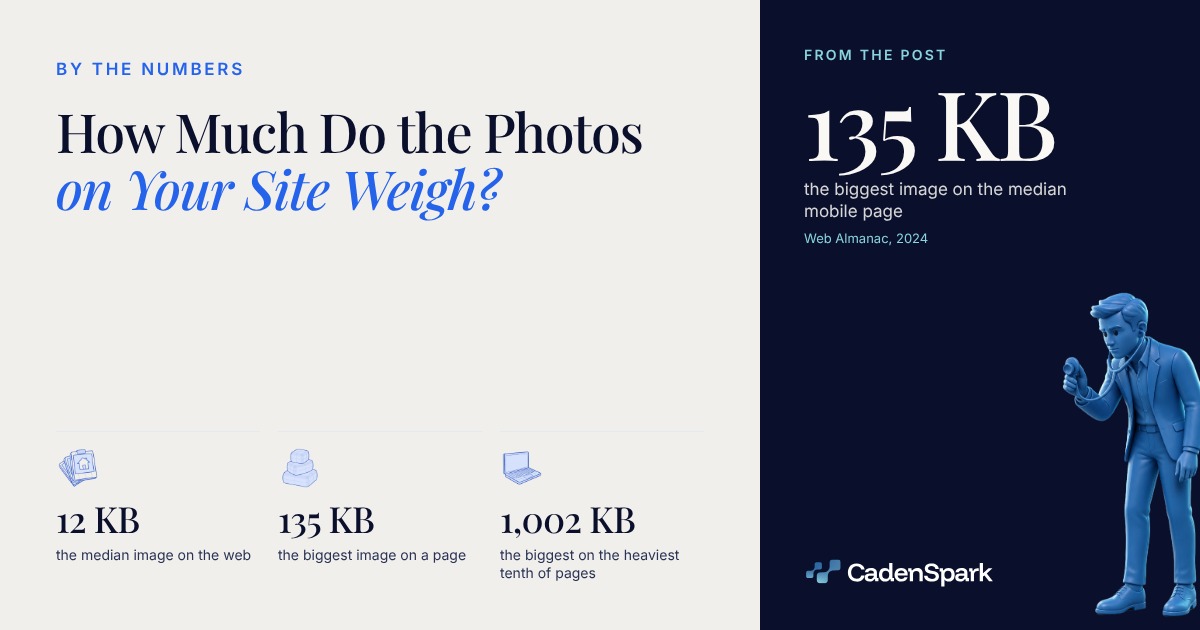
The median mobile homepage loads 900 KB of images, one of them 135 KB on its own (Web Almanac, 2024). On a service site, that file is usually a job photo.
How much does one photo on a website weigh?
The median image weighs 12 KB, but that counts icons and tracking pixels. The honest number is the largest image on a page: 135 KB at the median (Web Almanac, 2024).



That biggest image is up 8% since 2022.
Web Almanac 2024 · HTTP Archive crawl of June 2024, mobile crawler
View data
| Item | Value |
|---|---|
| 25th percentile | 37 |
| Median | 135 |
| 75th percentile | 404 |
| 90th percentile | 1002 |
How much do all the photos on one page weigh?
Nine hundred kilobytes on the median mobile homepage, more than JavaScript, fonts, CSS and HTML put together (our sum of the Almanac’s 2024 figures).
Web Almanac 2024 · HTTP Archive crawl of June 2024, video excluded
View data
| Item | Value |
|---|---|
| Images | 900 |
| JavaScript | 558 |
| Fonts | 111 |
| CSS | 73 |
| HTML | 18 |
Weight is paid in load time, and those 111 KB of fonts are their own question.
Which page carries the photos, the home or the gallery?
Today the home: 900 KB against 348 KB on the median inner page, and 20 images against 14 (Web Almanac, 2024). A gallery inverts that.
Web Almanac 2024 · HTTP Archive crawl of June 2024, median page
View data
| Item | Value |
|---|---|
| Homepage | 900 |
| Inner page | 348 |
Why is the file heavier than the space it fills?
Because the browser downloads the whole file and the CSS shrinks it afterwards. Only 7% of images keep their own width (Web Almanac, 2024).
The biggest image on the median mobile page is 0.54 megapixels, about 735 by 735 (Web Almanac, 2024).
View data
| Step | Value |
|---|---|
| The camera file | 01 (more pixels than any screen slot needs) |
| Uploaded as it came | 02 (full width, full weight) |
| CSS shrinks it on screen | 03 (the slot is smaller than the file) |
| The visitor paid for both | 04 (pixels downloaded, then discarded) |

Tell the browser the wrong slot width and it picks the heavier file. The Almanac calls the waste below estimated.
Web Almanac 2024 · HTTP Archive crawl of June 2024. The Almanac declares these estimated: its crawlers loaded the incorrect resources, so the figures are derived from compression densities and aspect ratios.
View data
| Item | Value |
|---|---|
| Desktop, 90th pct | 920 |
| Mobile, 90th pct | 400 |
| Desktop, 75th pct | 179 |
| Mobile, 75th pct | 55 |
Does the file format change the weight?
Yes. At the 90th percentile a desktop JPG weighs 274 KB and an AVIF 45 KB (Web Almanac, 2024). Those are percentiles of what sites publish.
Web Almanac 2024 · HTTP Archive crawl of June 2024, percentiles of published files rather than one photo re-encoded
View data
| Item | Value |
|---|---|
| JPG | 274 |
| PNG | 196 |
| WebP | 116 |
| AVIF | 45 |
Web Almanac 2024 · HTTP Archive crawl of June 2024. JPEG fell from 40% in 2022.
View data
| Item | Value |
|---|---|
| JPEG | 32.4% |
| PNG | 28.4% |
| GIF | 16.8% |
| WebP | 12% |
| SVG | 6.4% |
| AVIF | 1% |
What do you do with the photos of a finished job?
Measure the slot, resize to it, pick a modern format, and lazy load everything except the first photo.
- 01Measure the slot on screenOpen the gallery on a phone and note how wide one photo actually renders. That width, not the camera’s, is the target.
- 02Resize to the slotExport at the slot width, doubled for dense screens. Everything past that is weight the visitor pays for and never sees.
- 03Pick a modern formatAt the 90th percentile a desktop JPG runs 274 KB and an AVIF 45 KB (Web Almanac, 2024). Keep a JPG fallback for older browsers.
- 04Lazy load all but the firstNative lazy loading is on a third of all websites (Web Almanac, 2024). Leave the top photo out of it.
9.5% of the images responsible for the largest paint on mobile are lazy loaded, which the Almanac calls an anti-pattern because it makes the page slower (Web Almanac, 2024).
42% of pages now use srcset, up from 34% in 2022, but 1 in 5 desktop sizes attributes is wrong enough to make the browser pick the heavier file (Web Almanac, 2024).
Only 7% of images keep their own width (Web Almanac, 2024). One export reused in a thumbnail, a gallery and a hero is three wrong sizes.
The Almanac measures the web at large, not service companies. No public source weighs the photos a contractor uploads, and this post will not invent one.
The Almanac measures the web at large, not service businesses. A file straight off a camera sits above the 90th percentile it did measure: 1,002 KB, 3.13 megapixels.
- 01Count the photos
- 02Resize to the slot
- 03Change the format
- 04Lazy load the rest
Open your own gallery and compare the file sizes to 135 KB. The photo earns its weight only if the page arrives.
Questions owners ask
How much should a photo on my website weigh?
No published standard exists, but the measured web gives a ceiling: the biggest image on the median mobile page weighs 135 KB, and the heaviest tenth carry one near 1,002 KB (Web Almanac, 2024). Above that, you are heavier than 90% of the web.
Is my website slow because of images?
Often yes: images are the heaviest resource type on the median mobile homepage, 900 KB against 558 KB of JavaScript (Web Almanac, 2024). Weigh your own page before you blame anything else.
What size should I upload job photos at?
Match the slot. Only 7% of images keep their own width and 70% are scaled by CSS (Web Almanac, 2024), so the browser downloads pixels it throws away. The biggest image on the median mobile page is about 735 by 735.
Does converting photos to WebP or AVIF help?
The measured web says lighter formats carry lighter files: at the 90th percentile a desktop JPG weighs 274 KB and an AVIF 45 KB (Web Almanac, 2024). That compares what sites publish, not one photo encoded twice, so treat it as direction.
Sources
The first meeting starts with findings, not promises.The free Business Health Report reads your business and shows you what it found, in days.
Get Your Free Business Health Report