




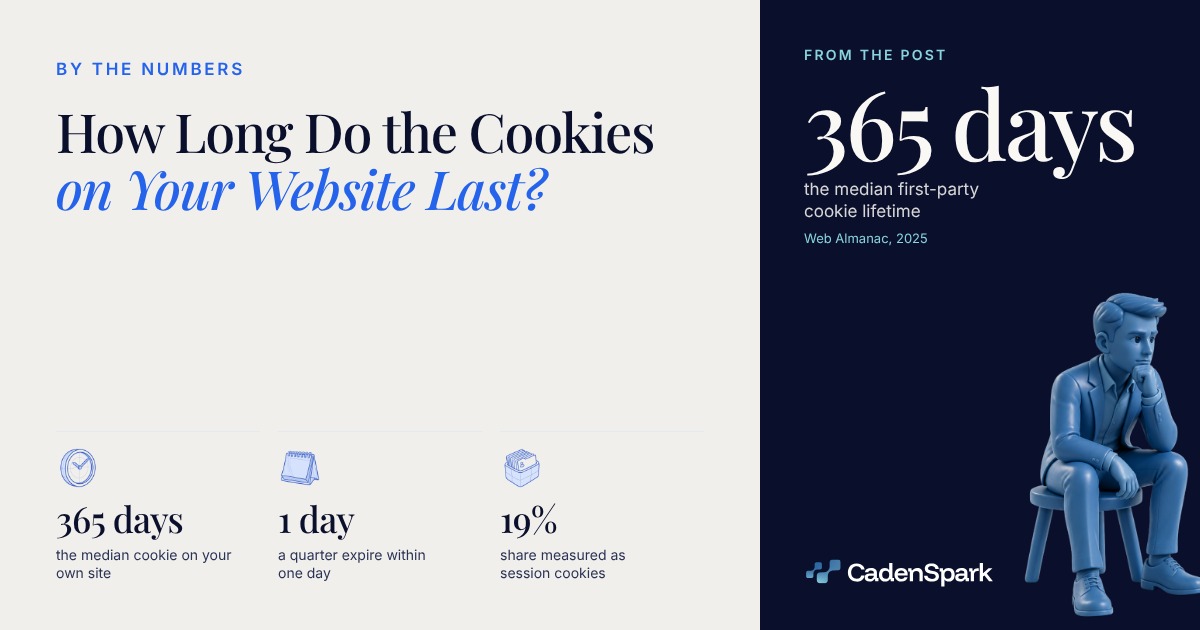
Close to a year. The median cookie a site sets itself expires 365 days out and the median third-party cookie 360, measured across the top one million sites in the July 2025 HTTP Archive crawl (Web Almanac, 2025). The median hides the half that matters: a quarter of first-party cookies are gone within a day.
How long does a cookie on your website last?
About 365 days for the cookies your own domain sets, and 360 days for the ones another company sets through your pages. Both are desktop medians.



What the number is
how long a cookie remembers a visitorthe expiry date it was written with
The chapter measures the attribute, not how long the cookie survives a real browser.
What the sample is
your sitethe top one million sites by CrUX rank
HTTP Archive crawl of July 2025 (Web Almanac, 2025).
View data
| Metric | Day zero → target |
|---|---|
| What the number is | how long a cookie remembers a visitor → the expiry date it was written with |
| What the sample is | your site → the top one million sites by CrUX rank |
View data
| Step | Value |
|---|---|
| A session cookie | 0 days (no expiry date at all; 19% of first-party cookies) |
| The soonest quarter | 1 day (the 25th percentile on your own domain) |
| The median | 365 days (the cookie a site sets itself) |
| The browser’s ceiling | Capped (a hard cap Chrome imposes on expiry attributes) |
Which cookies expire fast, and which stick around?
The spread sits below the median, not at it. The soonest quarter of first-party cookies is gone in a day, while three in four third-party cookies outlive 30 days.


A quarter of the cookies measured expire in that window or sooner. It is not an average, and it is where the short-lived ones sit.
Most first-party and third-party cookies are not ephemeral and have a median age of a full year (Web Almanac, 2025).
In the chapter’s words, the longer cookies live, the longer they can be used for re-identification or cross-site tracking.
The longest expiry the survey can observe is fixed by a hard cap Chrome imposes on cookie expiry attributes, not by the site. Who sets the cookies on your pages is a separate count.
Web Almanac, 2025 · our arithmetic on the chapter’s published percentiles
View data
| Stage | Value |
|---|---|
| first-party cookies measured on the top one million sites | 100 |
| carry an expiry date at all, since 19% are session cookies | 81 |
| are written to outlive a single day, the 25th percentile | 75 |
| are written to outlive a full year, the median | 50 |
Which cookies disappear when the visitor closes the browser?
Session cookies do. They carry no expiry date at all: 19% of first-party cookies and 7% of third-party ones on desktop, 5% on mobile.
Web Almanac, 2025 · Cookies chapter · top one million sites, July 2025 crawl
View data
| Item | Value |
|---|---|
| First-party, both clients | 19% |
| Third-party, desktop | 7% |
| Third-party, mobile | 5% |
Session cookies are valid for a single user session and expire once the visitor quits the website they were set on or closes the browser, whichever happens first (Web Almanac, 2025).
The other 81% of first-party cookies carry one. That subtraction is ours, on the chapter’s 19%.
The chapter counts the attribute, not the reason it was set that way. No published figure splits it by intent.
Does the device change how long a cookie lasts?
Almost never. One cell moves: the median third-party cookie expires 270 days out on mobile against 360 on desktop, and the first-party median is 365 on both.
Web Almanac, 2025 · top one million sites, July 2025 crawl
View data
| Item | Value |
|---|---|
| First-party, desktop | 365days |
| First-party, mobile | 365days |
| Third-party, desktop | 360days |
| Third-party, mobile | 270days |
The cell that moves
360 days on desktop270 days on mobile
The third-party median expiry (Web Almanac, 2025).
The cell that does not
365 days on desktop365 days on mobile
The first-party median expiry, identical on both (Web Almanac, 2025).
What the chapter says about the gap
an explanationnothing
It reports rarely observing any significant difference between the two types of devices.
View data
| Metric | Day zero → target |
|---|---|
| The cell that moves | 360 days on desktop → 270 days on mobile |
| The cell that does not | 365 days on desktop → 365 days on mobile |
| What the chapter says about the gap | an explanation → nothing |
What is in a cookie that lasts a year?
Around 41 bytes on your own domain. That is room for an identifier, not for a record of the visitor, and the ceiling is 4,096 bytes.
Web Almanac, 2025 · top one million sites, July 2025 crawl
View data
| Item | Value |
|---|---|
| 25th percentile | 29bytes |
| Median | 41bytes |
| 75th percentile | 67bytes |
| 90th percentile | 157bytes |
- 01Which ones does the site set itselfYour own domain writes the first-party cookies. Everything else arrived with something embedded in the page.
- 02How long is each one written forThe expiry attribute is the whole answer. A quarter of first-party cookies are written for a day or less (Web Almanac, 2025).
- 03Does anything here need a yearThe longer a cookie lives, the longer it can be used for re-identification or cross-site tracking (Web Almanac, 2025).
- 04Who wrote the restAnything your domain did not set came in with a third party, and that is a different count.
Read your own list before you read the web’s median. The consent side of the same list is its own question for a US-only site.
Questions owners ask
How long do cookies last?
A median of 365 days for the cookies a site sets itself and 360 for third-party ones on desktop, across the top one million sites in the July 2025 crawl. The soonest quarter of first-party cookies expires within a day.
Do cookies expire on their own?
Some end the moment the visit does. Session cookies carry no expiry date and die when the visitor leaves the site or closes the browser, whichever comes first: 19% of first-party cookies and 7% of third-party ones on desktop.
How much data fits in a cookie?
Not much. The median first-party cookie is 41 bytes and the ceiling is 4,096 bytes, the limit RFC 6265 defines. That is room for an identifier, not for a record of the visitor.
Does this measure my site?
No. These are the top one million sites by CrUX rank in one crawl, not broken out by industry, so no figure here is about service businesses specifically. It is the shape of the web your visitor’s browser already carries.
Sources
The first meeting starts with findings, not promises.The free Business Health Report reads your business and shows you what it found, in days.
Get Your Free Business Health Report