




 Google
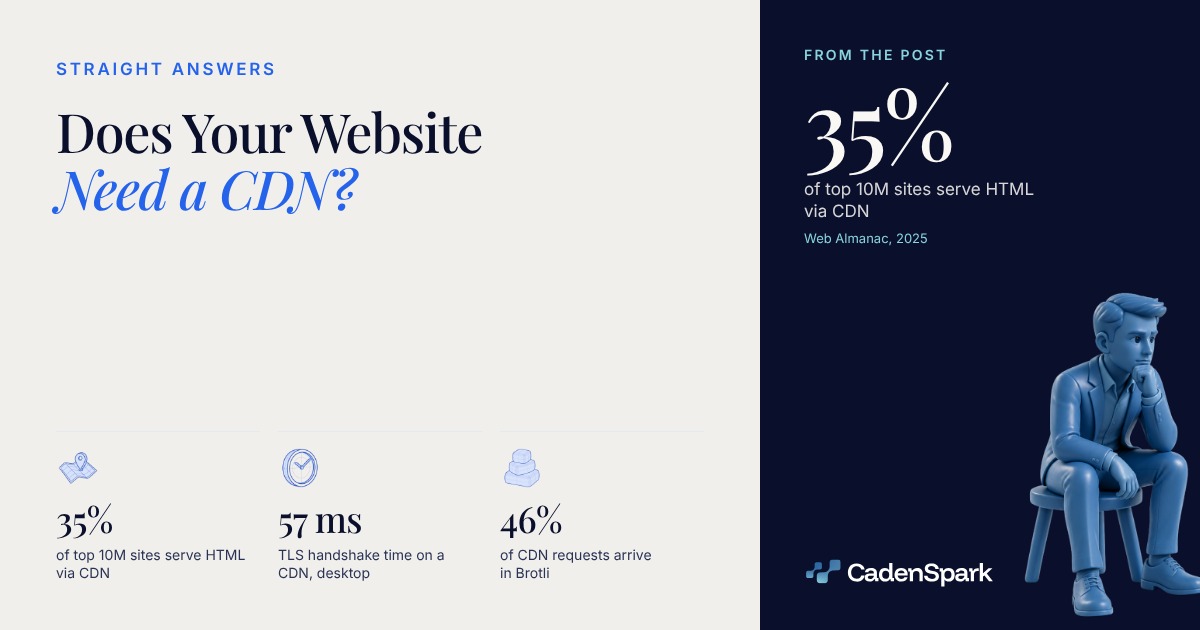
Probably not as the next thing you buy, and you may already have one. Among the top 10 million sites, 35% serve their HTML through a CDN, against 71% of the top 1,000 (Web Almanac, 2025). What it measurably changes is the start of the connection, not the weight of your page.
Does your website need a CDN?
Almost nobody decides this from scratch. Adoption tracks popularity: 71% among the top 1,000 sites, 35% among the top 10 million.



HTTP Archive, Web Almanac 2025 · mobile, July 2025 crawl. The buckets are cumulative, not bands: the top 1 million includes the top 1,000. Measured on the main document request.
View data
| Item | Value |
|---|---|
| Top 1,000 | 71% |
| Top 10,000 | 70% |
| Top 100,000 | 62% |
| Top 1 million | 49% |
| Top 10 million | 35% |
The chapter credits free and bundled tiers for the rise among smaller sites: HTML on a CDN went from 33% of requests in 2024 to 35% in 2025.
What does a CDN actually change?
The first milliseconds of the connection. Desktop TLS negotiation ran a median 57 ms through a CDN against 177 ms from origin in the Almanac’s lab test.
HTTP Archive, Web Almanac 2025 · July 2025 crawl, measured from a datacenter with an empty cache and no session resumption. The chapter calls that over three times faster.
View data
| Item | Value |
|---|---|
| Origin, 90th | 277ms |
| Origin, median | 177ms |
| CDN, 90th | 89ms |
| CDN, median | 57ms |


Origin requests served effectively no HTTP/3 at all, and HTTP/1.1 on CDN HTML fell from 16% in 2024 to 2%. Nearly all CDN traffic is on TLS 1.3, which is a version and a handshake, not what the padlock proves.
Does a CDN make the page smaller?
No. It changes which compression arrives. On mobile, CDN requests came 46% Brotli, 42% gzip and 12% Zstandard, while origins served 61% gzip.
HTTP Archive, Web Almanac 2025 · share of compressible requests on mobile, July 2025 crawl
View data
| Item | Value |
|---|---|
| Origin gzip | 61% |
| CDN Brotli | 46% |
| CDN gzip | 42% |
| Origin Brotli | 39% |
| CDN Zstandard | 12% |
46% of CDN requests against 39% from origin servers. The chapter describes Brotli as 20 to 26% better than gzip, without measuring that in this dataset.
61% of origin requests, the same majority the chapter reported in 2024 (Web Almanac, 2025).
The chapter reports it on the CDN side only (Web Almanac, 2025).
Compression is how the same file travels. The images, the scripts and the page weight are still what you shipped.
Who is serving the web’s HTML?
A short list. Of the HTML already served through a CDN on mobile, Cloudflare carried 58%, Google 21% and Amazon CloudFront 7%.
HTTP Archive, Web Almanac 2025 · base is the HTML already served through a CDN, July 2025 crawl. The chapter states this shows usage patterns among crawled sites, not true market distribution.
View data
| Item | Value |
|---|---|
| Cloudflare | 58% |
| 21% | |
| Amazon CloudFront | 7% |
| Fastly | 5% |
| Akamai | 2% |
| Vercel | 2% |
A CDN is already doing more for other people’s scripts on your page than for your own HTML. The third-party share fell from 75% in 2024 to 71% in 2025.
What is this measurement not telling you?
Four things, and the chapter declares all four. The biggest two: it is a lab test from a datacenter, and the CDN detection undercounts.
16,213,084 sites crawled in July 2025 from a datacenter, with an empty cache and nobody logged in. Not what your visitors experience.
It reads DNS chains and HTTP headers, so anycast addresses and multi-CDN setups stay hidden. Every CDN share here is a floor, not a ceiling.
The chapter says so in its own caveats, and it ranks no provider by any business outcome.
It sets its own 69% HTTP/3 figure for Cloudflare resources against the roughly 21% global adoption Cloudflare published for 2025.
- 01Do I already have oneMany hosting plans bundle a CDN now, which is what the chapter credits for the rise among smaller sites (Web Almanac, 2025).
- 02What is it servingHTML on a CDN is the exception at 35% of requests. Static files and third-party assets are the common case, at 52% and 71% (Web Almanac, 2025).
- 03Which compression arrivesBrotli reached 46% of CDN requests against 39% from the origin. Check what your own pages get (Web Almanac, 2025).
- 04Then test it yourselfThe chapter tells owners to run their own controlled performance testing, because its numbers come from one datacenter.
Ask your host before you buy anything. A CDN tightens the handshake and the compression; the page you shipped is still the page they wait for, and that is where the seconds live.
- 01Ask if your host includes one
- 02Turn it on for static files
- 03Check the compression
- 04Then look at the page
Questions owners ask
Does my website need a CDN?
Most sites run without one. Among the top 10 million sites, 35% serve their HTML through a CDN, against 71% of the top 1,000 (Web Almanac, 2025). The practical question is usually whether your host already includes one.
What does a CDN actually speed up?
The start of the connection. In the Almanac’s lab test, desktop TLS negotiation ran a median 57 ms through a CDN against 177 ms from origin, and DNS resolved in 52 ms against 129 ms (Web Almanac, 2025). Those are datacenter measurements.
Will a CDN fix a slow website?
Nothing in the data says so. A CDN changes delivery: the protocol, the handshake and the compression. The weight of the page, the images and the scripts stay exactly as you shipped them.
Do I get better security with a CDN?
You get newer defaults, not more security. For third-party requests, 96% of those through a CDN used TLS 1.3 against 78% from origin servers (Web Almanac, 2025). The chapter notes that counting headers is not a proxy for security posture.
Sources
The first meeting starts with findings, not promises.The free Business Health Report reads your business and shows you what it found, in days.
Get Your Free Business Health Report