




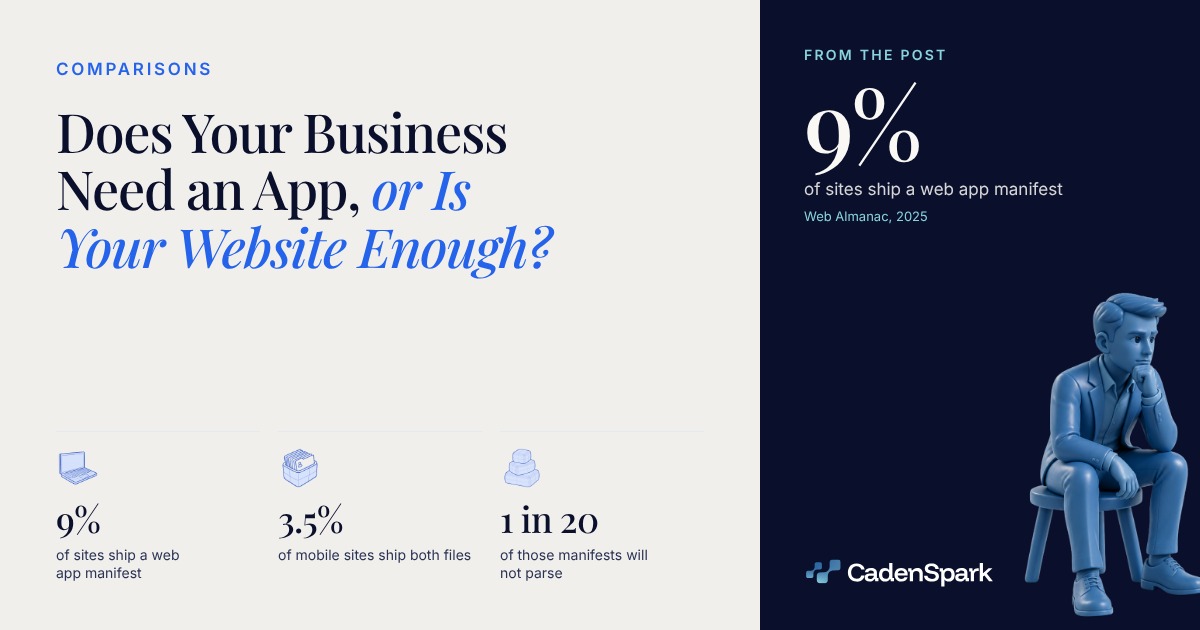
Almost always the website is enough, and the app part is a file you add to it. Across 16,213,084 sites crawled in July 2025, about 9% ship a web app manifest, the file that lets a browser offer to install a site (Web Almanac, 2025).
Does your business need an app, or is your website enough?
For a service company, the website. The icon on someone’s phone comes from a file added to the site you already own, not from a second product with its own store listing.



This is the part the web already does. A manifest plus HTTPS is what makes Chrome and Edge offer to install your site (Web Almanac, 2025).
A separate question, answered below, and mostly decided at the permission prompt rather than by the app.
That is a service worker, a second file. Only 3.5% of mobile sites ship both it and a manifest (Web Almanac, 2025).
The only one of the four a website cannot do, and the only one that brings an account, a review and a second product to maintain.
What does an app do that your website doesn’t?
Three things people usually mean: an icon, notifications, and working without a connection. The web does the first with one file. The other two come with asterisks.
Your site turns up in a search and opens from a text with one tap. An app has to be installed before it can do anything at all.
A manifest served over HTTPS is enough for Chromium browsers to show an install badge (Web Almanac, 2025). Safari does not prompt for installation.
Their own question, with their own numbers. Read do push notifications work for a local business before planning around them.
The service worker does that, and it is a second file: 3.5% of mobile sites ship both (Web Almanac, 2025).
View data
| Step | Value |
|---|---|
| A search or a text, one tap | Today (your site opens; nothing installed, nothing created) |
| Find it in a store | With an app (they have to be looking for you by name already) |
| Install it and open it | Then (a download, often a login, space on the phone) |
| They book | Only then (the same booking they could have made in step one) |
How many websites already ship the app part?
About one in ten. And the manifests that do exist are filled in much the same way: a name, icons and a display mode, with the functional fields thinning out fast.
Web Almanac, 2025 · 16.2 million sites, July 2025 crawl · base: manifests found, mobile
View data
| Item | Value |
|---|---|
| name | 93% |
| icons | 91% |
| short_name | 85% |
| display | 85% |
| start_url | 68% |
| scope | 35% |
| description | 27% |

What makes a site installable, and what breaks it?
A manifest file served over HTTPS. Chromium dropped the service worker requirement; Safari never prompts, and on an iPhone the visitor does it by hand from the Share menu.
- 01Serve the site over HTTPSStill required. The rest of the old trifecta is not.
- 02Link a manifest fileOne small file referenced from the page. Service workers are no longer required for Chrome and Edge to show the install prompt (Web Almanac, 2025).
- 03Give it a name and iconsThe two fields almost every manifest has: name in 93% and icons in 91% of mobile manifests (Web Almanac, 2025).
- 04Set start_url and displaystart_url is in 68% of mobile manifests and display in 85% (Web Almanac, 2025). The first decides what opens when someone taps the icon.
About 1 in 20 of the manifests found cannot be read (Web Almanac, 2025), and the browser then has nothing to offer.
The icons field is in 91% of mobile manifests, so nearly one in ten has nothing to put on a home screen (Web Almanac, 2025).
About 32% of mobile manifests leave it out (Web Almanac, 2025), so the icon can open on whatever page the visitor happened to install from.
Safari does not prompt at all (Web Almanac, 2025). iOS relies on a manual Safari-driven install flow, which the Capabilities chapter says limits uptake.
When is a native app the right call, and what does it cost?
When people who already know you use the thing over and over. The bill starts with a developer account and a review that rejects apps which are only a repackaged website.

Apple asks that an app "include features, content, and UI that elevate it beyond a repackaged website" (Apple, App Store Review Guidelines, guideline 4.2, read November 13, 2026).
The app and the site both need updating, and the day they drift apart the phone number on one of them is wrong.
A price or an address you fix on the site is live in minutes. In an app it goes out when the store says so.
Nobody publishes how many service businesses have an app or how many of those get installed, so that demand is yours to prove before you build.
Open your own site on a phone and look for an install option. If it is not offered, the fix is a file, not a second product. First make sure a visitor can reach you in one tap.
- 01Open your site on a phone
- 02Look for the install option
- 03Fix the manifest if it is missing
- 04Ask the app question again in a year
Questions owners ask
Does my small business need an app?
Almost certainly not as a first move. The web app manifest, the file that lets a browser put your site on a home screen, was on roughly 9% of 16.2 million sites crawled in July 2025 (Web Almanac, 2025).
Can a website have an icon on a phone?
Yes. Chrome and Edge offer to install a site that links a manifest and is served over HTTPS; the service worker that used to be required no longer is (Web Almanac, 2025). On an iPhone it is a manual flow through Safari’s Share menu.
Will an app let me send notifications?
That is a separate question with its own numbers, and most of it is decided at the permission prompt rather than by the app itself. Read our post on push notifications for a local business before you plan around them.
What does putting an app in a store cost?
A developer account before a line of code: Apple’s is a $99 annual membership (Apple, 2026). Apple’s review guidelines also ask that an app elevate itself beyond a repackaged website, so wrapping your site is not a safe plan.
Sources
- HTTP Archive, Web Almanac 2025, PWA chapter (16,213,084 sites, of which 15,426,398 mobile and 12,155,374 desktop; July 1, 2025 crawl; chapter source read November 13, 2026) (2025)
- HTTP Archive, Web Almanac 2025, Capabilities chapter (same crawl; install prompts and the manual iOS flow) (2025)
- HTTP Archive, Web Almanac 2025 Methodology (sample size and crawl date) (2025)
- Apple, Apple Developer Program enrollment page, $99 annual membership (2026)
- Apple, App Store Review Guidelines, guideline 4.2 Minimum Functionality (2026)
The first meeting starts with findings, not promises.The free Business Health Report reads your business and shows you what it found, in days.
Get Your Free Business Health Report