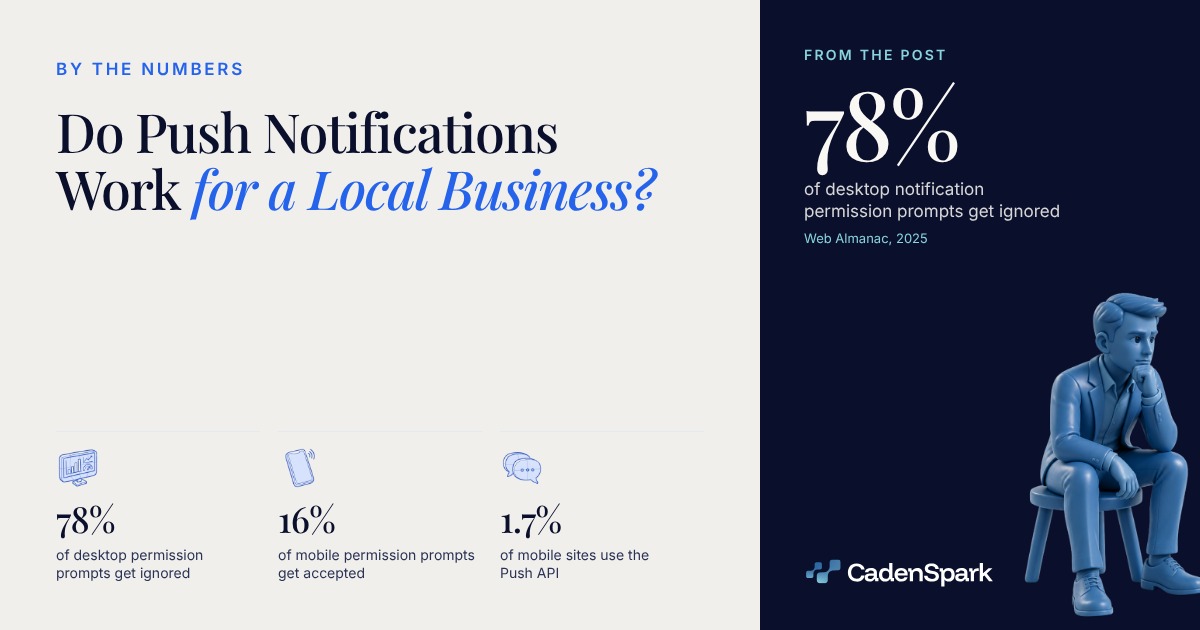
Rarely, and the figure everyone quotes is about the permission prompt, not the notification. On sites that already run a service worker, 78% of desktop prompts are ignored and 6% accepted (Web Almanac, 2025).
Do push notifications work for a local business?
Rarely. What the web measures is the ask: 78% of desktop permission prompts are ignored and 6% accepted, against 48% ignored and 16% accepted on mobile (Web Almanac, 2025).



Those shares are percentiles across origins, and the chapter does not state which percentile it plots.
HTTP Archive, Web Almanac 2025 · origins running a service worker, Chrome usage data for June 2025 · percentiles across origins
View data
| Item | Value |
|---|---|
| Desktop, ignored | 78% |
| Mobile, ignored | 48% |
| Mobile, accepted | 16% |
| Desktop, accepted | 6% |
How many websites even send them?
Almost none. The Push API appears on 1.7% of mobile sites and 1.6% of desktop sites in HTTP Archive’s July 2025 crawl of 16.2 million sites.
HTTP Archive, Web Almanac 2025 · all sites crawled, July 2025 · Add to Home Screen is the API a site calls, not people installing anything
View data
| Item | Value |
|---|---|
| Async Clipboard | 17.9% |
| Web Share | 9.6% |
| Add to Home Screen | 6.8% |
| Push | 1.7% |
The plumbing is far more common than the push: 20.0% of mobile pages and 20.5% of desktop pages are controlled by a service worker, up from 1.4% in 2022, and about a quarter of crawled sites have one or a manifest file. Of those, about 7% register for push.


Will a push notification reach someone on an iPhone?
Only if they saved your site to their Home Screen. Safari on iOS has had the Push API since 16.4, and only for web apps saved to the home screen.
MDN’s compatibility data: in the iOS WebView, the one inside other apps, the Push API is not supported at all. On desktop, Safari has it from version 16, with notifications supported on macOS Ventura and later.
View data
| Step | Value |
|---|---|
| Open the site | 01 (in Safari on iOS) |
| Add to Home Screen | 02 (from the Share menu) |
| Open it from the icon | 03 (not from a browser tab) |
| Push can arrive | 04 (iOS 16.4 and later) |
- 01Open your site in Safari on an iPhoneNot Chrome, not a browser inside another app. Safari is the behavior you are testing.
- 02Share, then Add to Home ScreenIf the option is awkward to find or the icon comes out blank, your manifest is the thing to fix first.
- 03Open it from the icon and ask the real questionWould a stranger have done those three steps for a plumber they found this morning? That is the honest ceiling on web push for a local service company.
When is it OK to ask for permission?
Not on page load. Lighthouse flags a page that requests the notification permission on load, and tells you to tie the request to something the visitor did.
Lighthouse fails the page with "Requests the notification permission on page load", and its stated reason is that users are mistrustful of or confused by sites that request to send notifications without context.
The same audit’s guidance is to consider tying the request to user gestures instead. Someone who just booked knows what they would be saying yes to.
The check sits in Lighthouse’s trust and safety group with a weight of 1, which is small. Nothing about it moves search rankings.
A reply to the number a customer dialed arrives without asking anyone for anything. See what your confirmation text must say.
- 01What you will send"Updates when your part arrives" is a reason to say yes. "Allow notifications" is not one.
- 02How oftenA frequency the visitor can picture. Once per job, not whenever someone has an idea.
- 03Once, and then not againIf they dismiss it, that was the answer. Browsers count dismissals and act on them, which is the next section.
What happens if people keep blocking your prompt?
The browser can stop treating it as a prompt. Chromium’s source lists eight reasons Chrome shows a notification request quietly instead, and three where it blocks the request outright.
One quiet path comes straight from a preference the person set in their own browser.
Another is crowd-sourced denial: enough people blocked requests like yours that Chrome stops asking loudly.
Two more are a service-side and an on-device prediction that a grant is very unlikely.
Three name abusive requests, abusive content and disruptive behavior. The eighth, a missing user gesture, is in the code but disabled by default, so Chrome is not silencing you for that today.
The count of eight is ours, from the cases in that one switch statement.
Chrome’s console warning says it is blocking notification permission requests on the site because the site tends to show permission requests that mislead, trick, or force users into allowing notifications.
A second warning covers sites that tend to show notifications with content that mislead or trick users.
A third says the site exhibits behaviors that may be disruptive to users. All three have an earlier "might start blocking" version, which is the warning before the block.
Ask after someone has done something, on a channel they already use. Same answer as whether you need an llms.txt file: probably not, and checking costs an afternoon.
- 01See it on a phone
- 02Do not ask on arrival
- 03Say what you will send
- 04Count who accepts
Questions owners ask
Do push notifications work for a local business?
Rarely as a channel. On sites that already run a service worker, 78% of desktop permission prompts were ignored and 6% accepted; on mobile, 48% ignored and 16% accepted (Web Almanac, 2025). The prompt is where most of it ends.
How many websites send web push at all?
The Push API appears on 1.7% of mobile sites and 1.6% of desktop sites in HTTP Archive’s July 2025 crawl of 16.2 million sites. Among sites that already run a service worker, about 7% register for push.
Do web push notifications work on an iPhone?
Only for a site the person saved to their Home Screen. Safari on iOS supports the Push API from version 16.4, and the compatibility data notes that notifications are supported in web apps saved to the home screen.
When should a website ask for notification permission?
Not on page load. Lighthouse flags a page that requests the notification permission on page load, and its guidance is to tie the request to something the visitor did instead.
Sources
- HTTP Archive, Web Almanac 2025, Progressive Web Apps chapter (16,213,084 sites, of which 15,426,398 mobile; July 1, 2025 crawl; permission figures from Chrome usage data for June 2025, limited to origins running a service worker; read November 2, 2026) (2025)
- HTTP Archive, Web Almanac 2025 Methodology (sample size, crawl date, Chrome usage dataset and Lighthouse 12.8.0) (2025)
- MDN browser compatibility data, PushManager (browser support records, not a sample; read November 2, 2026) (2026)
- Google Lighthouse, notification-on-start audit and default config (source code, trust and safety group, weight 1; read November 2, 2026) (2026)
- Chromium source, components/permissions/permission_request_manager.cc and features.cc (quiet-UI reasons and console warnings; read November 2, 2026) (2026)
The first meeting starts with findings, not promises.The free Business Health Report reads your business and shows you what it found, in days.
Get Your Free Business Health Report