




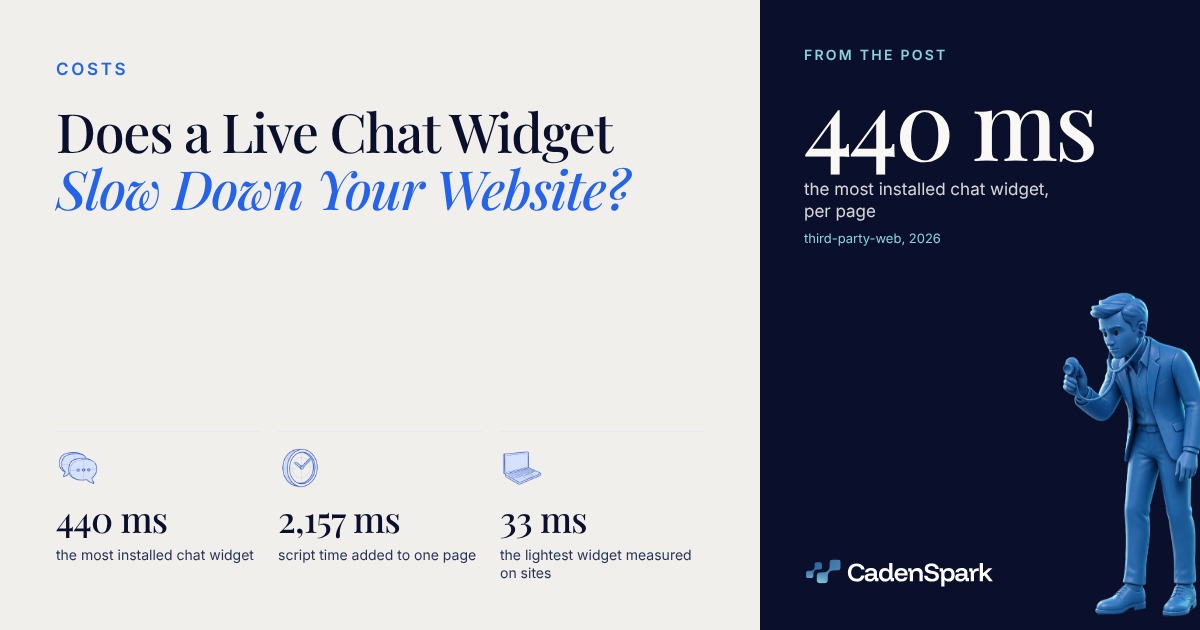
Yes, and which one you install decides how much. Across the 23 chat and support providers measured in HTTP Archive’s mobile crawl, the widget’s own scripts average between 33 ms and 3,089 ms of execution time per page (third-party-web, 2026). The most installed one averages 440 ms.
Does a live chat widget slow down your website?
Yes, measurably, and the size of the hit is a product choice. The lightest widget measured averaged 33 ms of script time per page and the heaviest 3,089 ms.



What the widget costs the page
nothing33 ms to 3,089 ms
third-party-web, 2026: average script time per page, by provider, in the March 2026 dataset.
Where the decision lives
whether to have chatwhich one you install
The gap between the lightest and the heaviest is close to a hundredfold.
What the number covers
the whole pagethat widget’s own scripts
Lighthouse’s bootup-time field, attributed to the provider’s own domain, per page.
View data
| Metric | Day zero → target |
|---|---|
| What the widget costs the page | nothing → 33 ms to 3,089 ms |
| Where the decision lives | whether to have chat → which one you install |
| What the number covers | the whole page → that widget’s own scripts |
Which chat widgets are heavy, and which are light?
Ordered, the nine with the widest reach run from 33 ms to 3,089 ms. Five of the 23 providers in the published table cross a full second by themselves.
third-party-web, 2026 · March 2026 dataset, HTTP Archive mobile crawl · average per page where the script was found
View data
| Item | Value |
|---|---|
| Crisp | 33ms |
| Help Scout | 427ms |
| Tawk.to | 440ms |
| Smartsupp | 647ms |
| Jivochat | 994ms |
| LiveChat | 1116ms |
| Intercom | 1433ms |
| ZenDesk | 2157ms |
| Freshchat | 3089ms |


Both counts are ours, off those 23 rows and nothing wider. The widget joins the third parties already on the page.
Is the one everybody installs the slow one?
No. Popularity does not predict cost: the most installed widget of the group sits among the lighter ones, and the second most installed is nearly five times its weight.
third-party-web, 2026 · pages of the HTTP Archive mobile crawl, not customers of the product · rounded to thousands
View data
| Item | Value |
|---|---|
| Tawk.to | 177k |
| ZenDesk | 111k |
| Jivochat | 84k |
| LiveChat | 63k |
| Intercom | 58k |
| Crisp | 1.6k |
Tawk.to was found on 176,551 pages of the crawl and averaged 440 ms per page (third-party-web, 2026).
ZenDesk was found on 111,484 pages and averaged 2,157 ms per page (third-party-web, 2026).
Crisp was found on 1,577 pages and averaged 33 ms per page (third-party-web, 2026).
Usage counts pages of the HTTP Archive mobile crawl where the script appeared, not companies paying for the product.
How much script time is too much?
Lighthouse publishes its own scale, and it is for the whole page: about 500 ms of JavaScript scores near 100, past 1.3 seconds turns yellow, past 3.5 seconds turns red (Lighthouse 13.6.0).
Lighthouse 13.6.0 · bootup-time audit constants read in the source · scores the whole page, not one script
View data
| Item | Value |
|---|---|
| Scores near 100 | 500ms |
| Turns yellow | 1282ms |
| Turns red | 3500ms |
Both numbers come out of the bootup-time audit. Lighthouse scores a page’s total; third-party-web splits that total across the third parties on it.
An average per page where the script was found, in one monthly crawl. Not a worst case, and not your page.
HTTP Archive crawls around 4 million sites a month with Lighthouse on mobile, from a datacenter, logged out (third-party-web, methodology).
The dataset is rebuilt every month, so light today is not light forever. Cite the file date, which is March 2026 here.
The rest of the page competes for the same budget, which is how fast a service business site needs to load.
What do you do if you want the chat box anyway?
Load it when somebody clicks it, not when the page loads. The Web Almanac calls that pattern a facade and names chat widgets as one of its cases.
- 01Who answers it, and between which hoursA box that collects messages nobody reads costs you the script time and the goodwill. Settle the coverage before the code.
- 02Which provider, measuredThe published table runs from 33 ms to 3,089 ms per page (third-party-web, 2026). Look up the one you are about to install.
- 03Does it load on clickA facade leaves a button on the page and fetches the provider only when a visitor taps it (Web Almanac, 2025).
- 04What your own report saysRun Lighthouse on the page. The third-party insight lists every third party with the main-thread time it took (Lighthouse 13.6.0).
Those percentages are not sites with chat: they are pages carrying any embed with a known facade, video and social included (July 2025 crawl).
View data
| Step | Value |
|---|---|
| A button, not a widget | 01 (zero bytes from the provider until somebody clicks) |
| The widget loads on interaction | 02 (the pattern the Web Almanac calls a facade (2025)) |
| Someone answers, with a time | 03 ("we reply within X minutes" lets the visitor decide to wait) |
| Measure the page again | 04 (the third-party insight lists the time each third party took) |
Nobody publishes how many of those chats turn into work. What is published is the bill: 33 ms or 3,089 ms, for the same box in the corner.
Questions owners ask
Does a live chat widget slow down your website?
Yes, and how much depends on which one. Across the 23 chat and support providers measured in the mobile crawl, average script time runs from 33 ms to 3,089 ms per page (third-party-web, 2026). The most installed one averages 440 ms.
Which chat widget is the lightest?
Of the 23 providers in the published table, the lightest averaged 33 ms of script time per page and the heaviest 3,089 ms. It is a monthly measurement of one crawl, not a permanent property of the product, so check the current dataset.
Can you keep the chat box without the load time?
Mostly, yes: load it when somebody clicks instead of on page load. The Web Almanac calls that pattern a facade and names chat widgets as one of its cases. In the 2025 crawl, 41% of mobile home pages were flagged for one.
How do you check what the widget costs on your own site?
Run a Lighthouse report. Version 13 dropped the facade check, but its third-party insight still lists each third party with the main-thread time it took. Same measurement as this post, run on one page instead of four million.
Sources
- third-party-web, Customer Success table and the 2026-03-01 entity dataset (HTTP Archive mobile crawl, around 4 million sites per month; the nine provider figures recomputed from data/2026-03-01-entity-scripting.json at commit a631d7a; read November 17, 2026) (2026)
- Lighthouse 13.6.0, bootup-time audit default options (p10 1282, median 3500, scoring the page's total JavaScript execution time), commit 546477a (2026)
- Lighthouse 13.6.0, third-parties insight (replaces the third-party summary audit, reports main-thread time per third party) (2026)
- Web Almanac 2025, Page Weight chapter, facades section (HTTP Archive July 2025 crawl, measured with Lighthouse 12) (2025)
The first meeting starts with findings, not promises.The free Business Health Report reads your business and shows you what it found, in days.
Get Your Free Business Health Report