


 Google
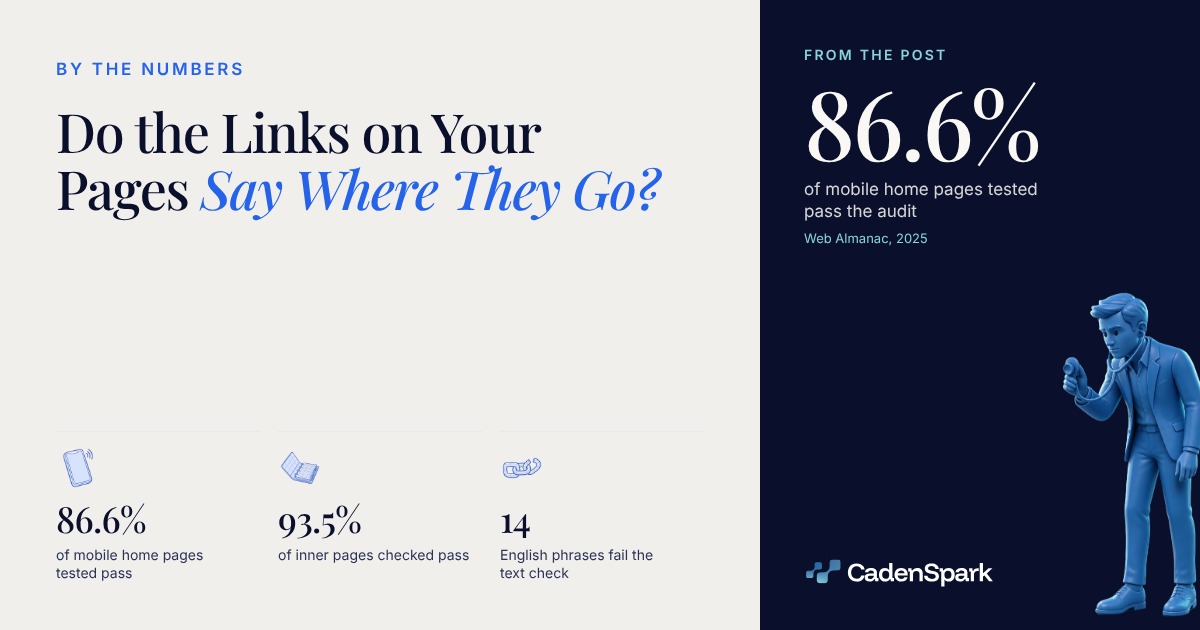
Most do. In the Web Almanac’s July 2025 crawl, 86.64% of mobile home pages tested pass the link-text audit and 93.45% of inner pages do. The audit is a code check inside Lighthouse 12.8.0, not a measurement of Google Search, and it fails on a closed list of fourteen English phrases.
Do the links on your pages say where they go?
Most do. The weak one is the page everyone sees first: home pages tested pass at 86.64% on mobile and 84.64% on desktop, inner pages at 93.45% and 92.42% (Web Almanac, 2025).


Web Almanac, 2025 · Lighthouse 12.8.0 on one home page and one inner page per site
View data
| Item | Value |
|---|---|
| Inner pages, mobile | 93.45% |
| Inner pages, desktop | 92.42% |
| Home pages, mobile | 86.64% |
| Home pages, desktop | 84.64% |
Which words make a link fail the check?
Fourteen exact phrases in English: click here, learn more, read more, here and this, among others. The audit compares the whole link text, so the same words with a destination attached pass.
Link on a quote page
Click hereGet a quote
Both open the same page. Only one of them says so.
Link under a service
Learn moreSee what the audit checks
Learn more is on the list. The longer line is not.
Link at the end of a post
Read moreRead what the crawler sees
Read more is on the list for the same reason.
Button on the home page
StartStart a quote request
Start fails on its own and passes with three words added.
View data
| Metric | Day zero → target |
|---|---|
| Link on a quote page | Click here → Get a quote |
| Link under a service | Learn more → See what the audit checks |
| Link at the end of a post | Read more → Read what the crawler sees |
| Button on the home page | Start → Start a quote request |
- 01It skips four kinds of linkNo href at all, a rel that includes nofollow, a javascript: or mailto: target, or an anchor to the same page. Those never reach the text comparison.
- 02It trims and lowercases the textWhat gets compared is link.text.trim().toLowerCase(), so capitals, trailing spaces and a stray line break change nothing.
- 03It matches the whole stringThe comparison is a set lookup on the entire text, not a search inside it. Click here fails. Click here to get a quote does not.
- 04One link decides the pageThe audit reports either Links have descriptive text or Links do not have descriptive text. There is no partial credit for the other forty links.
Why is the home page the worst page on your site for this?
Because a home page links with navigation and promotional buttons, while an inner page links inside sentences that already name the destination. On mobile the distance is 6.81 points, our subtraction.
"The gap between home pages and inner pages persists", with inner pages running about 6 to 9 points higher (Web Almanac, 2025).
93.45% of inner pages tested minus 86.64% of home pages tested. That subtraction is ours, not the chapter’s.
The chapter’s own read: "The remaining opportunity lies in improving home page link clarity, where vague CTAs are still most common."
Their links sit in the middle of a sentence that supplies the context, the same context a crawler reads on a service page.
Home page link text
the nav plus one repeated buttonthe name of the page it opens
86.64% of mobile home pages tested pass today.
Inner page link text
already written in contextleave it alone
93.45% of mobile inner pages tested pass.
Desktop, same two pages
84.64% of home pages pass92.42% of inner pages pass
Device parity is close on both page types.
What the audit returns
Links do not have descriptive textLinks have descriptive text
The title flips on the first vague link it finds.
View data
| Metric | Day zero → target |
|---|---|
| Home page link text | the nav plus one repeated button → the name of the page it opens |
| Inner page link text | already written in context → leave it alone |
| Desktop, same two pages | 84.64% of home pages pass → 92.42% of inner pages pass |
| What the audit returns | Links do not have descriptive text → Links have descriptive text |
How many links does a page have, and where do they go?
Mostly to itself. On the median mobile page the 2025 crawl counted 39 links to the same site and 6 to other sites. There is no required number.
Web Almanac, 2025 · mobile percentiles. Desktop sits a little higher: 43 at the median and 174 at the 90th
View data
| Item | Value |
|---|---|
| 10th percentile | 6 |
| 25th percentile | 17 |
| Median | 39 |
| 75th percentile | 82 |
| 90th percentile | 161 |

The other count per page worth knowing is the length of the page itself.
What do nofollow, noopener and sponsored do on a link?
Two of them protect the visitor and one talks to the search engine. On mobile pages noopener appears on 40.9%, nofollow on 32.3% and noreferrer on 25% (Web Almanac, 2025).
Web Almanac, 2025 · desktop differs by about a point: noopener 41.8%, nofollow 30.8%, noreferrer 25.5%, ugc 0.6%, sponsored 0.5%
View data
| Item | Value |
|---|---|
| noopener | 40.9% |
| nofollow | 32.3% |
| noreferrer | 25% |
| ugc | 0.5% |
| sponsored | 0.5% |
The most common rel value in the crawl. It stops the page you link to from reaching back into your tab.
Hides where the visitor came from. Like noopener, the chapter notes neither one affects positioning.
The one aimed at search engines, and the one that quietly removes a link from this audit entirely.
The specific labels Google asked for have not moved. Most sites still use nofollow for everything.
What should the links on your contact and quote pages say?
The destination. Write the name of the page or the action it starts, and the vague phrase has nowhere left to sit. Do not reach for nofollow to hide one.
- 01Name the destination, not the gestureGet a quote. See pricing. Call the office. Each one is the page it opens, which is also the only promise a visitor gets before it loads.
- 02Fix the home page firstIt is the page type with the lowest pass rate in the crawl, and the one where the same button repeats in the nav, the hero and the footer.
- 03Leave the exempt links aloneA mailto: target, a javascript: target and an anchor to the same page are skipped by the audit. Rewriting those buys you nothing here.
- 04Check the other languageWhen a link does not declare its own lang, the audit compares the text against all nine language lists. An aqui on an English page fails the same way.
"Descriptive link text helps search engines understand your content" is the audit’s own description. There is no published ranking effect, so we do not claim one.
It is one SEO check in Lighthouse, run on two pages per site. It says nothing about position, and nothing about conversions.
It takes the link out of the audit and changes what the search engine sees. The visitor still reads Click here.
Reading the links out loud. Any one that would fit on any page of any website is the one to rewrite.
Open your home page and read the links out loud. The ones that could belong to any business are the ones to rename.
- 01Count the vague links
- 02Name the destination
- 03Fix the home page first
- 04Re-run the audit
Questions owners ask
Do links that say click here hurt your SEO?
Lighthouse’s own audit says descriptive link text helps search engines understand your content. Nobody publishes a ranking effect, so we do not claim one. What is measured: 86.64% of mobile home pages tested pass the check and 93.45% of inner pages do (Web Almanac, 2025).
Which exact phrases fail the check?
Fourteen, in English: click here, click this, go, here, information, learn more, more, more info, more information, right here, read more, see more, start, this. The list is in the source of Lighthouse 12.8.0, the version the crawl ran.
Does Click here to get a quote fail?
No. The audit trims the link text, lowercases it, and compares the whole string against the list. A phrase that carries the destination inside it is not on the list, so it passes.
How many links should a page have?
There is no required number. On the median mobile page the 2025 crawl counted 39 links to the same site and 6 to other sites; at the 90th percentile, 161 and 24 (Web Almanac, 2025).
Sources
- HTTP Archive, Web Almanac 2025, SEO chapter, Non-descriptive links, Outgoing links and Anchor rel attribute use (16,213,084 websites: 15,426,398 mobile and 12,155,374 desktop, one home page and one inner page each, July 2025 crawl; read November 23, 2026) (2025)
- HTTP Archive, Web Almanac 2025, Methodology (sample sizes, the July 2025 crawl date and the Lighthouse version used: 12.8.0) (2025)
- Google Chrome, Lighthouse 12.8.0, core/audits/seo/link-text.js (the source code of the check itself: the phrase lists, the exemptions and the comparison. It is a code audit, not a measurement of Google Search) (2025)
The first meeting starts with findings, not promises.The free Business Health Report reads your business and shows you what it found, in days.
Get Your Free Business Health Report