




 Google
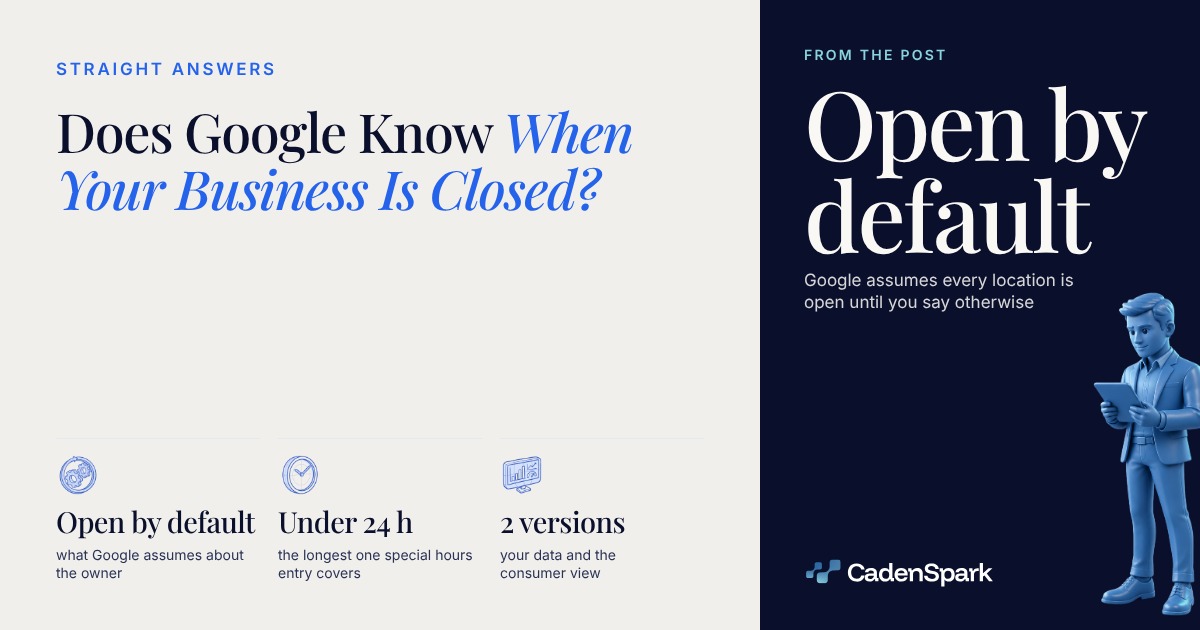
No, unless you tell it. Google’s own API definition says all locations are open by default, unless updated to be closed, and holiday hours live in a separate field that has to be filled one date at a time.
Does Google know when your business is closed?
It assumes nothing. The My Business Business Information API defines every location as open until someone changes it, and its status field accepts four values.



The default value of the status field. Nothing was ever declared, which is where most profiles sit on the day they are claimed.
"All locations are open by default, unless updated to be closed" (My Business Business Information API v1, rev. October 26, 2026).
CLOSED_TEMPORARILY, the third of the four values the field accepts.
CLOSED_PERMANENTLY, the fourth. Four values, and the one you never set is the one that holds.
Where do holiday hours actually live?
In a separate field. Google’s API calls it specialHours, says it overrides regular business hours, and says it cannot be set without regular hours already in place.
Keeping them current is one line in our map pack checklist, and this is that line.
View data
| Piece | What happens |
|---|---|
| Door | Regular hours |
| Door | Special hours |
| Door | Department hours |
| Hub | One location record — regular hours first, and special hours override them |
| Stage | Today’s hours, resolved — the special entry wins on the date it covers |
| Stage | What Maps and Search publish — the consumer view, returned separately by its own method |
| Return | Next holiday, next entry — one entry per date, under 24 hours each |
"Special hours for the business. This typically includes holiday hours, and other times outside of regular operating hours. These override regular business hours" (Google API, 2026).
"This field cannot be set without regular hours" (Google API, 2026). A profile with no regular hours has nowhere to put a holiday.
The field is optional in the schema. Optional means the day passes with the regular hours showing unless somebody typed an entry.
Why does each holiday need its own entry?
Because one entry is capped. A special hour period must represent a range of less than 24 hours, and its end date can be at most one day after its start date.
A week of closure
one entryseven entries
One per date: a period must represent a range of less than 24 hours (Google API, 2026).
An overnight close
left open-endedan end date, 1 day out
The end date "must be equal to or at most 1 day after start_date".
A closing time
guesswork at midnight00:00 to 24:00
"24:00 represents midnight at the end of the specified day field".
A full day off
hours zeroed outthe closed flag
If true, end date, open time and close time are ignored and the whole date reads closed.
View data
| Metric | Day zero → target |
|---|---|
| A week of closure | one entry → seven entries |
| An overnight close | left open-ended → an end date, 1 day out |
| A closing time | guesswork at midnight → 00:00 to 24:00 |
| A full day off | hours zeroed out → the closed flag |
- 01Thursday, closed all dayOne entry, start date on the holiday, closed set to true. Google then ignores the open and close times for that date entirely.
- 02Friday, open lateA second entry, same shape, different hours. It cannot be merged with Thursday: each period covers a range of less than 24 hours.
- 03Christmas Eve, closing at 2 p.m.A third entry, written weeks earlier. Nothing in the field schedules itself, and the regular hours show until an entry exists.
- 04An overnight shiftAllowed, with an end date at most one day after the start date. Anything longer is two entries, not one.
Can different parts of the business publish different hours?
Yes. The API carries a moreHours field for a business’s different departments or specific customers, and which extra types you can publish depends on your category.
"More hours for a business’s different departments or specific customers" (Google API, 2026). The office, the counter and the crew can differ.
The list of extra hour types is marked output only and comes back "available for this business category", so it is read, not chosen.
moreHours sits alongside regular hours. It adds a second set of labelled hours; it does not replace the ones a caller reads first.
Why does Google show hours you never set?
Because two versions exist. One read method returns your version, another returns the one live on Maps and Search, which may have been updated by Google or user-generated content.
View data
| Step | Value |
|---|---|
| The hours you set | Your version (returned "as last set by the merchant", and it "may not reflect updates from Google or user-generated content that are live on Google Maps") |
| Google or users change it | External edits (the consumer view "may have been updated by Google or user-generated content and may differ from the merchant’s version") |
| What differs, and from whom | diffMask ("the fields where the values in the view as it appears to consumers are different than the merchant’s information") |
| Your edit, still in flight | pendingMask (it "only tracks the status of the merchant’s own edits, not external changes") |
| The version a customer reads | Maps and Search (you accept the change by patching the location, or reject it by patching your own values) |

Does your website have to say the same thing?
The vocabulary is there. schema.org defines a special opening hours field meant to explicitly override the general opening hours a page already publishes.
Whether a given search feature reads it is Google’s documentation to answer, not schema.org’s.
- 01openingHoursSpecification for the normal weekschema.org describes it as "the opening hours of a certain place", the structured value a page uses for its regular week.
- 02specialOpeningHoursSpecification for the holidayDefined to "explicitly override general opening hours brought in scope by openingHoursSpecification or openingHours" (v30.1).
- 03Leave out the opening hour to mean closed"The place is open if the opens property is specified, and closed otherwise." Omission is the closed signal, not a zero.
"Days are specified using the following two-letter combinations: Mo, Tu, We, Th, Fr, Sa, Su" (schema.org v30.1).
"Times are specified using 24:00 format. For example, 3pm is specified as 15:00". A published example reads Tu,Th 16:00-20:00.
schema.org defines what the field means. It makes no claim about what any search feature does with it, and neither do we.
Set the regular hours, then add one entry per closed date before the holiday, not after it. The phone still rings on the days the profile says closed, and that is a separate problem.
- 01Set regular hours
- 02Add one entry per date
- 03Mirror it on the site
- 04Read the consumer view
Questions owners ask
If I never set holiday hours, what does Google show?
Your regular hours. Google’s own API definition says all locations are open by default, unless updated to be closed, and that holiday hours live in a separate field that overrides the regular ones (My Business Business Information API v1, rev. October 26, 2026).
Can I enter a week-long closure as one entry?
Not as one entry. A special hour period must represent a range of less than 24 hours, and its end date must be at most one day after its start date. A week is seven entries.
Why do the hours on Maps differ from what I typed?
Because there are two versions. One read method returns your version; another returns the live one, which the API says may have been updated by Google or user-generated content, with a mask listing which fields differ.
Do I need holiday hours on my website too?
The vocabulary exists: schema.org defines specialOpeningHoursSpecification to explicitly override the general opening hours (v30.1). Whether a given search feature reads it is Google’s documentation to answer, not schema.org’s.
Sources
The first meeting starts with findings, not promises.The free Business Health Report reads your business and shows you what it found, in days.
Get Your Free Business Health Report