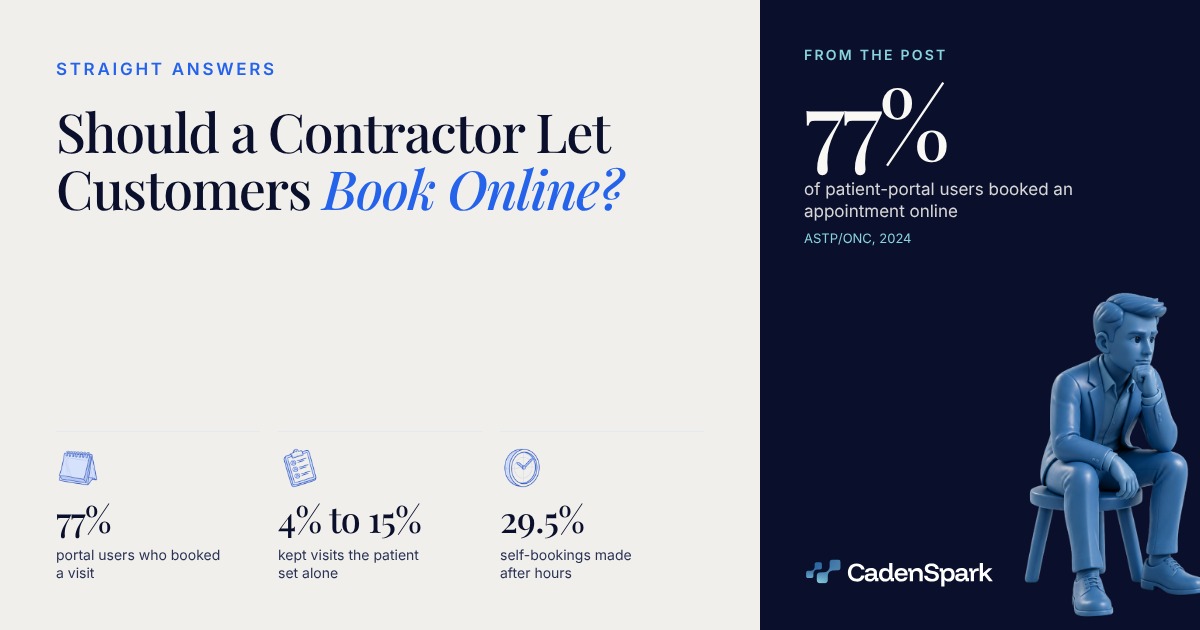
Yes, for the work you can name, price and time without seeing it. Everything else takes a request, not a slot. Self-booking has only been measured in medical practices: 77% of the adults who opened a patient portal at least once in 2024 used it to book an appointment (ASTP/ONC, 2024). Contracting has no equivalent study.
Should a contractor let customers book online?
Yes for jobs with a known duration and a price that does not move with what you find. Everything else is a request, and you set the hour after you look.



A slot. Known duration, a trip charge you honor, nothing to discover before you arrive.
A slot. The look itself is the product, so the hour is the thing you are selling.
A slot. Same scope every time, same hour, same price, year after year.
A slot, as long as you are holding the hour and not the quote. The quote comes after.
A request. The duration is whatever the fault turns out to be.
A request. Scope, permits and lead times pick the date, not the customer.
Which jobs can be booked online, and which should stay a request?
The ones you can describe in one sentence and time to the half hour. Two tests settle it: can you name the duration, and does the price survive whatever you find on site.
The customer picks it off a list instead of describing their house to you.
You can hold a block and keep it, in the worst version of that job.
A flat fee or a trip charge with no "it depends" buried inside it.
Nothing about the address can cancel the visit after the truck arrives.
View data
| Step | Value |
|---|---|
| The customer picks the work | 1 (from a short list, in plain words) |
| Slot or request | 2 (your list decides, not the customer) |
| A time window, or a callback time | 3 (both are an answer, only one is an hour) |
| One calendar the crew reads | 4 (the hour exists before anyone drives) |
Do customers actually book online when you give them the option?
Where it has been measured, they do, and a real share of it lands while the office is closed. Both studies are from medical practices, not contracting, so read them as evidence that people use the button, not as your conversion rate.
About 65% of U.S. adults opened a patient portal at least once in 2024, and 77% of those used it to book an appointment, from 7,278 completed surveys fielded March to September 2024 (ASTP/ONC, 2024).

Who sets the visit
front desk, 4% self-booked15% self-booked
JAMIA, 2022: 1,995,909 appointments across more than 30 medical sites, January 2019 to June 2021.
When the booking happens
business hours only29.5% after hours
JMIR Medical Informatics, 2021: 354 of 1,201 self-scheduling actions in a primary-care study.
Missed appointments
the practice baselinelower among self-bookers
Same JAMIA study. Cancellations ran higher, which is a hole you can put back up for sale.
Your own trade
no published numberstill no published number
Nobody has published what share of U.S. contractors offer online booking, or a measured conversion lift from switching it on.
View data
| Metric | Day zero → target |
|---|---|
| Who sets the visit | front desk, 4% self-booked → 15% self-booked |
| When the booking happens | business hours only → 29.5% after hours |
| Missed appointments | the practice baseline → lower among self-bookers |
| Your own trade | no published number → still no published number |
What does the booking step have to ask, and where does the link live?
Four facts and nothing else: what work, what address, how the crew gets in, and who to call. The link belongs wherever the person already found you, with a single calendar behind every door.
- 01What work, from your listNot a free-text box. That choice is what sets the duration and the price you have to honor.
- 02The address, not the cityIt decides the travel block, and whether the job sits inside your zone at all.
- 03How the crew gets inGate code, dog, tenant, stairs. An hour nobody can enter is an hour you lose twice.
- 04Who to call when the truck is outsideOne number that answers at the booked time. Fewer fields get filled, so stop at four.
View data
| Piece | What happens |
|---|---|
| Door | Your site |
| Door | Your Google listing |
| Door | A text reply |
| Door | An email reply |
| Hub | One calendar, one set of rules — duration, travel time and zone live here, never on the page |
| Stage | The hour is held and confirmed — with a window, and the address read back |
| Stage | The crew sees it before the drive — same entry, same notes, no second system |
| Return | A cancellation puts the hour back up — the slot is for sale again the minute it opens |
What breaks when you turn online booking on?
Four things, and all four are configuration: a double-booked hour, a duration set too short, a trip outside your zone, and the hole a cancellation leaves behind.
A calendar with a resource per crew, not one shared list of times. The page can only sell what the calendar can hold.
Set the duration to the worst version of that job. A 90-minute service call booked as 30 ruins the next three.
A zone rule and a travel block, applied before the slot is offered, not after the customer has confirmed it.
A cancelled hour is inventory. Self-bookers cancelled more in the same JAMIA study, so plan the refill first. Reminders are what cuts the no-shows.
- 01Hours offered against hours keptIf the page sold an hour the calendar could not keep, that is the first thing to fix.
- 02Requests that arrived as slotsEvery one of them names a job type that belongs on the request side of your list.
- 03Bookings made outside business hoursIn the primary-care study, 29.5% of self-scheduling actions happened after hours (JMIR, 2021).
- 04The gap between booked and dispatchedOne calendar means the crew sees the hour you sold. Two systems mean a phone call to fix it.
- 01Turn it on for one job type
- 02Watch it for two weeks
- 03Add the second job type
- 04Open the whole calendar
Start with the one job you could book in your sleep. The list of what stays a request is the real product here, not the button.
Questions owners ask
Should a contractor let customers book online?
Yes for jobs with a named scope, a known duration and a price that does not depend on what you find. Service calls, diagnostics, seasonal maintenance and estimate visits qualify. Anything whose hour depends on the fault stays a request you schedule after you look.
What jobs should never be bookable online?
The ones priced by what you find: unknown-fault repairs, replacements, remodels, anything with a depends in it. Selling an hour you cannot keep costs more than the booking brings, because the customer already told the household what time you were coming.
Does online booking cause more no-shows?
No primary study measures that outside healthcare. In a study of 1,995,909 medical appointments, self-booked visits were missed less often but cancelled more often (JAMIA, 2022). Reminders are the part of this with trial evidence behind it.
Where should the booking link live?
Wherever the person already found you. One page, reached from your site, from the replies you send, and from the listing people use to look you up. One calendar behind all of them, so the hour exists before anyone drives.
Sources
- ASTP/ONC (HHS), Health IT Data Brief No. 77, July 2025, on the National Cancer Institute's HINTS 7 survey (7,278 completed surveys, fielded March 25 to September 16, 2024) (2025)
- Woodcock, Sen and Weiner, Automated patient self-scheduling: a case study, JAMIA 29(9):1637-1641 (1,995,909 appointments booked January 2019 to June 2021 across more than 30 medical sites) (2022)
- Impact of Web-Based Self-Scheduling on Finalization of Well-Child Appointments in a Primary Care Setting, JMIR Medical Informatics 9(3):e23450 (1,201 self-scheduling actions) (2021)
The first meeting starts with findings, not promises.The free Business Health Report reads your business and shows you what it found, in days.
Get Your Free Business Health Report