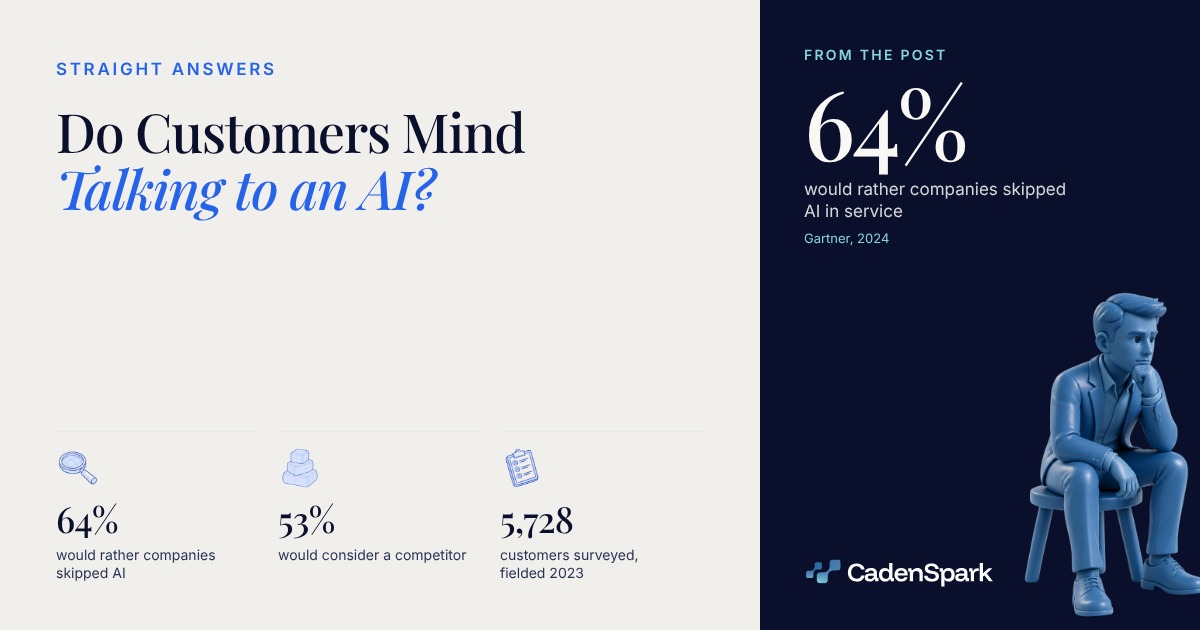
Asked the question straight, most customers say they would rather not: 64% of 5,728 people surveyed preferred that companies did not use AI for customer service (Gartner, 2024). But almost nobody chooses between an AI and a person. They choose between something that answers and nothing.
Do customers mind talking to an AI?
Asked that way, yes. Nearly two in three would rather companies skipped it, and about half say they would look at a competitor over it (Gartner, 2024).



Whether you would prefer that companies did not use AI for customer service. A preference stated in the abstract, by 5,728 customers (Gartner, 2024).
A phone ringing at 7:40 on a Tuesday. The choice in front of them is not an AI or a person. It is an answer or a voicemail greeting.
Someone can dislike automated service and still take it over nobody. The survey did not put those two side by side, so it cannot settle that.
It does not measure behavior, and it does not mean the rest want AI. 64% said they would rather companies skipped it. That is the whole finding.
What exactly do they object to?
Not the voice. The dead end: the concern named most often in that same survey was that AI makes it harder to reach a person (Gartner, 2024).
Gartner, 2024 · one question, one base of 5,728 customers surveyed
View data
| Item | Value |
|---|---|
| Harder to reach a person | 60% |
| Displacing jobs | 46% |
| Giving wrong information | 42% |
| Data security | 34% |
| Bias | 25% |
Giving their name twice. A few seconds of hold. A voice that is obviously automated, as long as the errand moves forward.
Telling the whole story to something that did not keep it, and finding no way out to a human being.
The exit. Most of what an AI receptionist does on a call is a question of what it hands off, and how fast.
Wrong information, named by 42% (Gartner, 2024). A new hire quoting last year’s price is the same failure with a human voice.
Does the answer change when the alternative is voicemail?
Yes, and this is the comparison that matters. Across Invoca’s benchmark set, 56% of calls to businesses reach a person.

A separate base tells the same story by trade. CallRail looked at 1.1 million leads and reported missed-call rates by industry; the two below are from that report, not from Invoca’s.
Those calls are not weighing a machine against a receptionist. Many of them arrive when the office is closed, which is what happens to a call after hours, and the cheapest thing you can put in that gap is a text back to the number that rang.
Does it help to say up front that it is an AI?
Yes, and in California a narrow version of saying it is written into law. One sentence covers the courtesy and the disclosure at once.
- 01Say who you areThe business name, not a character name. The caller dialed a company and the first thing they should hear is that company.
- 02Say what it is"You are speaking with an automated assistant." Six words, before the first question, in the voice it will keep using.
- 03Offer the exit in the same breath"Say agent at any time and I will get you a person." The sentence is only worth saying if the handoff behind it actually works.
California’s B.O.T. Act, Business and Professions Code sections 17940 to 17943, in force since July 1, 2019, makes it unlawful to use a bot to deceive someone in order to incentivize a sale or influence a vote. Clear disclosure is the safe harbor.
It aims at deceptive use, not at every automated call, and commentary on it notes there is no duty to disclose where a reasonable person would already understand they are dealing with a bot.
The rest of that opening sentence. No statute asks you to offer a person on request. Your callers do, and the surveyed concern above is exactly that one.
We paraphrased the statute from legal commentary and we are not lawyers. State rules differ and they change. Ask counsel about yours before you rely on any of this.
What should you measure on your own line?
Four counts, on your own calls, for two weeks. Your numbers settle this argument because they are the ones your own callers made.
Calls answered inside 30 seconds
not countedevery call
Count rings, not intentions. Most owners have never had this number in front of them.
Errands finished without a person
not countedthe three you repeat daily
Booking, hours and directions, a price range. Nothing clever.
Calls handed off on request
not countedevery time it is asked
The exit is the whole deal. If it fails once, the objection in the survey is correct.
Hang-ups in the first 15 seconds
not countedunder your voicemail rate
The one honest test of whether your callers actually mind.
View data
| Metric | Day zero → target |
|---|---|
| Calls answered inside 30 seconds | not counted → every call |
| Errands finished without a person | not counted → the three you repeat daily |
| Calls handed off on request | not counted → every time it is asked |
| Hang-ups in the first 15 seconds | not counted → under your voicemail rate |
- 01Two weeks and one notebookA row per call: the time, what they wanted, who finished it, and whether they asked for a person.
- 02The call log you already haveYour phone system lists answered and missed calls with durations. Anything under 15 seconds is a hang-up, and the missed ones are the baseline.
- 03Compare against today, not a benchmarkThe only fair comparison is your own answer rate from the two weeks before. A published average is not your line.
Your partner is right that people say they dislike this. He is answering a different question than the person calling you at 7:40 is.
In the abstract, 64% of those surveyed agree with him (Gartner, 2024). On hold at closing time, they are answering a different question.
Maybe you should. Weigh coverage and cost across the three options before you commit to one of them.
The four counts above, on your own line, for two weeks. Nothing published settles it for you.
See how your business answers today, free, at cadenspark.com/audit.
Questions owners ask
Do customers mind talking to an AI?
Asked directly, most say they would rather not: 64% of 5,728 customers surveyed preferred that companies did not use AI for service (Gartner, 2024). Your caller faces a narrower choice, since only 56% of calls to businesses reach a person (Invoca, 2026).
What do people object to about AI in customer service?
Mainly the dead end. In the same survey of 5,728 customers, 60% worried it would be harder to reach a person and 42% that it would hand out wrong information (Gartner, 2024). The voice itself is not the complaint.
Do I have to tell callers they are talking to an AI?
Say it in one sentence regardless. California’s B.O.T. Act, in force since July 2019, bars deceptive bot use to push a sale or sway a vote, and disclosure is the safe harbor. Not legal advice; ask counsel about your state.
What makes the difference between annoyed and fine?
Three things: it answers on the first ring, it can finish the one errand they called about, and a person is one sentence away. Count all three on your own calls for two weeks.
Sources
- Gartner, survey of 5,728 customers on AI in customer service (fielded December 2023, findings released July 9, 2024); figures confirmed through search results rather than the rendered page on October 31, 2026, so they are paraphrased, not quoted (2024)
- Invoca, Lead Conversion Benchmarks Report (70M calls, 600M minutes, 10 industries) (2026)
- CallRail, From Conversations to Conversions (analysis of 1.1 million leads across seven industries; missed-call rates reported for four of them; published January 15, 2025) (2025)
- California B.O.T. Act, Business and Professions Code sections 17940 to 17943 (operative July 1, 2019); paraphrased from legal commentary rather than the rendered statute page, and not legal advice (2019)
The first meeting starts with findings, not promises.The free Business Health Report reads your business and shows you what it found, in days.
Get Your Free Business Health Report