Missed call text back is an automatic text message sent to the number that just called you and did not reach a person, usually within seconds of the hang-up. It says who you are, that you saw the call, and what happens next. Whether it works depends on what you compare it to: nobody independent has measured how many missed callers a text recovers, but the thing it replaces, the voicemail greeting, has been measured, and the result is not good.
This post uses five sources and keeps them apart. Invoca (70 million calls, 2026) and CallRail (1.1 million leads, 2025) size the gap; both are call-tracking vendors measuring their own customer bases, so they dimension the problem and do not settle it. Clio (500 U.S. law firms phoned in 2019) is the only published field test of what happens to a call that reaches voicemail. Pew Research Center (5,022 U.S. adults, 2025) says whether the caller can receive a text at all. Jobber (1,050 home-service owners, 2026) says what owners believe about speed. Every recovery rate you will find on a vendor page is the vendor measuring its own feature, and none of them appear here.
What is missed call text back?
An automatic text message to the number that just called and did not reach a person, sent within seconds, saying who you are, that you saw the call, and what happens next: a call back at a stated time, a booking link, or one question. It is a safety net under the phone, not a front door.
Most phone systems and call-tracking tools sell a version of it. One call-tracking vendor describes its own as "an immediate automated text message to the caller, acknowledging the missed call and letting them know someone will be in touch shortly" (CallRail, 2025), and that description holds for the whole category: the text does not answer the caller’s question, it tells the caller that the question was received. The trigger is a call that ends without a person on the line, whether it rang out, hit voicemail, or was abandoned during the greeting. The message goes to the caller ID number, so it reaches a landline never and a cellphone almost always.
What it is not: it is not a conversation unless someone picks up the thread, it is not a booking unless the link in it gets used, and it is not an answer. It converts a silence into a receipt.
How many calls to a business actually go unanswered?
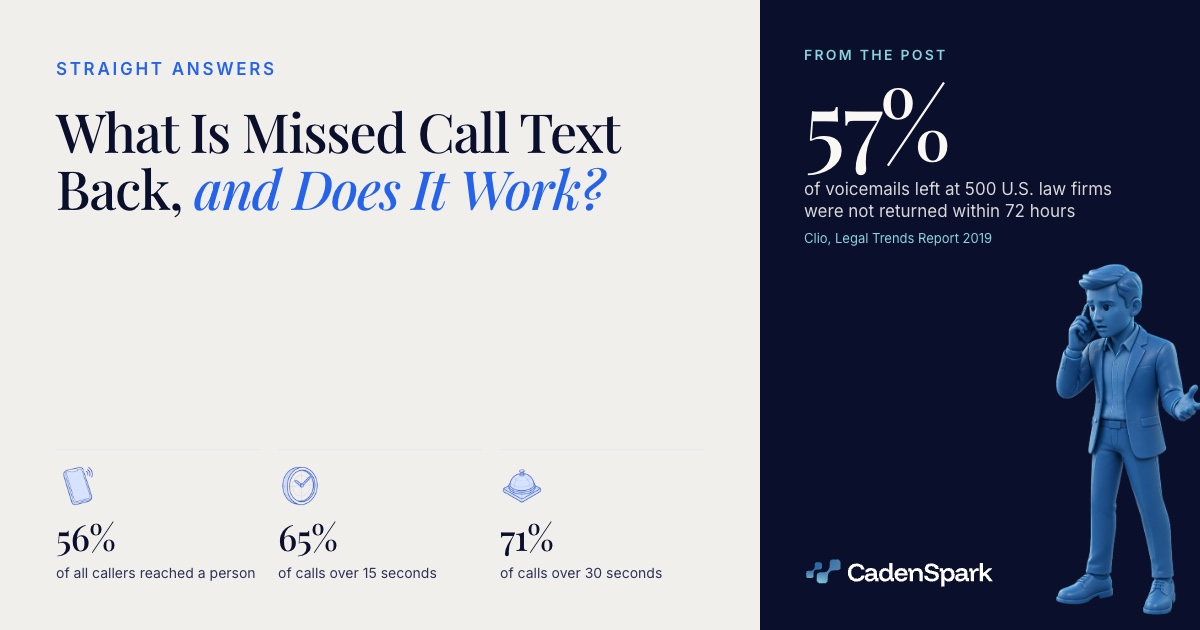
Roughly four in ten, in the largest dataset that counts them. Across more than 70 million calls tracked by Invoca, 56% of calls to businesses were answered by a person; filtering out calls under 15 seconds, the rate rises to 65%, and for calls over 30 seconds it reaches 71% (Invoca, Lead Conversion Benchmarks Report 2026).



The 30-second cut is the one to keep in mind, because it answers the usual objection that most unanswered calls are misdials and quick hang-ups. Even after taking those out, about three in ten callers who stayed on the line did not get a person. Invoca’s figures are averages across its customer base, businesses that already pay for call tracking, with data spanning 10 industries and 7 marketing channels, so the number describes companies paying attention to their phone, not the universe of U.S. businesses.
A second vendor cuts it by industry with a different definition. CallRail’s 2025 analysis of 1.1 million leads reports missed-call rates of 32% in healthcare, 28% in legal, 14% in home services and 9% in real estate, the four industries it examined for missed calls (CallRail, From Conversations to Conversions, 2025). "Missed call" in CallRail’s count is a lead-level measure on marketing-generated calls, and "answered by a person" in Invoca’s is a call-level one; they point the same direction and they do not add up to a single number. Treat both as the size of the hole, not the diagnosis.
What happens to a missed call when nobody texts back?
It goes to voicemail, and most voicemails never turn into a call back. When Clio phoned 500 U.S. law firms in 2019 posing as a prospective client, 56% of firms answered, 39% of calls went to voicemail, and of those voicemails, 57% were not returned within 72 hours; 5% of calls were simply unanswered (Clio, Legal Trends Report 2019).
Clio, Legal Trends Report 2019 · 500 firms phoned as a prospective client
View data
| Item | Value |
|---|---|
| Answered | 56% |
| Went to voicemail | 39% |
| Unanswered | 5% |
Read the 57% carefully: it is 57% of the 39% that reached voicemail, not of all calls. Put together, 73% of the 500 firms either picked up or called back, which means 27% could not be reached by phone at all. And the firms that did return a voicemail did so quickly or not at all: only 43% of firms responded to a voicemail, and most of those responses (86%) came within 24 hours, which Clio summarized as firms being "either likely to get back to their clients within a day or not at all."
The dataset is legal and it is 2019, so carry both labels with it. It has not been replicated with a published methodology since, and it is still the only large field test where someone called real businesses, left a real message, and waited. The pattern it found is the one text back is built against: a voicemail is a promise the business makes to itself, and more than half the time, in that test, the business did not keep it.
Does missed call text back work?
The honest answer is that nobody independent has measured it. There is no published dataset with a sample and a method that says what share of missed callers reply to a text back or book from one; the recovery rates on vendor pages are vendors measuring their own feature on their own customers. What is measured is everything around it.
Three things are measured. First, the gap: 56% of callers reached a person across 70 million calls (Invoca, 2026), so there is a large population of callers for the text to go to. Second, the fallback: in the only field test, 57% of the voicemails left at 500 law firms were not returned within 72 hours (Clio, 2019), so the thing the text replaces mostly fails. Third, the reach: 98% of U.S. adults own a cellphone of some kind and 91% own a smartphone (Pew Research Center, 5,022 adults surveyed February to June 2025), so nearly every caller holds a device that can receive the text. Pew measures ownership, not whether people read texts from businesses, and that is all it should be asked to say.


The fourth piece is what owners themselves report. Among 1,050 U.S. home-service business owners Jobber surveyed in December 2025, 60% said they reply to a new lead the same day and 20% within the hour; the same owners reported that more than half of their customers expect a reply within the hour (Jobber, Home Service Trends Report 2026). That last figure is owners describing their customers, not customers describing themselves, so take it as the expectation owners are working against. How fast is fast enough is its own post; here the point is narrower: a text that lands in seconds clears a bar that only one in five owners reports clearing by hand.
So the arithmetic you can do is about the gap, not the recovery. Say your business takes 100 calls a month and 44% do not reach a person, Invoca’s average: that is 44 callers who heard a greeting or nothing. What share of those 44 answer a text is a number you read in your own log after a month, not one anyone can quote you. That multiplication is ours, with model numbers; plug in your own.
What should the text-back say?
Four things, in under 160 characters: your business name, that you saw the call, one next step with a time or a link, and how to stop the messages. Nothing else.
An example with the four parts: "This is Northside Plumbing. We saw your call and missed it. We will call you back before 2 pm, or book here: [link]. Reply STOP to opt out." The name comes first because an unlabeled number reads as spam. The acknowledgement is what separates this from a marketing blast: the text responds to something the caller did. The next step needs a time or a link, because "we’ll be in touch" is a voicemail greeting in a different font. And the way out has to be there and has to work.
What stays out: any offer, discount or promotion, which turns a response into a solicitation; a shared link shortener, which hides who sent the text; and a second automatic message if the first one gets no reply. A text-back is one text. Everything after it is a person.
A text-back is a message your business sends first, not a reply to one the customer sent, and that puts it in the territory of the consent rules for automated business texts. This post does not interpret those rules; whether your setup needs consent before the text fires is a question for counsel. The carriers' checklist for the text itself, the part about identifying yourself and honoring STOP, is the same one your appointment confirmation text already has to pass.
When is missed call text back not the answer?
When you could have answered. A text does not replace picking up, and 56% answered (Invoca, 2026) is the benchmark to beat, not the ceiling to accept: every point you add to the answer rate is a caller who did not need the text. The text covers the remainder.
It is also not the answer when the caller needs a person now. An existing customer with water on the floor reads "we’ll call you back" as a brush-off, and a text that says so faster is still a brush-off. If your missed calls are mostly current customers rather than new ones, the fix is coverage during the hours they call, not a receipt.
And it is not the answer when nobody follows the text. A text-back that promises a call that never comes is Clio’s 57% with an extra step: the caller now has written proof that you saw them and did not act. In the same Invoca dataset, 64% of businesses never asked the lead to buy or book during an answered call (Invoca, 2026), which is a reminder that the text-back fixes the missed call and nothing about what happens on the answered one.
What should you do first?
Count your missed calls for two weeks before you buy anything. Your phone system or call log already has the number; most owners have never looked at it as a count per day.
If the count is a handful a day or more, a text-back is the cheapest patch and, more usefully, it is a measurement: after a month you will know how many of those callers answer a text, which is the number no vendor can give you. Then decide whether the window where calls go unanswered needs a person, a schedule change, or both. If the misses cluster after closing time, the problem is the hours, and what happens to a call after hours is the post for that.
What a text-back will not tell you is why the call was missed in the first place. That is the number worth fixing.
Questions owners ask
What is missed call text back?
An automatic text sent to the number that just called you and did not reach a person, usually within seconds. It says who you are, that you saw the call, and what happens next: a call back at a stated time, a booking link, or one question. It replaces the voicemail greeting as the first thing a missed caller gets from you.
Does missed call text back actually work?
No independent study measures how many missed callers a text-back recovers, so treat any recovery rate you read as the vendor’s own number. What is measured is the gap it covers: across 70 million calls, 56% of callers reached a person (Invoca, 2026), and when Clio phoned 500 U.S. law firms in 2019, 57% of the calls that reached voicemail were not returned within 72 hours. Count your own missed calls for two weeks and measure the replies.
What should a missed call text say?
Your business name, that you saw the call, one next step with a time or a booking link, and how to stop the messages. No discount, no shared link shortener, no second automatic message if the first gets no reply. Keep it to one text; a person takes it from there.
Should I use text back instead of answering the phone?
No. It is the safety net under the phone, not a replacement for picking up: the benchmark is a person answering, and a text that promises a call that never comes is the voicemail problem with an extra step. Use it to catch what you miss, and to measure how much you miss.
Sources
- Invoca, Lead Conversion Benchmarks Report 2026 (anonymized data from over 70 million calls and 600 million minutes on the Invoca platform, 10 industries, 7 marketing channels; averages across Invoca's customer base; read October 9, 2026) (2026)
- CallRail, From Conversations to Conversions (analysis of 1.1 million leads across seven industries; missed-call rates reported for the four industries examined; figures read in the report PDF on October 9, 2026) (2025)
- Clio, Legal Trends Report 2019 (500 U.S. law firms phoned as a prospective client across five practice areas; 2,000 consumers and 2,507 legal professionals surveyed; report PDF read October 9, 2026) (2019)
- Pew Research Center, Mobile Fact Sheet (5,022 U.S. adults surveyed February 5 to June 18, 2025; published November 20, 2025; read October 9, 2026) (2025)
- Jobber, Home Service Trends Report 2026 (survey of 1,050 U.S. home service business owners, fielded December 2025 through Conjointly, margin of error ±3 points at 90% confidence; read October 9, 2026) (2026)
The first meeting starts with findings, not promises.The free Business Health Report reads your business and shows you what it found, in days.
Get Your Free Business Health Report