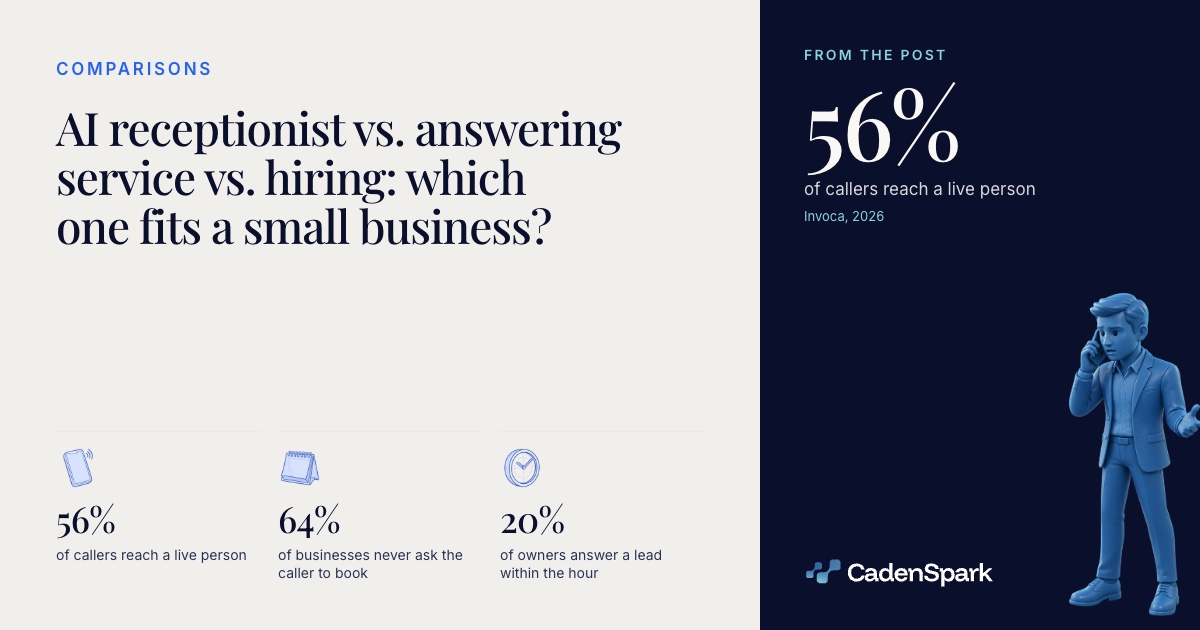
If the front desk does more than answer the phone, you need a person. If messages when nobody picks up are enough, an answering service covers it. If missed calls become missed appointments with no follow-up, an AI receptionist fits that gap.
What does each option cost, structurally?
A hire is a fixed payroll line, an answering service is a metered bill, an AI receptionist is a flat software line. The shape of the cost matters more than the sticker price.
The same cost at five calls a day or fifty, plus training, taxes, time off and re-hiring.
Billed per minute or per call. The bill tracks volume, up and down.
A flat subscription, unchanged as volume moves.
Map it to a line you already pay, not one more app. Dollar figures vary too much to list here; see what an AI receptionist costs per month.
Who answers at night, on weekends and during lunch?
A service and an AI receptionist both cover all 168 hours of the week. One hire covers about 40 of them, and often not the 40 when your customers actually call.
One hire is a full-time week; a service and an AI cover the clock
View data
| Item | Value |
|---|---|
| One hire | 40h |
| Answering service | 168h |
| AI receptionist | 168h |



One person cannot close that gap. It is arithmetic, not work ethic.
What happens after the call, and who can book it?
A receptionist follows up only if it is explicitly someone’s job; a service delivers a message; an AI receptionist logs every call and books against your calendar within rules you set. Most answering services do not book at all.
View data
| Step | Value |
|---|---|
| of digital-marketing calls are leads | 38% (Invoca, 2026 · 70 million calls across 10 industries) |
| of those leads convert on the call | 42% (when someone answers and asks) |
| of businesses never ask | 64% (the booking that was there for the taking) |
| is when most messages get answered | Tomorrow (60% of home-service owners reply the same day, 20% within the hour (Jobber, 2026)) |
Follow-up
if it is someone’s jobautomatic, and logged
A message that waits until tomorrow is how a ready buyer goes cold.
Booking
a message to call backon the calendar, within your rules
A trained receptionist books best, with full judgment; most services take messages.
The handoff
bolted ondesigned in
A complex insurance question or an emergency judgment call still goes to a person.
View data
| Metric | Day zero → target |
|---|---|
| Follow-up | if it is someone’s job → automatic, and logged |
| Booking | a message to call back → on the calendar, within your rules |
| The handoff | bolted on → designed in |
What about Spanish-speaking callers?
An AI receptionist takes English and Spanish on the same line. With the other two, bilingual coverage is a hiring constraint or a paid add-on.
Bilingual coverage
a hiring constraintthe same line, both languages
Finding one great front-desk hire is hard; fluent Spanish narrows the pool further.
When that person is out
coverage goes toonothing changes
The line answers in the caller’s language regardless of who is in.
With a service
a paid tier, varying by shiftincluded
Still: confirm names and addresses in any language, and test with real calls first. Do not take any vendor’s word, ours included.
View data
| Metric | Day zero → target |
|---|---|
| Bilingual coverage | a hiring constraint → the same line, both languages |
| When that person is out | coverage goes too → nothing changes |
| With a service | a paid tier, varying by shift → included |
What breaks first as call volume grows?
A person hits one call at a time; a service’s bill grows with every minute; an AI receptionist hits the edge of what you taught it. Pick the failure you can live with.
One receptionist on one call sends the second caller to voicemail. CallRail’s 1.1 million leads put missed-call rates at 32% in healthcare and 14% in home services (CallRail, 2025).
Scales linearly: double the calls, double the bill, with script drift as operators rotate.
Takes simultaneous calls, but new services, prices and policies need updating, or it answers last quarter’s questions.
So which one should you pick?
Match the option to the job: a person when the work is in the room, a service when messages are enough, an AI receptionist when booking and follow-up are what is missing.
- 01Is the job bigger than the phone?In-person check-in, payments, the face of the office, with steady daytime volume to keep the role busy. Hire.
- 02Are a human voice and a reliable message genuinely enough?Low call volume, after-hours emergencies, dispatch in the trades. An answering service.
- 03Is the phone where revenue enters?Calls outside staffed hours, and booking plus follow-up, not messages, is what is missing. An AI receptionist; see what it does on a call.
Hire: fixed payroll line. Service: per minute or per call. AI: flat software line.
Hire: about 40 of 168 hours. Service and AI: all 168 hours.
Hire: yes, with judgment. Service: usually messages only. AI: yes, within your rules.
Hire: follow-up if assigned. Service: message delivered, done. AI: logged, follow-up automatic.
Hire: one call at a time. Service: bill grows with volume. AI: the edges of what you taught it.
An AI receptionist takes over coordination, not the in-person work. And it is not instant: 46% of small employer firms use AI but only 7% have it fully integrated (Federal Reserve Banks, 2026). That gap is setup and iteration: call flows, calendar rules, a monthly review against written goals.
A vendor who skips that conversation is selling the demo, not the result. To see which option your own numbers point to, start with the free Insight Report.
- 01Count the missed calls
- 02Match the option to the job
- 03Build the call flows and handoff
- 04Review monthly against written goals
Questions owners ask
Does an AI receptionist take over the front desk?
No. It takes over phone coordination (answering, booking, logging, follow-up) while the in-person work stays with your team. Front desks that offload the phone usually get better at everything else they do.
When is a basic answering service the right choice?
When a human voice and a reliable message are genuinely enough: low call volume, after-hours emergencies, dispatch in the trades. If callers need to book rather than leave messages, it stops being enough.
When is hiring the right answer?
When the role is bigger than the phone: greeting customers, taking payments, running the room. With steady daytime volume and real in-person work, hire, and let coverage tools handle the hours one person cannot.
What happens when the AI gets a question it cannot answer?
A well-built one says so and hands off: it takes a message, transfers to a person, or schedules a callback, and logs the call either way. If a vendor cannot show you that handoff, that is the demo to ask for.
Sources
The first meeting starts with findings, not promises.The free Business Health Report reads your business and shows you what it found, in days.
Get Your Free Business Health Report