Three messages with three different jobs. Day 1 restates the price and names an hour, day 3 asks one question, day 7 offers an easy no. This cadence is ours, not a finding: no study measures the right number of follow-ups.
What should a quote follow-up say on day 1, day 3 and day 7?
Write the three below once and let them send themselves. What is measured is not the timing: it is that the customer is holding two other prices.



- 01Day 1, restate it and give a time"Your estimate: [price] for the 40 gallon heater, installed, haul-away included. I will call Thursday at 10 unless another time is better."
- 02Day 3, ask one question"Quick one: is it the price you are weighing, or the Thursday install date? Either way I can send you an option that fits."
- 03Day 7, make the no easy"Last note from me. This price holds through Friday. If you have gone another way, reply no and I will close the file."
View data
| Piece | What happens |
|---|---|
| Door | Emailed |
| Door | Texted |
| Door | Handed over |
| Door | Left in a portal |
| Hub | Day 1: price, scope, and an hour — nothing to decode, one next step |
| Stage | Day 3: one question — the only message built to get a reply |
| Stage | Day 7: an easy no, with a date — borrowed evidence, from mailed letters |
| Return | Booked, or the file is closed — either answer frees the slot |
Why does a quote go quiet?
Almost never the price. The customer asked two other companies for the same job, and nobody gave them a reason to answer today.
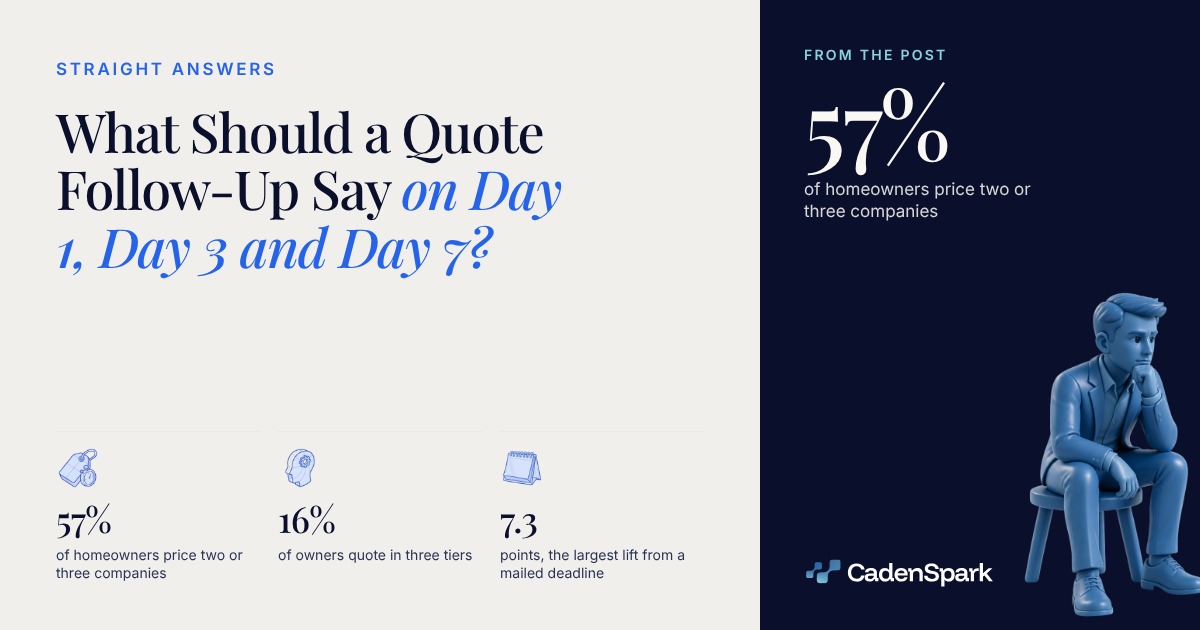
57% of 1,000 U.S. homeowners get a price from two or three companies before choosing (Roto-Rooter, April 2024).
A number with no next step leaves nothing to reply to. No published figure measures this, and it is the cheapest thing on this page to fix.
Only 16% of 1,050 U.S. owners quote in three tiers (Jobber, fielded December 2025), so the choice reads as yes or no.
The figures that circulate have no primary source with a sample. The speed of the first reply does: how fast to respond to a new lead.
View data
| Step | Value |
|---|---|
| The price leaves your hands | Quote sent (Email, text, paper or portal) |
| Two other companies are quoting | Silence (57% price two or three (Roto-Rooter, 2024)) |
| Price, scope and an hour | Day 1 ("I will call Thursday at 10") |
| One question | Day 3 (Built to be answered in four words) |
| An easy no, with a date | Day 7 (The last message, on purpose) |
| Either answer frees the slot | Booked or closed |
What should be in the quote before you follow up at all?
Options. Only 16% of 1,050 U.S. home service owners offer three pricing tiers (Jobber, fielded December 2025), so most customers get one number and a yes-or-no choice.
What the customer compares
your one price against two rivalsyour three options against two rivals
Jobber, 2026: 16% of 1,050 owners quote in three tiers.
The next step in the quote
"let me know"a named hour you will call
No study measures this. It is our recommendation, not a finding.
Where the follow-up lands
an inbox nobody openedthe phone they already carry
Pew, 2025: 98% of 5,022 U.S. adults own a cellphone. That is reach, not a reply.
The first five minutes
handled by memoryalready automatic
That part is written up: the five minutes after a form submit.
View data
| Metric | Day zero → target |
|---|---|
| What the customer compares | your one price against two rivals → your three options against two rivals |
| The next step in the quote | "let me know" → a named hour you will call |
| Where the follow-up lands | an inbox nobody opened → the phone they already carry |
| The first five minutes | handled by memory → already automatic |
Pew measures ownership, not replies, so treat the phone as reach only.


Does putting a deadline on day 7 actually work?
In the one preregistered trial we could read, yes, by a few points. It mailed cancer screening kits to 7,711 people, not quotes, so the direction is borrowed and the size is not.

Every arm with a deadline beat the control by 2.5 to 7.3 percentage points (all ps below .004), and the date on its own matched the date plus money.
- 01Quote with options
- 02Day 1 and day 3
- 03Day 7, with a date on it
- 04Closed out either way
So a deadline always works?
No. A second randomized trial found nothing, and every deadline result we could open comes from public health mail rather than a priced job.
246 men were mailed a health survey: 88.9% responded with a deadline against 85.0% without, not significant (odds ratio 1.41, 95% CI 0.67 to 2.99, p = 0.36). Gattellari and Ward, 2004.
In the screening trial a short deadline alone matched a deadline plus a small payment, 9.7% against 9.1% (Lieberman et al., 2021).
Neither trial priced a job, named a contractor or used a phone. Borrow the direction, not the number.
If the price still stands on day 20, the day 7 date taught the customer that your dates do not mean anything.
What about "80% of sales need five follow-ups"?
It has no primary source. Vendors trace it to a 2014 compilation and to two citations with no sample; one aggregator labels its own entry source pending verification. Count your own two numbers instead.
model numbers, our arithmetic, not a published benchmark. Plug in your own counts.
View data
| Stage | Value |
|---|---|
| quotes sent last month | 100 |
| got the day 1 message | 62 |
| got the day 3 question | 31 |
| answered either way | 14 |
Quotes that got a second message
not counted anywherecounted every month
The number nobody publishes a benchmark for, including us.
The cadence
whenever someone remembersday 1, day 3, day 7, automatic
This cadence is ours, not a finding. No study measures it.
"Five touches"
a rule from a slideyour own close rate
The figure has no primary source with a sample behind it.
When you stop
the thread stays openday 7, then closed
An easy no is an answer, and it frees the slot.
View data
| Metric | Day zero → target |
|---|---|
| Quotes that got a second message | not counted anywhere → counted every month |
| The cadence | whenever someone remembers → day 1, day 3, day 7, automatic |
| "Five touches" | a rule from a slide → your own close rate |
| When you stop | the thread stays open → day 7, then closed |
Write the three messages this week, put them on a timer, and count how many quotes got the second one. Nobody publishes a benchmark worth chasing.
Questions owners ask
What should you say in a follow-up after sending a quote?
Restate the price and the scope in one line, then give a time: "I will call Thursday at 10 unless another time is better." A follow-up that only says "just checking in" gives the customer nothing to answer. The time is what turns silence into a reply.
How many times should you follow up on a quote?
Three is our working answer: day 1, day 3, day 7, then stop. No published study measures the right number, and the figure that circulates ("80% of sales need five follow-ups") has no primary source with a sample behind it. Pick a cadence, automate it, and measure your own close rate.
Does putting an expiry date on a quote work?
The evidence is borrowed. In a trial of 7,711 cancer screening letters, every deadline arm beat the control by 2.5 to 7.3 points, and a short deadline alone matched one paired with a payment (Lieberman et al., 2021). A second trial, of 246 men mailed a survey, found no significant effect (Gattellari and Ward, 2004).
What should the last follow-up say?
Give them an easy no: "If you have gone another way, reply no and I will close the file." It ends the thread without a chase, it gets you an answer either way, and it is the only message in the cadence designed to be the last one.
Sources
- Lieberman A, Gneezy A, Berry E, Miller S, Koch M, Argenbright KE, Gupta S, The effect of deadlines on cancer screening completion: a randomized controlled trial, Scientific Reports, July 6, 2021 (preregistered field experiment, 7,711 participants mailed colorectal cancer screening kits) (2021)
- Gattellari M, Ward JE, Does a deadline improve men's participation in self-administered health surveys? A randomized controlled trial in general practice, Journal of Public Health 26(4), pp. 384-387 (246 men: 126 mailed a deadline, 120 without; general practices in Sydney) (2004)
- Jobber, 2026 Home Service Trends Report (survey of 1,050 U.S. home service business owners run by Conjointly, fielded December 2025, margin of error 3 points at 90% confidence; company that sells quoting software) (2026)
- Roto-Rooter, The State of Home Repair in 2024 (company-commissioned survey of 1,000 U.S. homeowners, April 2024) (2024)
- Pew Research Center, Mobile Fact Sheet, November 20, 2025 (5,022 U.S. adults, fielded February 5 to June 18, 2025; device ownership, not messaging behavior; read October 20, 2026) (2025)
The first meeting starts with findings, not promises.The free Business Health Report reads your business and shows you what it found, in days.
Get Your Free Business Health Report