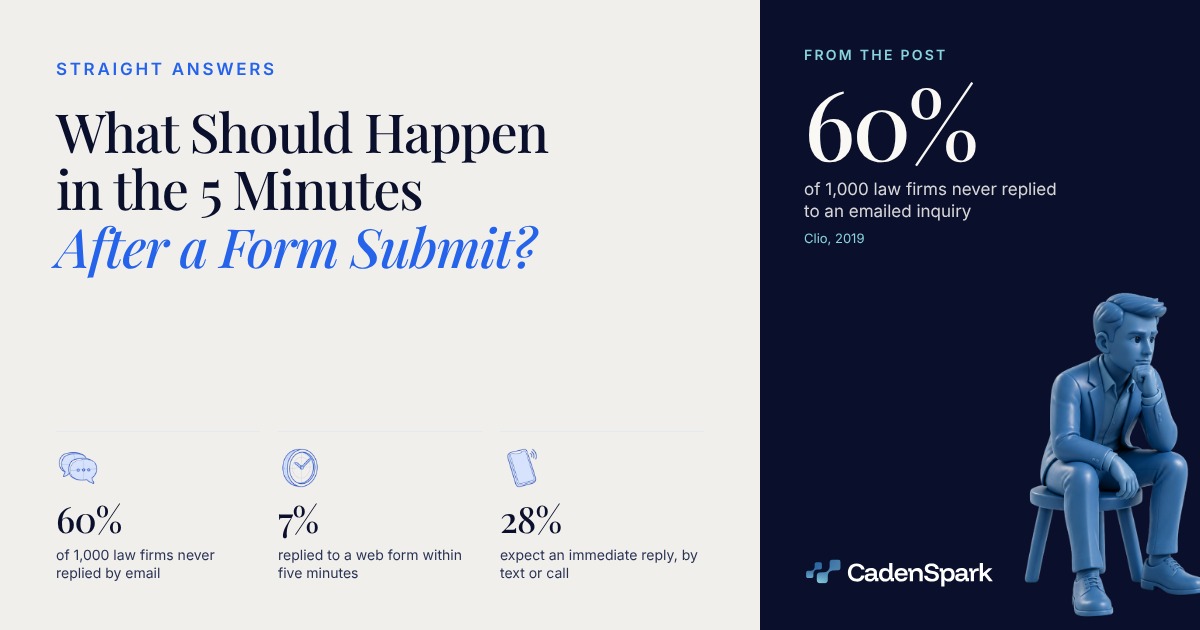
Four things, in order: a confirmation that names the business and gives a time, one named person who acknowledges the lead, a human call before minute five with a text if nobody answers, and a timestamped record of each step.
What should happen in the 5 minutes after a form submit?
The sequence below, by the clock. How fast is fast enough is a separate question; this post is about what the five minutes contain, and who does each part.
View data
| Step | Value |
|---|---|
| The form lands, the confirmation goes out | 0:00 (automatic, by text and email, with a time in it) |
| One name gets it | 0:01 (a notification to a person’s phone, not a shared inbox; no "got it" by 0:03 and it rings the next person) |
| A human dials | 0:02 (the form open in front of them; their words open the call) |
| No answer, one text | 0:04 (who you are, that you called, one question, from the business number) |
| Logged | 0:05 (submit, confirm, assign, attempt, outcome, each with a time) |
The window is mostly empty. In a 2017 vendor test of 433 B2B software companies, 7% replied to a web form within five minutes (Drift, 2017).



What should the confirmation and the first messages say?
Three messages, each with who you are, what they asked for in their words, and a time or one question. The call ends with the booking ask.
- 01The confirmation, in seconds"Bright Air Heating here. We got your request for a furnace tune-up at [address]. Sam will call you by 3:10 p.m. from this number. If sooner works, reply with a time." Who you are, what they asked, a time.
- 02The call opener, by minute two"Hi, it’s Sam from Bright Air. You asked about a tune-up at [address]. Is Thursday morning or afternoon better?" Opens with their words, ends with the booking ask.
- 03The no-answer text, by minute four"Sam from Bright Air, just tried you about the tune-up. Thursday at 9 or at 2? Reply here or call this number." One question, one number, nothing promotional.
Clio, Legal Trends Report 2019 · replies received from 1,000 emailed U.S. law firms
View data
| Item | Value |
|---|---|
| Friendly tone | 58% |
| Clear and easy to understand | 57% |
| Clear next steps | 28% |
| Cost information | 27% |
| What to expect from the process | 13% |


Who gets the lead, and how do you know they took it?
One named person, notified on their phone, who taps "got it"; if nobody does by minute three, it rings the next person. A shared inbox is where a lead goes to wait.
A lead sent to "everyone" is owned by no one. The notification goes to one phone, with the lead’s name and address on it.
If nobody taps "got it" by minute three, it rings the next person. The acknowledgment is the handoff.
Address, service, their exact words, on the screen before the call starts. Nobody asks "so what were you looking for?"
Jobber attributes its fastest responders' sub-60-minute replies to automated notifications, follow-up reminders and online booking (Jobber, 2026).

Call first or text first?
Call first, with the form in front of you; text in the same minute if nobody answers. The text stays informational, and that is what the consent question turns on.
The CTIA’s voluntary guidelines list "entering a telephone number through a website" as one way a consumer shows opt-in consent (CTIA, 2023).
The same document says a business that already asks for contact information can add a field to capture the consumer’s consent. One checkbox, in plain words.
"We got your request, Sam will call by 3:10" answers what they asked. A coupon makes it promotional, which the guidelines say needs the consumer’s written agreement first.
The guidelines say so, and so do we. Ask counsel about your state. What the text itself has to carry is in what your confirmation text must say.

What should get recorded, and what do you measure?
Five timestamps on one record, and one number: median minutes from submit to the first human attempt. Owners believe they reply within a day; the emailed test says otherwise.
Who owns the lead
"the team"one name, with a time
The acknowledgment is the handoff and the record.
Time to first human attempt
not measuredmedian minutes, per lead
The one number this post is about.
Confirmation sent
sometimes, by handevery form, in seconds
Automatic, from the business number, with a time in it.
Leads that end with a next step
unknownshare of forms with a booked slot
The call ends with the booking ask, and the log says whether it was made.
View data
| Metric | Day zero → target |
|---|---|
| Who owns the lead | "the team" → one name, with a time |
| Time to first human attempt | not measured → median minutes, per lead |
| Confirmation sent | sometimes, by hand → every form, in seconds |
| Leads that end with a next step | unknown → share of forms with a booked slot |
Clio, Legal Trends Report 2019 · replies received from 1,000 emailed U.S. law firms
View data
| Item | Value |
|---|---|
| Within 24 hours | 82% |
| After 24 hours | 11% |
| After 72 hours | 7% |
A person with a phone can run all of this today. Automation carries the confirmation and the handoff; the call is still yours. Start with the time in the confirmation and the record underneath it.
- 01Confirm automatically
- 02Assign to one name
- 03Attempt inside five minutes
- 04Log and measure
Questions owners ask
What should happen right after someone submits a form?
A confirmation within seconds that names the business and gives a time, a notification to one named person, a human call before minute five with a text if nobody answers, and a record of each step. The sequence matters more than any one message.
Should the confirmation be a text or an email?
Both, and the text first: 98% of U.S. adults own a cellphone (Pew, 2025), and a number typed into your form is one opt-in mechanism under the CTIA’s voluntary guidelines (CTIA, 2023). Keep it informational. Not legal advice.
What should the first message say?
Who you are, what they asked for in their words, and a time you will call. When Clio emailed 1,000 law firms in 2019, only 28% of the replies gave a clear next step (Clio, 2019). The next step is the message.
Does any of this matter if I reply the same day?
Over 70% of customers expect a same-day reply and 28% expect an immediate one (Jobber, 2026). Same day meets the floor; the five-minute sequence separates you from the 55% of 433 software companies that sent nothing in five business days (Drift, 2017).
Sources
- Clio, Legal Trends Report 2019 (1,000 U.S. law firms emailed as a prospective client; 2,000 consumers and 2,507 legal professionals surveyed) (2019)
- Drift, Lead Response Survey (secret-shopper test of 433 B2B SaaS companies, published February 2017; now hosted by Salesloft) (2017)
- Jobber, Home Service Trends Report 2026 (1,050 U.S. home-service owners, fielded December 2025) (2026)
- CTIA, Messaging Principles and Best Practices (voluntary industry guidelines, May 2023) (2023)
- Pew Research Center, Mobile Fact Sheet (5,022 U.S. adults, February to June 2025) (2025)
- Invoca, Lead Conversion Benchmarks Report 2026 (over 70 million calls and 600 million minutes, 10 industries; published July 2026) (2026)
The first meeting starts with findings, not promises.The free Business Health Report reads your business and shows you what it found, in days.
Get Your Free Business Health Report