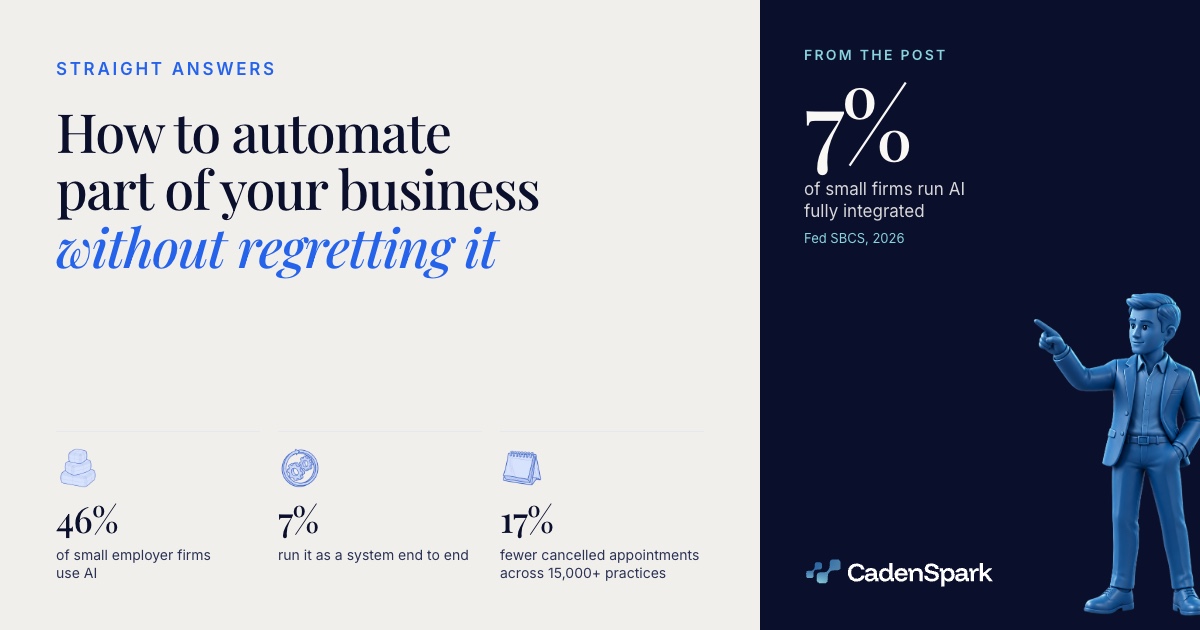
Most business automation ends up on a shelf. An owner buys a tool, sets it up over a weekend, and three months later nobody is checking it. Automating a process is a decision, not a purchase, and there is an order to getting it right.
- 01DiagnoseFind where the operation actually leaks, with measurements, not guesses.
- 02PrioritizeStart with the most expensive problem to leave alone, not the easiest to automate.
- 03BuildThe right mix of automation, AI and human oversight, on top of what already works.
- 04Run and improveRun it against written goals and review the numbers together monthly.



Where should you start?
With a diagnosis, not a tool. Find where work actually piles up or leads actually go cold, because the loudest problem and the most expensive problem are rarely the same one.
How many went unanswered last week.
How many never got a follow-up.
How many no-showed.
How many went to hold-and-reschedule instead of customers.
Should end with findings about your operation, not a pitch. The honest ones tell you where automation won’t help, too.
What do you automate first?
The problem that costs the most when left alone, not the one that is easiest to buy software for. Impact first, effort second.
View data
| Step | Value |
|---|---|
| every leak the diagnosis found | List (calls, quotes, no-shows, hours) |
| by what solving it returns | Rank (recovered revenue, hours given back, no-shows turned into kept appointments) |
| do the top one properly | One (a quote-chase workflow is harder than a missed-call text-back, and usually worth far more) |
| then start the second | Next (automating five things halfway is how you end up with five tools nobody trusts) |
What does "build it right" mean?
Building on top of what already works, not tearing it out. The right system mixes automation, AI and human oversight, wired into the calendar, phone system and records you already use.
View data
| Piece | What happens |
|---|---|
| Door | Phone system |
| Door | Calendar |
| Door | Website forms |
| Door | Books and records |
| Hub | The gaps between them, closed — nothing thrown out, the coordination wired |
| Stage | Booking and confirmations — the appointment confirmed without anyone touching it |
| Stage | Follow-up that keeps a lead warm — replied in minutes, not the next day |
| Stage | The review request and the Monday report — after the job, and assembled by itself |
| Return | Anything a machine shouldn’t decide goes to a person — the handoff is part of the build, by design |
How do you know it is working?
Because you agreed on the number before it launched, and you review it every month. We never promise a market outcome nobody can honestly control; we set written goals and keep improving until the system performs.
Case completion
42%47%
Year over year, across 15,000+ dental practices (Planet DDS, 2026).
Cancellations
the old ratedown 17%
The report credits proactive communication and scheduling systems.
The number you own
nobody can name itwritten down before launch
Missed calls, response time, no-shows rebooked, hours saved. Reviewed monthly.
View data
| Metric | Day zero → target |
|---|---|
| Case completion | 42% → 47% |
| Cancellations | the old rate → down 17% |
| The number you own | nobody can name it → written down before launch |
Installed and forgotten. Nobody reads its reports in month four.
Promise a market outcome nobody can honestly control.
Written goals, checked together monthly, and a system that gets adjusted until it performs.
What if you just want a tool to run yourself?
Then buy the tool and skip the agency. If you will genuinely operate it, keep it connected and read its reports in month four, you do not need us, and we will tell you so.
When you will run it yourself, month after month, and the function can live on your to-do list.
When you want the function handled and a number you can hold someone to, without it becoming one more thing you manage.
Our free Insight Report scans how your business handles a new call, form fill and follow-up, so you can see where the biggest problem actually is. Findings, not a pitch.
- 01Keep it connectedTo the calendar, the phone system and the books, so it keeps seeing the work.
- 02Name the number it movesMissed calls, response time, no-shows rebooked, hours saved. One of them, written down.
- 03Read its reports in month fourThe month most tools go quiet. If you are still reading, you are running it.
- 01Diagnose
- 02Prioritize
- 03Build
- 04Run and improve
That is the whole point of diagnosing, prioritizing, building and running it: the result shows up on your P&L instead of on a shelf.
Questions owners ask
What should a small business automate first?
Whatever is quietly costing you the most: the bottleneck where work piles up or leads go cold. You find it by measuring, not guessing. Automate the highest-impact problem first, not the easiest one to buy a tool for.
Isn’t buying a tool faster than hiring an agency?
Buying is faster; getting a result isn’t. A tool you operate in your spare time usually ends up on the shelf. What produces a result is a system that’s diagnosed, built into how you actually work, and run against a number someone reviews monthly.
Do I have to replace the software I already use?
Usually not. Good automation is built on top of what already works, your calendar, your phone system, your books, and connects around it. If a vendor’s first move is to rip out a system that’s doing its job, be careful.
How do I know the automation is actually working?
You agreed on a number before it launched (missed calls, response time, no-shows rebooked, hours saved) and you review it every month. If nobody can name the number it’s supposed to move, it isn’t being run; it’s just installed.
Sources
The first meeting starts with findings, not promises.The free Business Health Report reads your business and shows you what it found, in days.
Get Your Free Business Health Report