 Google
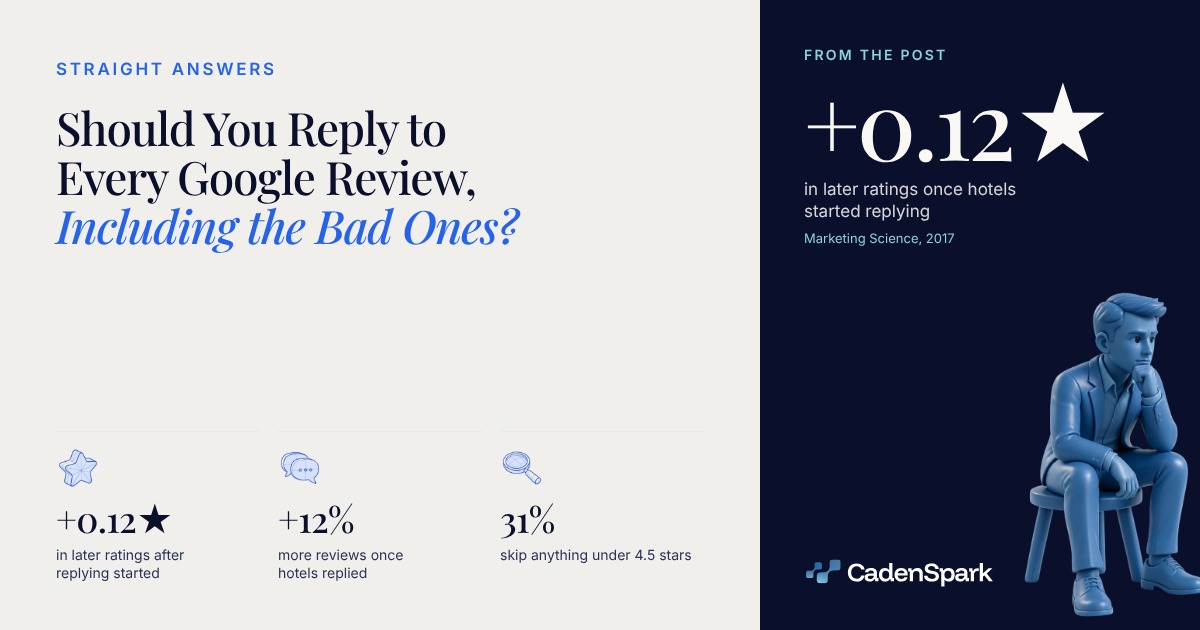
Yes, the good ones and the bad ones, and the evidence is about the bad ones. Hotels that started replying to reviews saw later ratings 0.12 stars higher and 12% more reviews (Marketing Science, 2017), and the reason the authors give is not flattery: the unhappy customer writes less often once the owner is visibly answering.
Should you reply to every Google review?
Yes, and the bad ones matter most. Google’s own help page asks owners to read and reply, and the only measured effect of starting runs through the negative reviews.



Volume and rating also feed what shows up in the map pack. The reply itself is not a ranking claim.
A one star review
sits there alonesits under your reply
The next reader sees two sides instead of one.
Review volume
flat12% higher
Marketing Science, 2017: hotels that started replying.
Later ratings
unchanged0.12 stars higher
Marketing Science, 2017, difference in differences.
The unhappy customer
writes the reviewoften writes nothing
The mechanism the authors report, not our guess.
View data
| Metric | Day zero → target |
|---|---|
| A one star review | sits there alone → sits under your reply |
| Review volume | flat → 12% higher |
| Later ratings | unchanged → 0.12 stars higher |
| The unhappy customer | writes the review → often writes nothing |
What does Google actually ask you to do?
Verify the business first, then read and reply from the profile. Google says a reply shows the customer that you value the feedback.
- 01Verify the businessReplying is only available on a verified profile. Nothing below this step works without it.
- 02Open your profile and pick Read reviewsThe reviews live in the profile, not in a separate tool.
- 03Click Reply on the reviewThe reply is public and signed as the business.
- 04Write it, then click Reply againGoogle checks the reply against its content policies and asks you to edit it if it is not approved.
View data
| Piece | What happens |
|---|---|
| Door | Five stars |
| Door | One star |
| Door | Off topic |
| Door | No text |
| Hub | Your verified profile — the only place an owner can reply |
| Stage | You reply in your own name — checked against Google’s content policies |
| Stage | The author is notified — Google’s help page says the reviewer is told |
| Stage | Report only a policy break — a low rating is not one |
| Return | The next customer reads both — and the next review comes in |
Can a bad review be removed?
Not for being negative. Google removes contributions that break its content policy, and a low rating is not on that list.
Google removes what it finds fake, not what it finds harsh (Google, 2026).
Images lifted from somewhere else break the policy on their own.
Content about something other than this customer’s experience of your business.
The line Google draws is the language, not the star rating.
And if one part of a post violates the policy, Google takes down the whole post.
View data
| Step | Value |
|---|---|
| Before you type | Read (the fact it leaves out is your reply) |
| In your own name | Reply (public, signed, and policy checked) |
| Only a real violation | Report (automated models and trained operators decide) |
| The next review | Earn (74% only value the last 90 days (BrightLocal, 2026)) |
Does replying change anything you can measure?
Two peer-reviewed studies say yes, and they disagree about the good reviews. Replying to a negative lifts what the next person writes; replying to a positive can run the other way.
Hotels that started replying saw later ratings 0.12 stars higher and 12% more reviews. The design is difference in differences: the same hotel replies on one site and almost never on the other, so it is its own control. 56% of the panel replies at all.
The authors report that a customer with a bad experience becomes less likely to leave a negative review once the hotel starts replying. Fewer negatives, and the ones that arrive are longer.
Replying to a negative review raises the opinion in the reviews that follow, but only when the reply is visible to the person writing next. On positive reviews the effect reverses. The abstract gives no sample, so no number goes here.
Both effects grow when the reply is written for that review instead of pasted in (JMR, 2018).
Marketing Science, 2017 · panel of hotel reviews, difference in differences
View data
| Item | Value |
|---|---|
| More reviews received | 12% |
| Hotels in the panel that reply at all | 56% |
Can you ask only your happy customers?
No. A federal rule in effect since October 21, 2024 bans fake reviews, bought reviews and the suppression of negative ones. Not legal advice; ask counsel.
The rule covers positive and negative. Paying for a bad review of a competitor is the same violation (FTC, 2024).
A review from an employee, an owner or a relative has to disclose the relationship.
Threats or intimidation to get a review taken down are prohibited, and so is displaying only the positive ones while hiding the rest.
A review site the company controls while presenting it as independent is covered too.
16 CFR Part 465, published in the Federal Register as 2024-18519 on August 22, 2024. Not legal advice; ask counsel.
What should a reply to a bad review say?
Three lines: name what happened, add the fact the review left out, and move the rest to a private channel.
- 01Name what happened, without arguingOne sentence that shows you read it. The audience is the next customer, and the author gets notified either way (Google, 2026).
- 02Add the one fact the review left outThe date, the scope, what you did afterward. Facts land; adjectives do not.
- 03Move the rest to a private channelA number or an address to write to. Nothing offered in exchange for a change to the review, which is the part the FTC rule prohibits (FTC, 2024).
- 01Read the new reviews
- 02Reply to the bad ones
- 03Report only policy breaks
- 04Ask for the next one
Replying is the only lever here you fully control. Ask for the next review inside the message you already send, which is the confirmation text.
Questions owners ask
Should you reply to every Google review?
Yes. Google’s help page asks owners to read and reply from the profile, and the peer-reviewed study of businesses that started replying found later ratings 0.12 stars higher and 12% more reviews (Marketing Science, 2017).
Can Google delete a bad review?
Not for being negative. Google removes contributions that break its content policy: deliberately false content, off-topic reviews, personal attacks. A low rating is not on that list, so the owner’s move is to reply, and report only a real violation (Google, 2026).
Can you ask only your happy customers for reviews?
No. The FTC rule in effect since October 21, 2024 bans fake and bought reviews and the suppression of negative ones, including using threats or intimidation to get one taken down (FTC, 2024). Not legal advice; ask counsel.
Do people even read the replies?
They read the reviews first, and only the recent ones: 74% of consumers only value reviews from the last 90 days, and 31% will not use a business rated under 4.5 stars (BrightLocal, 2026).
Sources
- Proserpio & Zervas, "Online Reputation Management: Estimating the Impact of Management Responses on Consumer Reviews", Marketing Science 36(5), 2017, pp. 645-665, DOI 10.1287/mksc.2017.1043 (panel of hotel reviews, difference in differences; abstract read October 17, 2026 through search results, not opened directly) (2017)
- Wang & Chaudhry, "When and How Managers' Responses to Online Reviews Affect Subsequent Reviews", Journal of Marketing Research 55(2), 2018, pp. 163-177, DOI 10.1509/jmr.15.0511 (peer-reviewed; the abstract gives no sample size, so no number is quoted from it) (2018)
- Google Business Profile Help, "Manage customer reviews" (official documentation, no sample) (2026)
- Google, "Maps user-generated content policy" (official documentation, no sample) (2026)
- Federal Trade Commission, Rule on the Use of Consumer Reviews and Testimonials, 16 CFR Part 465, final rule published in the Federal Register as 2024-18519 on August 22, 2024, in effect October 21, 2024 (federal rule, not a survey) (2024)
- BrightLocal, Local Consumer Review Survey 2026 (1,002 U.S. adults, report published February 11, 2026) (2026)
The first meeting starts with findings, not promises.The free Business Health Report reads your business and shows you what it found, in days.
Get Your Free Business Health Report